
 House Majority Leader Chuck Kopp, R-Anchorage, speaks in favor of the Alaska LNG tax break bill on the House floor Friday, June 12, during a special session at the Alaska State Capitol in Juneau. (Mari Kanagy / ADN)
The Alaska House of Representatives approved, by a large margin, a historic bill giving a huge tax break to support the Alaska LNG megaproject on Friday.
The 34-5 vote comes after months of discussion in the state Legislature, and three weeks into a special session called by Gov. Mike Dunleavy after lawmakers’ failure to pass an earlier version of the legislation backed by Dunleavy and gas line developer Glenfarne.
The bill must still pass the Senate, where lawmakers have been more resistant to a steep tax cut.
Some House members in speeches after the vote Friday said the addition of new safeguards for Alaskans, to help ensure affordable energy and extra revenue for communities, helped win their support.
The bill cuts property taxes for state and local communities by an estimated 85%, amounting to billions of dollars in revenue that the project could have generated if the tax is retained.
But it also retains production taxes, royalties and other revenue measures that will bring in billions of dollars over the coming years, if the pipeline is built.
The measure replaces the property taxes with a much smaller alternative volumetric tax that will apply to gas volumes shipped through a proposed 800-mile pipeline.
Several House lawmakers said that the bill increases the likelihood that the project will be built, but it doesn’t guarantee construction.
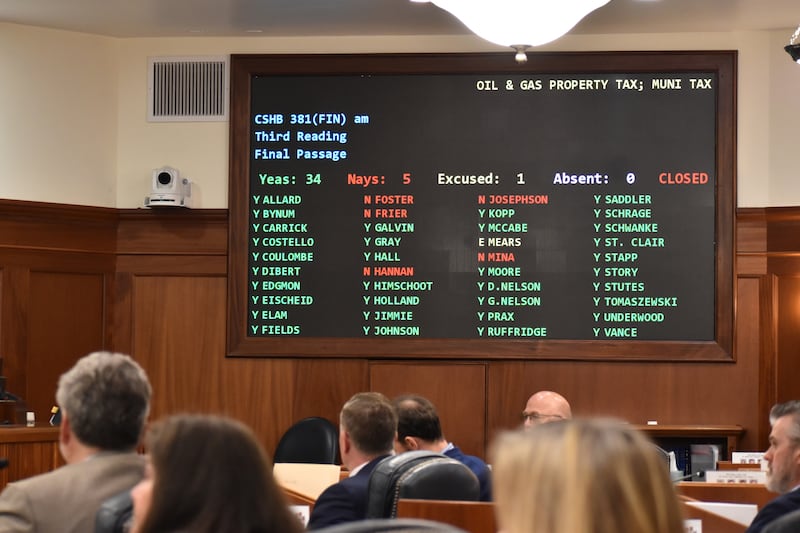 House lawmakers, in a 34-5 vote, pass an Alaska LNG tax break bill that cuts property taxes for state and local communities by an estimated 85%, but retains production taxes, royalties and other revenue on Friday, June 12, at the Alaska State Capitol in Juneau. (Mari Kanagy / ADN)
Alaska LNG proposes to deliver North Slope gas to Alaskans starting in 2029 and to Asian entities starting in 2031. Its cost has been estimated at between $45 billion and $55 billion, though critics say it could be much more.
Glenfarne still has not achieved final agreements with gas suppliers or buyers, or even committed to a final investment decision that would give the project a green light. An official said Thursday that work to install the gas line is proposed to begin next year.
Dunleavy immediately praised the House vote.
“This project has the potential to transform Alaska’s economy for decades,” Dunleavy said in a prepared statement. “I look forward to working with the Senate to get this important legislation across the finish line.”
Glenfarne Alaska LNG President Adam Prestidge also praised the decision.
“This bill safeguards communities during construction, expands access to natural gas in Interior Alaska, and provides borough-level opportunities to invest and share in project success,” he said.
“Alaskans have waited for decades for Alaska LNG and today’s vote brings us one step closer to delivering the benefits of this transformational project,” he said.
Only Democrats voted against the project.
They were Reps. Andy Josephson and Genevieve Mina of Anchorage, Sara Hannan of Juneau, Neal Foster of Nome and Robyn Niayuq Frier of Utqiagvik. Rep. Donna Mears, D-Anchorage, was excused from the vote.
The Senate Finance Committee is scheduled to hold meetings on the House-approved measure beginning on Monday, with plans to amend it before sending it to the Senate floor for a vote. The special session is scheduled to end June 19.
[Alaska LNG project and unions sign preliminary agreement to maximize Alaska hires]
A legislative first
The Alaska LNG project is similar to numerous earlier versions that have been proposed, and failed, for more than half a century, in large part because of the costs associated with building a cross-state gas line from the Arctic to Southcentral Alaska.
But the House’s approval comes at a unique time.
Alaska faces an energy crisis amid a shortfall of natural gas from Cook Inlet, raising concerns that fuel to provide power and heat for the state’s bigger cities and military bases will have to be imported from foreign sources, at a high future cost.
 Rep. Calvin Schrage, an Anchorage independent, is seen at ease on the Alaska House floor on Friday, June 12, as representatives prepared to vote on an Alaska LNG tax break bill during a special session at the Alaska State Capitol in Juneau. (Mari Kanagy / ADN)
The recent war in Iran has also highlighted the need for reliable shipments of liquefied natural gas, or LNG, to U.S. allies in Asia and the Pacific.
Larry Persily, a former federal gas line coordinator who served under President Barack Obama for an earlier iteration of the project, said this is the first time an Alaska legislative chamber has cut taxes for the proposed gas line project.
“It’s historic in that sense,” he said.
He believes the Senate Finance Committee will modify the bill, and pass it.
Whether the House accepts those changes is uncertain, he said.
“I expect the Senate version would be a little less to the governor’s or Glenfarne’s liking,” he said. “But whether it’s enough to blow it all up, I don’t know.”
Negotiations to move a bill forward in the House fell apart near the end of the regular session in May. At the time, House Majority Leader Chuck Kopp, an Anchorage Republican, had introduced a measure meant to satisfy the governor’s demands. The measure was introduced directly on the House floor, bypassing the finance committees in both chambers.
But it failed to move forward after House members adopted an amendment, by one vote, to allow the North Slope and Kenai Peninsula boroughs to retain some property taxing authority over the plants in their region, and to use tax relief to gain equity in the project.
Glenfarne said that path wouldn’t work for the project, and the bill never made it to the Senate.
Persily said that Glenfarne and its minority project partner, the Alaska Gasline Development Corp., have smartly emphasized Alaska LNG as a “save Alaska project” that can solve the gas shortfall, helping grow support for the idea.
Still, Persily doesn’t think Alaska LNG will be built, even if the Senate passes a tax cut that Glenfarne supports.
“(Alaska LNG) is too expensive in a global market with a lot of other less risky, less costly supplies (of liquefied natural gas),” he said.
Every region ‘will get a share’
Dunleavy had introduced the original version of the bill halfway through the legislative session in March, leading to complaints from lawmakers about the late arrival for such a major policy shift.
But committees in both chambers raced to analyze details of the project and its impact on the state over two months of near-daily meetings.
The grind continued into the special session, with lawmakers studying the measure and adding amendments to the competing proposals.
Under the House-passed bill, the project would initially receive a five-year abatement on taxes.
Once it reaches full operation, it would pay $131 million in that first year, with a 2% yearly increase, Kopp said on the House floor Friday.
The money would support communities across the state, but the North Slope and Kenai Peninsula boroughs would see the most income, he said.
The project would start on the North Slope with a gas-treatment plant and end on the Kenai Peninsula with a plant to super-chill the gas into a liquid for shipment overseas in tankers.
The governor’s original bill had proposed a smaller volumetric tax, of $76 million annually, at full operation.
In addition, Kopp said the project would generate $23 billion over three decades in royalties, production taxes and other revenue to the state.
The bill also contains requirements for a spur line to Fairbanks; that the developer pay into a community impact fund of at least $40 million and up to $80 million; and for a labor agreement for construction.
The bill caps natural gas prices of $16 per MMBtu, rising with inflation, to protect Alaska ratepayers, and includes a measure to prevent energy ratepayers in Alaska from being saddled with costs related to any cost overruns.
“Every region of Alaska will get a share of this project one way or the other, and there’s real protections for Alaska ratepayers,” Kopp said.
More than 20 House members spoke about the project before the vote.
Supporters said Alaska LNG will create thousands of jobs if it can be built, and will provide affordable and reliable energy to the state. They said it will provide economic hope for a state that’s struggling to keep its residents and pay its bills.
Critics said the project may not bring in enough revenue to cover the increased strain on roads, schools and emergency service that a large workforce will bring. They also expressed concern about risks to the state if the project is unsuccessful.
Several lawmakers on the House floor Friday said the bill isn’t perfect, but it represents a bipartisan compromise on one of the most important issues the Legislature will vote on.
Rep. Dan Saddler, R-Eagle River, said the measure could lead to the sale of natural gas that has long been stranded on the North Slope, and contribute to more discoveries of natural gas in the future.
“We have a 200 trillion cubic feet of gas, but it means nothing if we can’t get it to market,” he said.
“To members in the public who are concerned that this is a giveaway … I shake my head and I ‘tsk, tsk’ a little bit, because a high tax on no pipeline gets you no money, a lower tax on a real pipeline gets you money,” he said.
Rep. Josephson said he thinks the bill has come a long way from its original form.
But he said he could not vote for it because he believes the property tax break is far too lengthy. It will be in place for 34 years.
Under the bill, the state will see about $800 million less in property taxes annually, well over $20 billion over the decades, he said.
“That just seems like an awfully long time,” Josephson said. “There’s dialogue that future legislatures could intervene and adjust that. But that’s very challenging to do.”
Frier, who represents the North Slope in the House, sought to amend the bill on Friday to increase the potential revenue to the borough if the project is built. Her efforts failed.
 Rep. Robyn Niayuq Frier, D-Utqiaġvik, listens to debate on the House floor about the Alaska LNG tax cut bill on Friday, June 12, 2026, during a special session at the Alaska State Capitol in Juneau. She introduced two unsuccessful amendments, one to increase taxing authority for the North Slope and Kenai Peninsula boroughs, and another to increase tax income for the North Slope. (Mari Kanagy / ADN)
Frier said she believes in the project, but the boroughs want to negotiate directly with Glenfarne on property taxes to ensure they receive enough revenue to support local services, especially with rural energy prices soaring.
“We are going cold in rural Alaska, and I just feel like we don’t want to be on the table, we want to be at the table,” she said.
She said she hopes the Senate addresses some of her concerns.
A ‘fair share’
The Senate Finance Committee is set to begin reviewing the House-passed bill Monday. That committee will hold several days’ worth of meetings to consider changes, said its co-chair, Bethel Democratic Sen. Lyman Hoffman.
The full Senate is set to vote on the bill on Thursday at the earliest, said Hoffman. If it passes the Senate, the House will be asked to vote on whether to approve the changes made in the Senate by June 19, when the 30-day special session must end.
“It’s going to be critical that we decide what’s the best path forward with the administration, have dialogue with the House, and hopefully we can come up with a consensus,” said Hoffman.
 Sen. Lyman Hoffman, a Bethel Democrat who co-chairs the Finance Committee, speaks during a Senate Finance meeting at the Alaska State Capitol in Juneau on May 19. (Bill Roth / ADN)
During the regular legislative session, Hoffman said that he and other members of the Senate majority “vehemently disagreed” with the governor’s efforts to bypass the finance committees by backing a bill that hadn’t been reviewed by them.
Now in the special session, Hoffman said he’s been part of “very productive” meetings with Dunleavy and Glenfarne, the project developer.
Hoffman said his top priority is ensuring that the state gets its “fair share.”
How to define that fair share will be at the heart of debates as lawmakers work toward the June 19 deadline for passing the bill.
Shortly after the House passed the bill Friday, Sen. Bill Wielechowski, an Anchorage Democrat, said he’d already had multiple House members reach out to him and tell him they hope the Senate makes further changes to the legislation.
Those lawmakers, Wielechowski said, are hoping that the Senate can ensure the state brings in more revenue from the project.
Wielechowski and like-minded legislators hope to see a sunset provision that will lift the property tax breaks within a decade. They are also hoping to apply the state’s corporate income tax to privately held oil and gas companies, including Glenfarne and Hilcorp. Such a change is a long-held goal for some members of the majorities in the House and Senate. It could raise hundreds of millions of dollars annually for the state from so-called S corporations. But a similar effort to update the state’s corporate income tax law failed in the House earlier this year.
Wielechowski — who does not serve on the Senate Finance Committee — said it’s not clear whether the changes he seeks have support from a majority of members.
“I think that committee is pretty split,” he said. “I know that there’s some members who would probably support the bill just as it’s written, and there are other members who would be happy if no bill passed, and there’s other members who would support the changes I just outlined. So, I’m not sure how this falls out.”
Part of the special session endgame may also include consideration of Dunleavy’s possible vetoes of bills unrelated to the gas line. Two dozen bills, including top priority ones related to education and early childhood program funding, were transmitted to the governor earlier this month, giving him until Thursday to veto them or allow them to become law. If Dunleavy — who has not commented publicly on whether he supports any of the bills — vetoes priority measures, lawmakers have indicated they may call a joint session to override the governor.
“I’m sure if there are bills that are vetoed, there’s going to be pressure placed upon the Legislature for a joint session,” Hoffman said.
‘Not my first rodeo’
Longtime legislators said they are bringing their familiarity with past attempts to advance a gas line into this year’s efforts.
“It’s not my first rodeo,” Wielechowski said. “We’ve been through this before, and I fear that we’re on the verge of making a grave error — unless we lock in some of these promises — and that grave error will impact generations of Alaskans.”
 Sen. Bill Wielechowski, an Anchorage Democrat, speaks during a joint session at the Alaska State Capitol in Juneau on May 19. (Bill Roth / ADN)
Wielechowski said that Outside corporations have seen windfalls after pressuring Alaska lawmakers for concessions in the past.
Glenfarne “did the political calculation and figured that judging by past history in Juneau, you can be very successful in making your company billions of dollars in profit if you just push the right buttons,” Wielechowski said.
Hoffman, who is retiring this year after nearly four decades as a lawmaker, said that “every single governor, it seems, said, ‘I’m the one that’s going to do this.’” But this time may be different, he said.
“Initially I felt that this had very little hope, but as we proceeded, I think that this might have the best chance,” Hoffman said.