
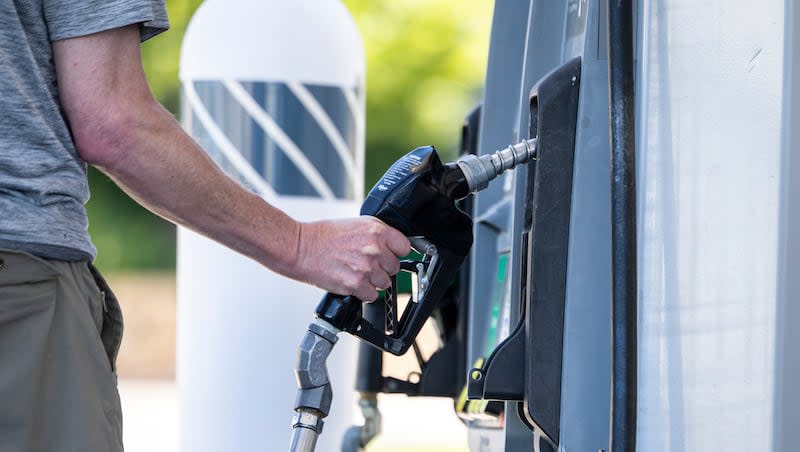
A customer fills up their car at the Foothill Drive Chevron in Salt Lake City on Monday, June 15, 2026. | Rio Giancarlo, Deseret News
Drivers can expect to see cheaper gas prices following a newly brokered deal between U.S. and Iranian officials to end the war, but experts warn a steep drop at the pump will take time.
While many questions surround the details of the agreement, one question weighing heavily on consumers’ minds is simple: How long until gas prices return to prewar levels? According to energy analysts, the answer is complicated.
“It’s going to take time for people to feel comfortable and for insurance to be in place … particularly to get people on the ground to restart some of these assets,” said Daniel Evans, global head of fuels and refining research at S&P Global Energy, according to ABC News.

Prices are displayed on a gas pump at the Foothills Chevron in Salt Lake City on Monday, June 15, 2026. | Rio Giancarlo, Deseret News
Before the war, about 20% of the world’s oil and natural gas passed through the waterway. Its nearly four-month closure has caused the greatest oil supply shock in history, according to NPR.
Following the announcement Sunday night, Brent crude, the international standard, fell $3.45 to $83.89 a barrel. U.S. benchmark crude oil lost $4.03 to land at $80.85 a barrel. Despite the drop, prices remain well above the $70-a-barrel average seen before the conflict, according to The Associated Press.
Dozens of oil tankers loaded before the war began have been stranded, waiting for the strait to reopen. As those ships exit, new tankers can enter to load.
“Ships of the World, start your engines,” Trump said in a social media post announcing the deal on Sunday. “I hereby fully authorize the toll free opening of the Strait of Hormuz, and, simultaneously herewith, authorize the immediate removal of the United States Naval blockade.”
Despite Trump’s celebration of the new deal on social media, Iranian Deputy Foreign Minister Kazem Gharibadbadi clarified the strait would remain closed until the agreement is signed.
In a follow-up post, Trump acknowledged that the strait would reopen “upon the signing of the Deal on Friday, for purposes of mine removal.”
The official agreement has not yet been published by the White House or Iran, so the details of the deal are not widely known. However, Pakistani Prime Minister Shehbaz Sharif, the mediator between negotiations, confirmed the two sides agreed to halt military operations on all fronts, according to CNBC.
Story Continues