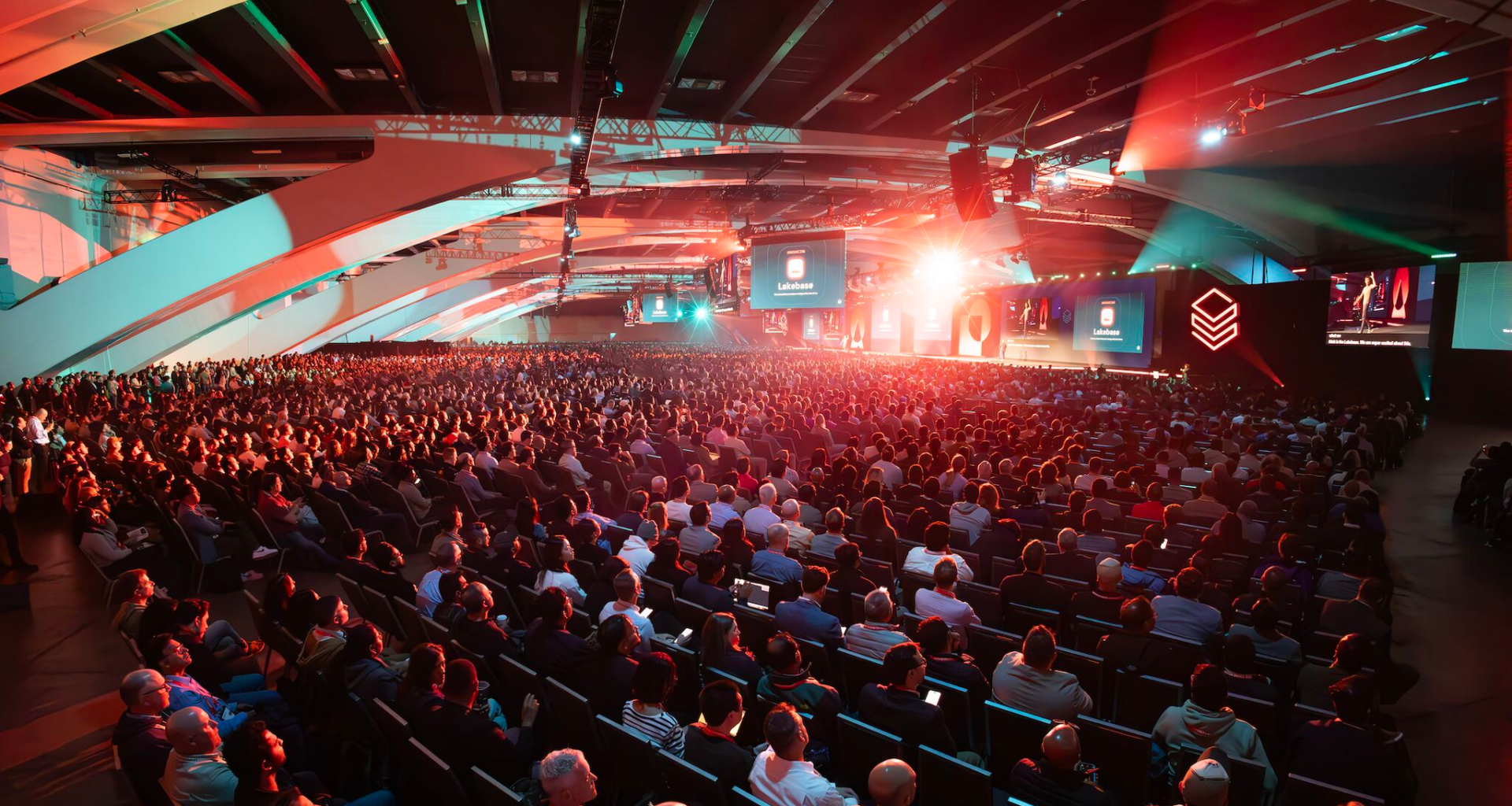
The second day of the Databricks Data + AI Summit 2026 is underway at Moscone Center in San Francisco, with more than 30,000 data and AI professionals on the conference floor and tens of thousands more watching virtually from 150-plus countries. The four-day summit runs through June 18 and has become the largest annual gathering dedicated exclusively to data infrastructure and artificial intelligence — and the sessions taking place today make the industry’s current priorities unmistakable: the conversations have moved decisively from asking whether AI can do something to asking how it gets deployed reliably at scale.
That shift is visible in every corner of Day 2’s programming. Tuesday’s agenda is dense with technical sessions on agentic AI architectures, catalog federation, and enterprise integration, and the presence of cloud giants AWS and Microsoft in co-presented sessions signals that infrastructure decisions made this week will shape deployment roadmaps for years to come.
The Summit’s Central Thesis: From Experiment to Enterprise
Databricks co-founders Ali Ghodsi, Matei Zaharia, Arsalan Tavakoli-Shiraji, and Reynold Xin are sharing the main keynote stage with live product announcements and customer demonstrations. Joining them are Greg Brockman, President and Co-Founder of OpenAI, appearing in person, and Satya Nadella, Chairman and CEO of Microsoft, featured in a pre-recorded fireside chat.
Magesh Bagavathi, Global Chief Data and AI Officer at PepsiCo, rounds out the executive guest speaker roster — and that choice of enterprise voice is itself a signal. The summit’s recurring theme for 2026 is not which AI model achieves the highest benchmark score but which infrastructure architecture lets an organization like PepsiCo, Mastercard, or AstraZeneca actually run AI in production. Databricks’ official keynote announcement confirmed the full speaker lineup and four-day programming structure on June 2.
The 800-plus breakout sessions available across the four days span data engineering, warehousing, governance, analytics, applications, agents, and AI. Featured agentic AI sessions from Anthropic, Cognition, CrewAI, Glean, LangChain, LlamaIndex, Lovable, OpenAI, and Replit are drawing significant attention — each covering what it actually looks like to run AI agents in production environments, not just in proofs of concept.
OpenSharing: The Protocol That Could Define the Agentic AI Economy
The most consequential announcement of summit week came six days before the conference opened. On June 10, Databricks and the Linux Foundation jointly launched OpenSharing, a new open, vendor-neutral protocol for sharing AI assets — including agent skills, machine learning models, and unstructured data — across organizations and platforms without copying files or relying on proprietary marketplaces. The Linux Foundation’s announcement described it as the first unified framework for exchanging agent capabilities across disparate platforms.
OpenSharing is the evolution of Delta Sharing, the open data-sharing protocol Databricks first contributed to the open-source community in 2021. Delta Sharing solved a narrow but important problem: how to let organizations share structured tabular data securely without making a copy and emailing a file. The mechanism behind it is straightforward — data stays in the provider’s cloud storage, and recipients receive short-lived authentication tokens that grant direct read access. No data moves through a broker. No central server touches it.
OpenSharing takes that same zero-copy REST architecture and extends it to the assets that enterprises are now actively trading in the agentic era: agent skills, trained model artifacts, and unstructured data volumes. Before OpenSharing, there was no standard protocol for sharing agent capabilities across organizations. Enterprises building multi-vendor AI workflows were forced to rely on point-to-point integrations or lock into a single vendor’s proprietary marketplace — the same fragmentation problem that plagued data sharing before Delta Sharing arrived. Databricks’ press release on OpenSharing confirmed it is now available on GitHub.
Hosted by the Linux Foundation and available on GitHub, OpenSharing adds support for Apache Iceberg IRC clients, expanding the protocol’s reach across the broader ecosystem of data platforms. Matei Zaharia, Co-founder and CTO of Databricks, described the intent directly: Delta Sharing proved the industry would choose open over locked-in, and OpenSharing extends that bet to the full range of AI assets.
The implications for enterprise AI reach beyond interoperability. If OpenSharing achieves the adoption that Delta Sharing did, it would establish a governance-compatible open standard for the agentic economy — preventing any single cloud or AI platform from controlling the exchange layer for agent capabilities the way proprietary app stores control software distribution.
Day 2 on the Floor: AWS, Mastercard, and Catalog Federation in Practice
On the AWS side, Tuesday’s programming includes a session on breaking data silos through multi-engine catalog federation, where Mastercard’s Director of Data Engineering will join a Principal Solutions Architect from AWS to describe how the company solved the multi-catalog sprawl that affects almost every large enterprise. The AWS and Databricks summit blog confirmed the session and the live demonstrations planned at Booth #100.
The specific technical challenge Mastercard addressed is one that most organizations with data spread across multiple clouds have encountered: when data governed in one catalog — say, Databricks Unity Catalog — needs to be accessed by compute engines that talk to a different catalog, such as AWS Glue, the default answer is usually a data copy, with all the governance, compliance, and freshness complications that introduces. Mastercard’s presentation covers how it federated the two systems, making Unity Catalog the single governance layer above both while allowing AWS Glue-native workloads to continue running without migration.
Unity Catalog itself is worth understanding in that context. Unlike the workspace-level Hive Metastore it replaced, Unity Catalog is an account-wide, cloud-agnostic, open-source metadata governance layer. It tracks data lineage, enforces fine-grained access control at the row and column level, and manages assets ranging from structured tables and views to machine learning models and unstructured files — all within a three-level namespace (catalog.schema.object) that persists across cloud environments. Federation with AWS Glue means adding an external catalog to that namespace without moving the underlying data.
At AWS Booth #100, a live demonstration shows the next step in that architecture: Amazon Bedrock AgentCore querying Unity Catalog-governed data in natural language via Databricks’ AI/BI Genie interface. In that demo, an AI agent built on Bedrock receives a question in plain English, routes it to Genie — which translates the question into structured queries against the governed data — and returns a business-relevant answer, with all data access logged and audited through Unity Catalog’s governance layer.
Microsoft’s Day 2 Presence: Zero-Copy Analytics and Joint Announcements
Microsoft, a Legend Sponsor of the summit, is running joint product announcement sessions with Databricks on Tuesday, with sessions covering zero-copy federated analytics and new Azure Databricks integrations. The Azure Databricks summit blog outlined the full Microsoft presence, including a Healthcare Breakfast co-sponsored with Opsera on Tuesday morning and a Happy Hour scheduled for Tuesday evening.
One session of particular note covers a new zero-copy federated path for oil and gas companies that have standardized on Azure Data Manager for Energy as their subsurface system of record. The session introduces an architecture that brings Databricks compute directly to data stored in that system — with native Unity Catalog governance and serverless scale — rather than requiring organizations to extract and copy massive datasets into a downstream platform for analytics. The result: Unity Catalog becomes a single governance layer across the full data estate, including on-premises storage.
Azure AI Studio users will also gain the ability to publish AI agents directly to Unity Catalog, making them discoverable and governed within Databricks’ unified platform — a cross-product integration that signals Microsoft’s commitment to Unity Catalog as the common governance plane for the joint Azure-Databricks ecosystem.
What the Agentic AI Track Is Actually Covering
The breakout track on agentic AI is drawing significant attendance on Day 2, and the sessions from Anthropic, Cognition, CrewAI, LangChain, LlamaIndex, Lovable, OpenAI, and Replit are notably practical in scope. The questions they address are not whether large language models can plan and execute multi-step tasks — that is settled — but how to run those systems reliably in production: how to govern data access when an agent queries a live database, how to control costs when agents are running autonomously, how to audit what an agent did and why.
That framing connects directly to Lakebase, Databricks’ serverless PostgreSQL product that reached general availability earlier in 2026. Lakebase is the operational database layer built specifically for AI agents — it provides the low-latency, transactional read-write capability that agents need when they are not just querying historical data but updating application state. The Data Intelligence Platform’s current architecture positions Lakebase for transactional agent operations alongside the lakehouse for analytical queries and Unity Catalog for governance of both, with Genie as the natural language interface across all three.
Summit Scale and What Comes Next
The numbers behind this year’s summit reflect an industry at full mobilization. The event includes 800-plus breakout sessions, 25-plus training and certification courses led by Databricks experts, a multi-day hackathon co-hosted with OpenAI focused on building agentic data apps for social impact, 80-plus special interest and networking events, and more than 240 sponsors and partners including Accenture, Anthropic, AWS, Deloitte, Google, Microsoft, and OpenAI.
Customer showcases this week feature AstraZeneca, Fox Corporation, lululemon, Mercedes-Benz, Nasdaq, Novo Nordisk, PepsiCo, Princeton University, Rivian, Virgin Atlantic, Warner Music Group, and Zillow — a cross-section of the 20,000-plus organizations worldwide, including more than 70 percent of the Fortune 500, that rely on the Databricks platform.
The Annual Women in Data + AI meetup is scheduled during the summit, celebrating and elevating women leaders and practitioners across the field.
Day 3 on Wednesday, June 17, will bring Data After Hours — Databricks’ annual party — at Oracle Park, home of the San Francisco Giants, with a performance by The Chainsmokers. A Founders Happy Hour co-sponsored by Microsoft and Databricks is also scheduled for Wednesday evening. The conference concludes on Thursday, June 18.
Frequently Asked Questions
What is OpenSharing and how does it differ from Delta Sharing?
Delta Sharing, which Databricks contributed to open source in 2021, established a zero-copy REST protocol for sharing structured tabular data across organizations — data stays in the provider’s storage and recipients receive short-lived access tokens rather than copies of files. OpenSharing extends that same architecture to AI-era assets: agent skills, machine learning model artifacts, and unstructured data volumes. The key difference is scope. Delta Sharing solved the data-sharing problem for structured tables; OpenSharing addresses the problem of sharing the AI capabilities built on top of that data. It is now hosted by the Linux Foundation and is available on GitHub.
What is catalog federation in Databricks Unity Catalog?
Catalog federation refers to the ability to govern and query data managed in external catalogs — such as AWS Glue or Hive Metastore — through Unity Catalog without copying the data into a new location. Unity Catalog becomes a single governance plane above multiple catalog systems, applying consistent access control, lineage tracking, and audit logging to data that continues to live in its original location. Mastercard’s session at the summit describes how the company implemented this across its Databricks and AWS environments.
What is Lakebase and why does it matter for agentic AI enterprise deployments?
Lakebase is Databricks’ serverless PostgreSQL product, generally available since early 2026, designed specifically to serve as the operational database layer for AI agents. Unlike the lakehouse — which is optimized for analytical queries against large datasets — Lakebase provides low-latency, transactional read-write access that agents need when they are updating application state rather than just reading historical data. The combination of Lakebase, the lakehouse, Unity Catalog, and Genie gives Databricks an integrated architecture for running governed, production-grade agentic AI applications.
What does OpenSharing mean for enterprises deploying agentic AI across multiple vendors?
Before OpenSharing, enterprises building workflows that combine AI agents from multiple vendors had no standard way to share agent skills across organizational boundaries without building custom integrations or accepting dependency on a single vendor’s marketplace. OpenSharing provides the discovery, authorization, and access APIs that make cross-organizational agent collaboration technically feasible through a single open protocol. Whether that protocol achieves the adoption that transforms it from a useful standard into foundational infrastructure will depend on platform vendors, cloud providers, and framework maintainers implementing it — but the Linux Foundation’s stewardship, combined with Databricks’ track record with Delta Sharing, gives it credibility that a vendor-controlled initiative would not have.