
Although Germany is not directly on the eastern flank, the condition of its roads and railways has a very direct impact on the defensibility of allies bordering Russia.
According to the GLOBSEC report, Germany occupies a key geographic position as an essential NATO hub for moving military equipment and units to the eastern flank. The country borders nine states, seven of them NATO members, and has an extensive transport infrastructure, including roughly 13,000 kilometers of highways and 38,400 kilometers of railways.
However, the report finds that Germany’s ability to serve as a transit country for NATO still leaves much to be desired.
If Germany’s aging bridges can no longer carry heavy military equipment, its tunnels cannot accommodate trains carrying tanks, and its agencies delay transit permits for ammunition and other equipment, all of this lengthens the time it takes, for example, for U.S. units to move from their main European port of arrival in Rotterdam to Poland, the main distribution hub for forces on the eastern flank.
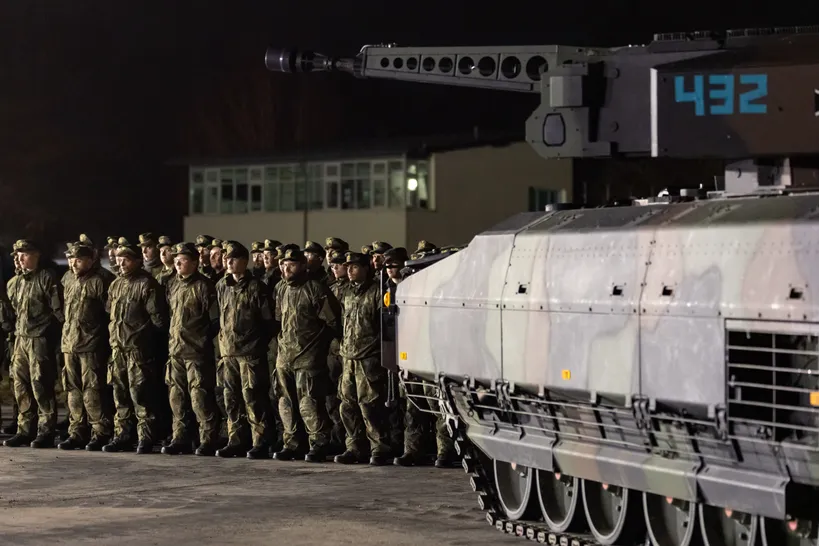
German troops in Bavaria, Grafenwöhr. Photo: Daniel Karmann
The allies are aware of this shortfall. In January 2024, the Netherlands, Germany, and Poland signed a declaration of intent aimed at jointly improving the usability of military transport corridors running from North Sea ports to the eastern flank.
Other military transport-corridor development initiatives have followed. In November 2024, Lithuania, Belgium, Luxembourg, Czechia, and Slovakia joined the same Dutch-German-Polish initiative. In its wake, Lithuania began reinforcing the section of Via Baltica leading toward the Suwałki Gap.
Greece, Bulgaria, and Romania launched work on a southern corridor in July 2024, while Denmark, Iceland, Norway, Sweden, and Finland agreed in November of the same year to coordinate improvements to military transport corridors across the Nordic region.
GLOBSEC’s analysis notes that the EU’s 2021–2027 budget allocates €1.7 billion to support military mobility and dual-use infrastructure projects. At the same time, the report says that despite some progress compared with the past, available resources remain far below actual needs. As an example, it notes that Germany alone would need at least €30 billion for urgent infrastructure upgrades.
On transit permits, the report highlights an Estonia-led European Defense Fund project to develop a secure digital information-exchange system that would help allies agree more quickly on the movement of military equipment and units.
However, the analysis also acknowledges the current confusion surrounding agreements and decision-making procedures. In some countries, allowing allied units and equipment to pass through still requires a parliamentary decision. In a fast-moving crisis, that could cause critical delays.