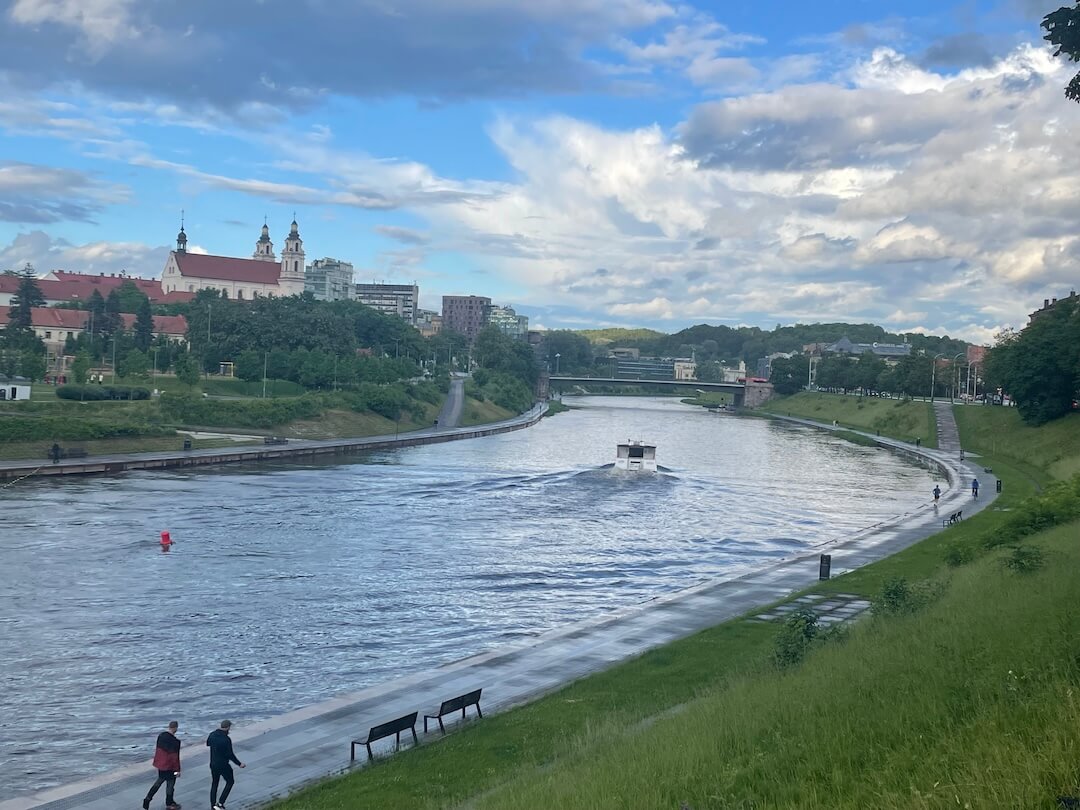
VILNIUS, Lithuania — In the Baltics — the three nations wedged between the Baltic Sea and an expansionist Russia and its ally Belarus — distances are short, but memories are long.
Col. Linas Idzelis commands the Lithuanian Riflemen’s Union, a militia and civil defense group founded in 1919. In 1993, he was a soldier when the final troops from the former Soviet Union withdrew from Lithuania, a country the Soviets had occupied, heavy-handedly, for about five decades.
During the withdrawal, a Russian commander shook Idzelis’ hand and said, “You know, in 10 or 15 years, we’re going to come back.”
That promise has not been kept yet, but Idzelis and his colleagues in Lithuania — as well as their neighbors in Estonia and Latvia — think about the threat from Russia constantly.
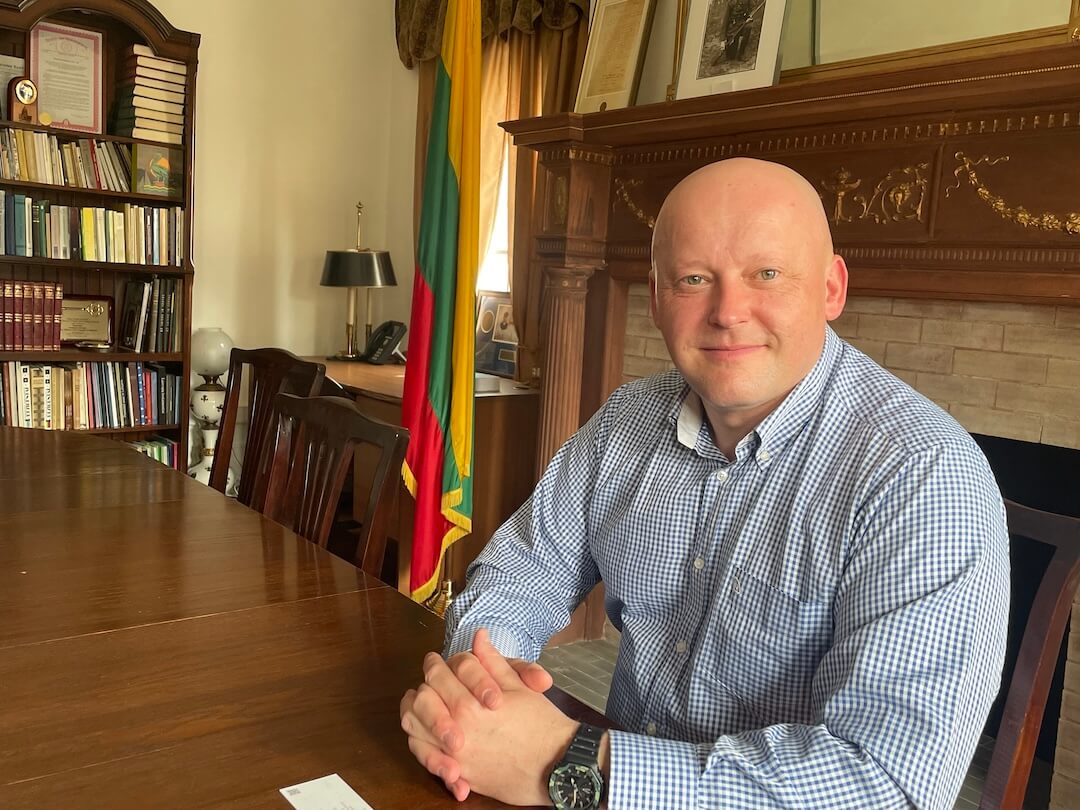
Col. Linas Idzelis, commander of the Lithuanian Riflemen’s Union (Louis Jacobson/Poynter)
“No one is surprised” at the region’s security dilemma, said Kristjan Prikk, Estonia’s ambassador to the U.S. “Russia throughout its history has had imperial and aggressive tendencies toward the countries close to her.”
As the International Fact-Checking Network’s annual GlobalFact conference prepares to begin its work in Vilnius June 17, we set out to understand the security concerns of the three Baltic nations. Here, the threats of warfare and disinformation are intimately linked.
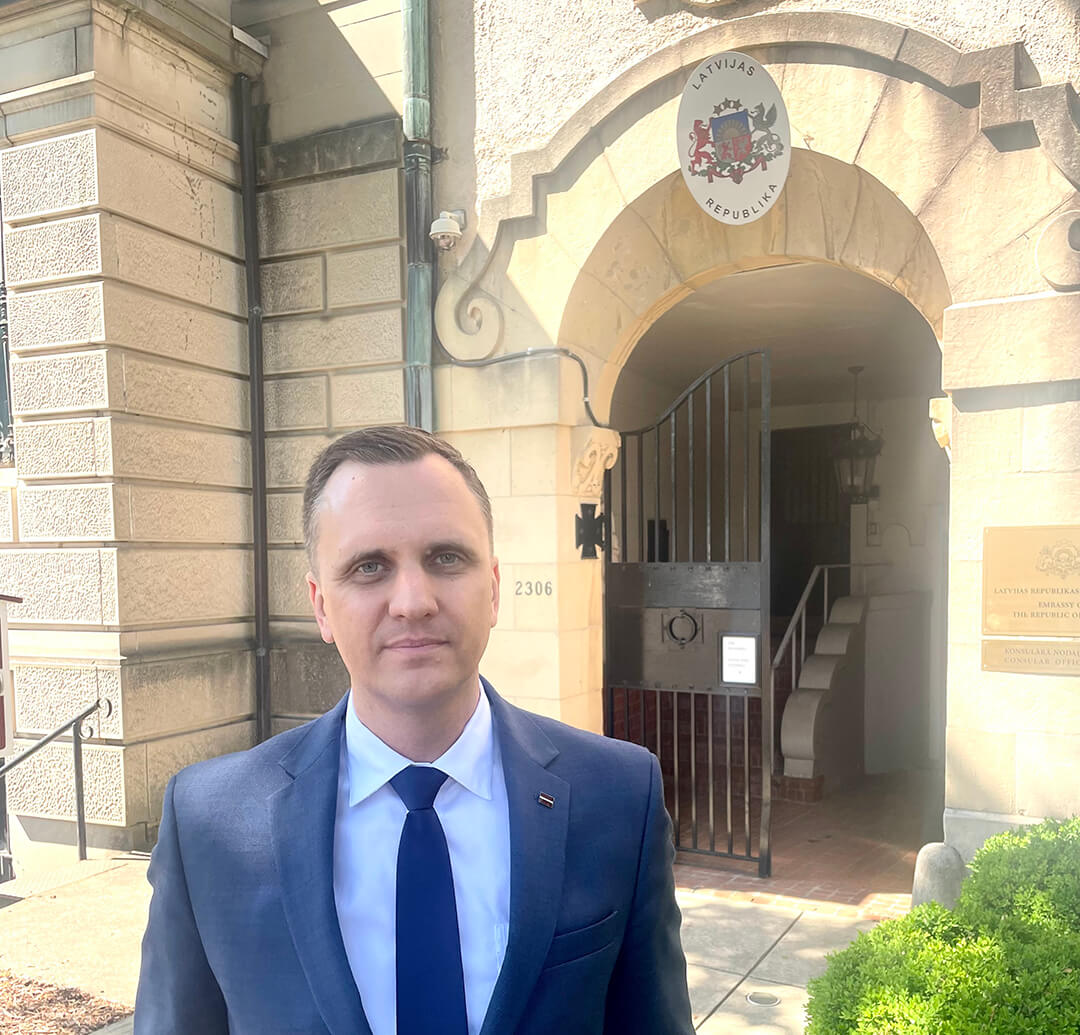
Jānis Beķeris, Latvia’s deputy chief of mission in the U.S. (Louis Jacobson/Poynter)
Proximity explains why the Baltics have been paying such close attention to the course of the war in Ukraine. Each country directly borders Russia; Estonia and Latvia touch Russia’s mainland, while Lithuania intersects with Russia’s exclave, Kaliningrad. Latvia and Lithuania additionally border Belarus.
In the World War II period, because of dueling occupations, the citizens of the Baltics “were forced to fight in the uniforms of the two totalitarian powers bent on the destruction of their nations” — Hitler’s Germany and Stalin’s Soviet Union, wrote Andres Kasekamp in “A History of the Baltic States.”
In that war-torn period, Latvia lost close to one-third of its population, and Estonia lost nearly as much, wrote Kasekamp, chair of Estonian studies at the University of Toronto. Lithuania, meanwhile, experienced the destruction of four longstanding ethnic minority communities within its borders: ethnic Germans, Jews, Roma and ethnic Swedes.
Today, the countries are small: Lithuania has the largest population at 2.8 million, followed by Latvia at 1.8 million, and Estonia at 1.3 million. The Baltics’ modest size and distance from bigger European countries shaped perceptions of the continent.
“Over many years, the Baltic faded away to the periphery of the wider West’s imagination,” wrote the journalist Oliver Moody in his 2025 book, “Baltic: The Future of Europe.” “Yet it sits quite literally at the heart of Europe. … The focus of geopolitics is shifting steadily eastwards. The Baltic Sea is becoming the nexus of a wider great game played out across Eurasia.”
As harsh as Russia’s assault on Ukraine has been, the Baltics would have an even smaller margin for error if Russia were to attack. Whereas Ukraine had territory to fall back into when invaded from the east, Vilnius is barely 20 miles from the Belarusian border, and none of the three Baltic capitals is located more than 650 miles from Moscow. To their west, each of the three Baltic nations is bounded by the Baltic Sea.
A strategic corridor called the Suwałki Gap — a portion of the Lithuanian-Polish border that lies between Russia’s heavily militarized Kaliningrad region and Belarus — is only about 40 miles wide. Were Russia and Belarus to take it over — admittedly, no easy task given the boggy and hilly terrain, experts say — the Baltics would be cut off by land from their allies in the NATO alliance.
Having experienced five decades of harsh Soviet control, the Baltic nations were on guard well before Russia rolled troops into Ukraine.
“All this horror watching the invasion into Ukraine — we don’t see anything new,” said Jānis Beķeris, Latvia’s deputy chief of mission in Washington, D.C. “This has been their rule book all along.”
But that war has only increased the stakes.
Linas Kojala, director of the Geopolitics and Security Studies Center in Vilnius, said it would be “a mistake” to interpret the continuing war in Ukraine as keeping Russia’s eye off the ball in the Baltics.
“Lithuanian intelligence warned in March that Russia is expanding units on NATO’s borders and, if sanctions were eased, could be ready for a wide-scale military conflict with NATO” within a couple of years, Kojala said. (Complicating the calculus is that in Estonia and Latvia, almost a quarter of the population is ethnically Russian; in Lithuania, it’s about 5%.)
Baltic experts agreed that the most urgent threat today comes from “hybrid” war — a combination of cyber-intrusions, ransomware, border provocations, spying, disinformation and sabotage of key pieces of infrastructure, such as undersea communications cables.
“You have to be preparing for all levels, starting with cyber and disinformation to full-scale conventional,” Kasekamp said in an interview.
Raimond Kaljulaid, a member of the Estonian parliament since 2019 who has specialized in national security matters, said Estonia, Latvia and Lithuania “have every reason to be very concerned. The current Russian leadership desires to re-establish Russian influence in the region. The preparedness level of our European partners needs to be improved significantly in the coming years.”
Gediminas Varvuolis, Lithuania’s ambassador to the United States, agreed. “There’s a lot of anxiety — but a kind of rational anxiety.”
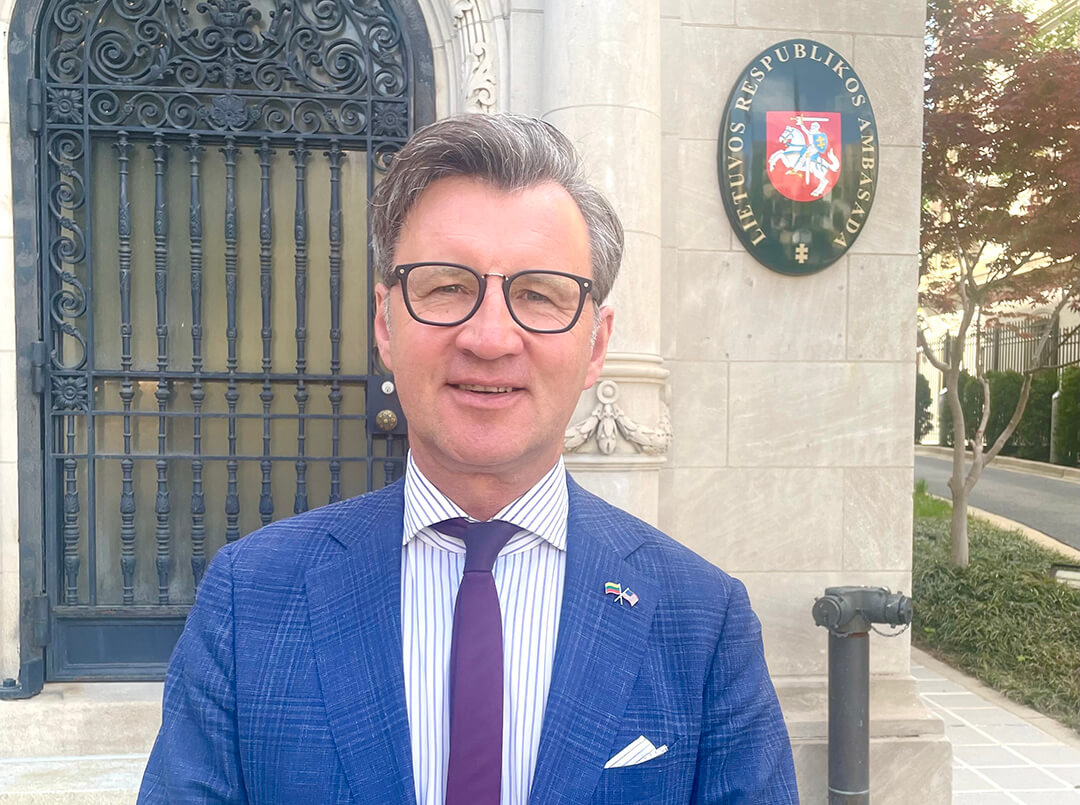
Gediminas Varvuolis, Lithuania’s ambassador to the U.S. (Louis Jacobson/Poynter)
What threats the Baltic nations are looking out for
The nature of the hybrid threat is constantly evolving, experts said.
“Cyber and information attacks are a constant threat. We’ve also had instances of arson attacks, of warehouses being lit on fire, and cutting cables in the Baltic Sea,” said Varvuolis, the Lithuanian ambassador.
As a result, Baltic governments, along with the private sector and universities, have become leaders by necessity in such areas as cyberdefense and drone (and antidrone) technology. Last year, 10 Ukrainians humbled two NATO battalions during an exercise in Estonia, simulating the destruction of 17 armored vehicles in half a day.
“For years, we have included the civilian part of society and critical institutions like banks, telecommunications firms and healthcare providers in national contingency planning,” said Prikk, the Estonian ambassador. “You cannot harden every building in Estonia, and you cannot guarantee that every service will be available in a major crisis. But there are things we can do to prioritize services, create redundancies, and do some extra stockpiling in some areas.”
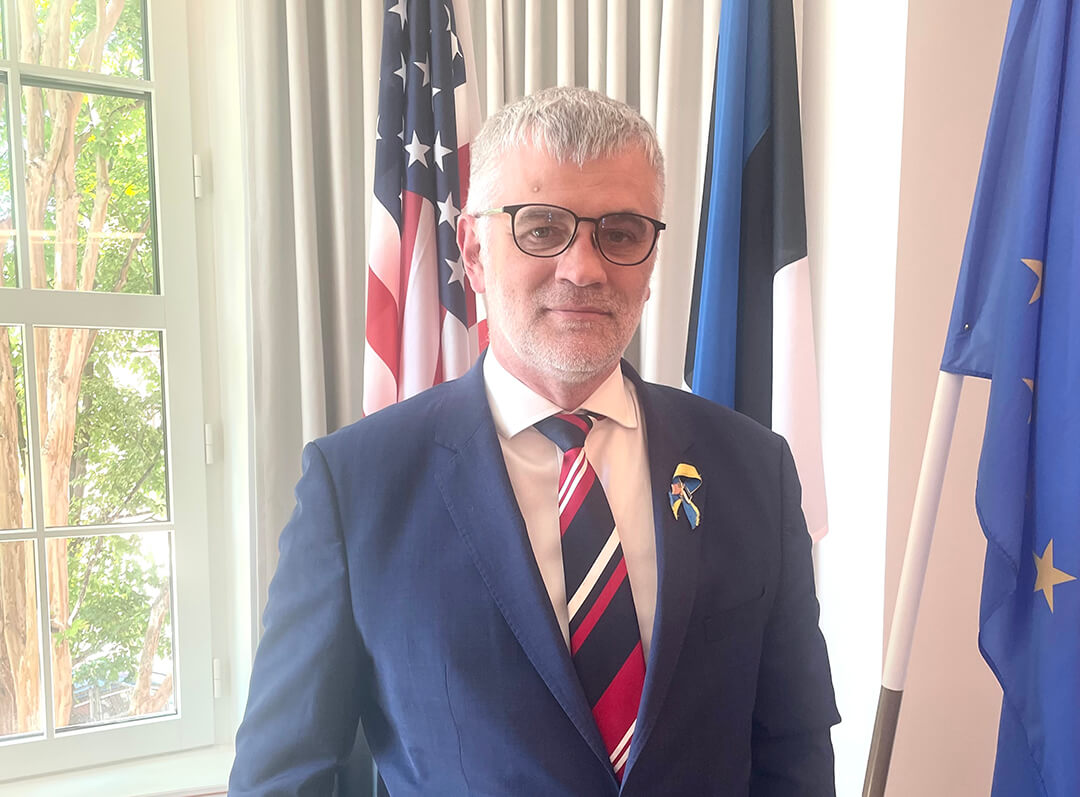
Kristjan Prikk, Estonia’s ambassador to the U.S. (Louis Jacobson/Poynter)
“I think we are doing quite well — better and better every day,” said Margarita Šešelgytė, director of Vilnius University’s Institute of International Relations and Political Science. “But the enemy is also getting better every day. It’s similar to fighting terrorism. We have to be successful all the time, while for them, they only have to inflict damage once.”
People living in the Baltics cannot avoid the precariousness of their security situation, so all they can do is be resilient and prepared, Kasekamp said. “You have some agency or control,” he said. “You’re aware of the threat, and you’re doing something about it.”
Will NATO be there to defend the Baltics?
A big lesson the Baltic nations learned from World War II is to stand up for their independence — and to forge alliances with the Western democracies.
The Baltics welcomed NATO allies’ troops on the ground. The United Kingdom serves as NATO’s lead in Estonia, while Canada leads in Latvia and Germany leads in Lithuania, said Guntis Smidchens, an associate professor of Baltic studies at the University of Washington. The Baltics have also forged strong ties with the Scandinavian nations and Poland, which also border the Baltic Sea, he said.
The Baltic nations have also spent aggressively on defense. Each of the Baltics easily exceeded NATO’s prior military expenditure threshold — 2% of GDP — and have pledged to meet the newly increased goal of 5%, with 3.5% for the military and 1.5% for resilience and critical infrastructure.
“The Baltics are not standing outside NATO asking whether NATO will show up,” Kojala said. “We are NATO. National readiness first, allied reinforcement second.”
Despite conflicting foreign policy signals from Washington under President Donald Trump, representatives of each of the Baltic nations, along with some academic experts, said in interviews that they still believe the U.S. will be on their side for the long haul.

Vilnius Cathedral, completed in 1783, in Vilnius Lithuania (Louis Jacobson/Poynter)
Official U.S. recognition of the three Baltic nations continued unbroken during the five decades of Soviet rule — Varvuolis, the Lithuanian ambassador, proudly notes that the embassy in Washington, D.C., where he works remained open that whole time — though the U.S., and its partners in the West, were slower to support full independence for the Baltics in the late 1980s and early 1990s, concerned about the realpolitik of derailing the Soviet Union’s fragile unraveling.
“The Baltics should always watch the political mood in the alliance carefully,” Kojala said. “But on the ground, deterrence is not theoretical. It is visible, multinational and in place.”
Baltic leaders also understand that expressing concern publicly about Trump’s foreign policy could harm their long-term interests.
“The Baltics don’t have a choice,” Kasekamp said. “They can’t turn back on NATO. So they have been more cautious in public.”
In any case, said Kaljulaid, the member of the Estonian parliament, “Concern does you very little good. Training and exercises are a better substitute.”