
Haredi protesters blocked traffic Wednesday morning near Bnei Brak during an anti-draft demonstration that became violent, with police using stun grenades and batons to disperse participants.
Five protesters were arrested during the demonstration, which blocked traffic in both directions on Route 4 east of Tel Aviv as morning rush hour reached its peak.
Eight protesters were lightly injured during the demonstration, the Hatzalah paramedic service told the Haaretz news outlet.
Cops were filmed tearing the trousers of participants as they dragged them off the highway, throwing stun grenades at demonstrators and hitting them with batons, in scenes the sparked sharp condemnation from ultra-Orthodox politicians.
A row of police lined up in front of a group of protesters sitting on the tarmac, threw stun grenades at them, then rushed them, beating them with batons.
Get The Times of Israel’s Daily Edition
by email and never miss our top stories
By signing up, you agree to the terms
In another video, the commander of Bnei Brak’s police station, Ch. Supt. Yuval Shavit, was seen tearing the trousers of an ultra-Orthodox man as he dragged him off the highway.
In a statement, police said that a number of protesters crawled under vehicles in an attempt to prevent the road from being cleared after the protest against the arrest of draft dodgers had been declared an illegal demonstration.
הפגנה בכביש 4: עימותים קשים בין המפגינים למשטרה pic.twitter.com/gzFBST7SFa
— כאן חדשות (@kann_news) June 17, 2026
One boy was seen walking with blood streaming down his face amid the chaotic demonstration, as officers shoved ultra-Orthodox men refusing to budge from their spots on the road.
במשטרה מתעקשים: הילד לא נפגע מאלימות שוטרים, פניו פגעו בברגים של לוחית רישוי של רכב ובשל כך נפצע https://t.co/dpdZOPVll5
— יואלי ברים yoeli brim (@yoeli_brim) June 17, 2026
Following the violence, the hardline Jerusalem Faction — which was responsible for organizing the surprise protest — threatened to petition the High Court of Justice over purported “selective enforcement” against Haredi protesters.
The organization accused “Ben Gvir’s police” of acting “with humiliating and unrestrained violence towards the protesters, using harsh measures and shocking methods that violate legal regulations.”
“If this unacceptable conduct continues, we intend to petition the High Court of Justice in the near future,” the group’s spokesman said.
Meanwhile, United Torah Judaism lawmaker Meir Porush likened the police conduct to repression seen in Turkey and Iran, calling it unworthy of “a country governed by Jews” that is also “purporting to be a democracy.”
“Itamar Ben Gvir, wake up!” said Shas chair Aryeh Deri, falsely claiming police apply a double standard against Haredi protesters that they did not apply to anti-government protesters. “Get up now and stop the police violence against Torah scholars.”
For his part, National Security Minister Itamar Ben Gvir — who has endorsed police use of severe violence against anti-government protesters in the past — put out a statement urging police to only use stun grenades in “exceptional cases.”

National Security Minister Itamar Ben Gvir leads a meeting of his Otzma Yehudit faction at the Knesset, in Jerusalem, on June 15, 2026. (Yonatan Sindel/ Flash90)
The far-right politician said he’d hold an “urgent meeting” to ensure law enforcement employs the measure only in “exceptional cases and in accordance with police regulations.”
“If their use is not limited to these cases, there will be no stun grenades in the police,” he wrote.
The ultranationalist minister’s sudden opposition to police use of stun grenades stood in stark contrast to his previous support for cops who employed the dispersal tool — which is liable to cause injury if thrown directly at a person — against anti-government demonstrators.
Ben Gvir gave public backing to police who threw stun grenades into a crowd of anti-government protesters in Tel Aviv during a March 2023 demonstration, which led to the hospitalization of two demonstrators.
The police commander at the scene, Supt. Meir Suissa, was indicted and later convicted for throwing a stun grenade that hit a protester in the face, causing her injury and facial disfigurement that required cosmetic surgery to fix.
Following the incident, Ben Gvir tried to promote Suissa and put him in charge of the south Tel Aviv police station, but the move was struck down by the Jerusalem District Court.
Wednesday’s demonstration were part of a wave of violent and disruptive protests against increased efforts to arrest draft evaders, and come less than a week after thousands of Haredim blocked central Israel highways and railroads last Thursday.
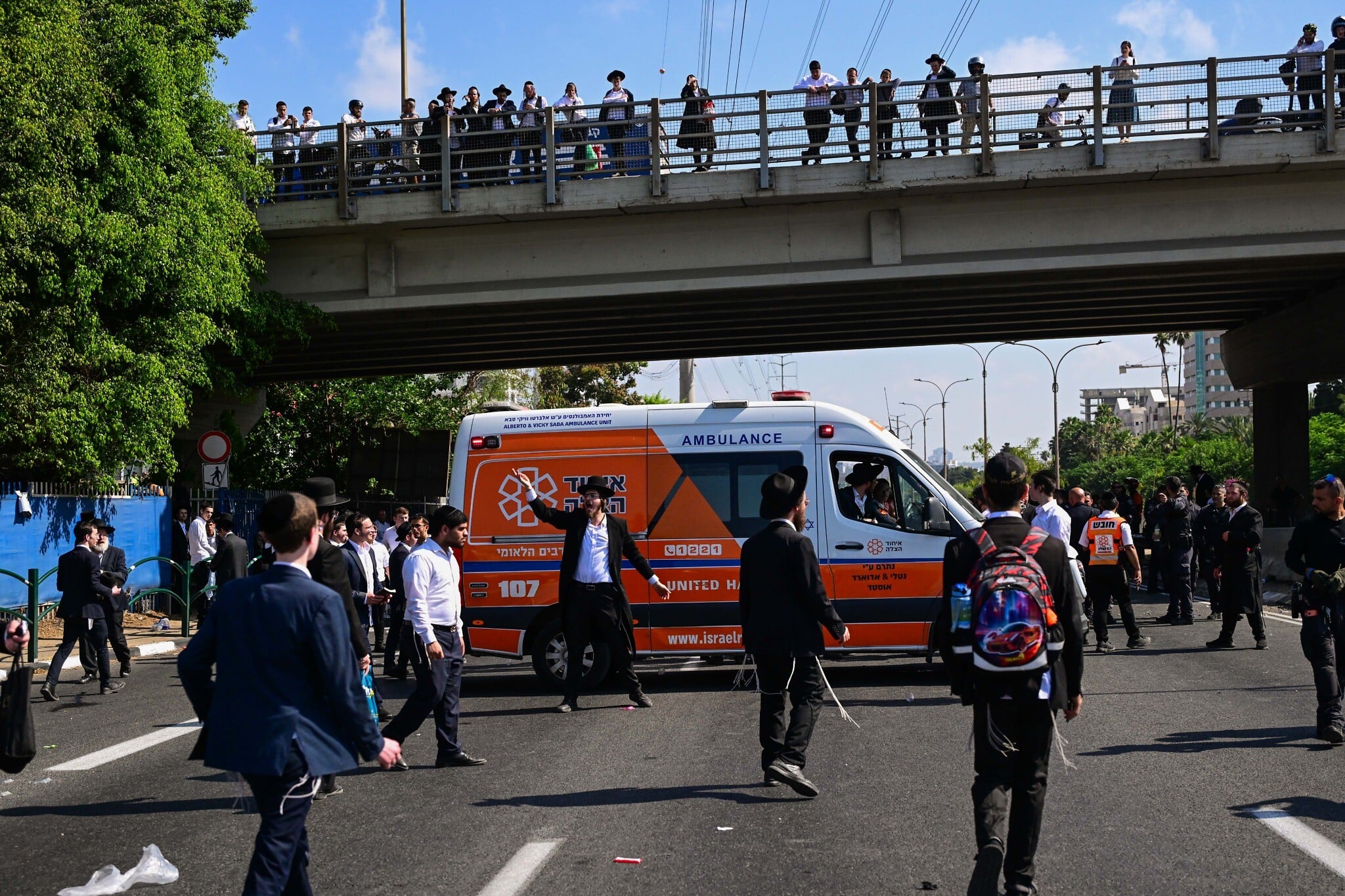
Ultra-Orthodox Jewish men block a road during a protest against the jailing of seminary students who failed to comply with an army recruitment order, on Route 4 near Bnei Brak, June 17, 2026. (Avshalom Sassoni/Flash90)
Two weeks ago, dozens of ultra-Orthodox extremists smashed windows and caused property damage while trying to break into Supreme Court Deputy Chief Justice Noam Sohlberg’s house during a riot.
Before that, a group of Haredi protesters broke into a police station compound in Beit Shemesh, rioting and clashing with officers. And members of the radical Jerusalem Faction in April broke into the home of the Military Police chief while his family was inside.
Haredi radicals also recently attempted to break into the police station in Jerusalem’s Russian Compound.
The Jerusalem Faction has openly bragged about disrupting police activities against draft dodgers but has largely been able to evade any legal consequences.
Ariela Karmel contributed to this report.
We can’t do this work alone.

The war with Iran has been draining for all of us in Israel. But when I heard about a high casualty incident – ballistic missile impacts in Arad and Dimona that left nearly 200 people wounded – I drank a cup of coffee, packed a bag, and headed south.
There, I spoke with Shilgit, the head of an after-school program for underprivileged youth. Standing outside her destroyed center, Shilgit said it was a miracle that no children were hurt and spoke about the community coming together in the hours since.
As a Times of Israel reporter, I’m committed to telling stories of resilience like Shilgit’s. But my colleagues and I can’t do this alone. If you value work like this, please consider joining our reader support group, The Times of Israel Community. Your financial support is essential to keep real human reporting like this going.
— Stav Levaton, military reporter
Already a member? Sign in to stop seeing this
You’re a dedicated reader

That’s why we started the Times of Israel – to provide discerning readers like you with must-read coverage of Israel and the Jewish world.
So now we have a request. Unlike other news outlets, we haven’t put up a paywall. But as the journalism we do is costly, we invite readers for whom The Times of Israel has become important to help support our work by joining The Times of Israel Community.
For as little as $6 a month you can help support our quality journalism while enjoying The Times of Israel AD-FREE, as well as accessing exclusive content available only to Times of Israel Community members.
Thank you,
David Horovitz, Founding Editor of The Times of Israel