Firefighters battled a stubborn cold-storage warehouse fire in Boyle Heights for a fifth day Sunday as residents’ concerns over air quality continue to mount.
Los Angeles Fire Department Chief Jaime Moore said fire crews made significant progress in combating the blaze. If progress continues at this rate, it should be out by week’s end.
A Fire Department spokesperson said Sunday evening that although crews have removed sections of exterior walls, allowing greater access to the fire, the property’s construction — such as supports of a collapsed roof — continues to create “complex and unstable conditions that require a cautious and methodical approach.”
“Firefighters are operating with a strong emphasis on safety and are closely monitoring potential structural failure hazards,” spokesperson Jamie Stewart said. “Fire conditions along the exterior portions of the structure have been largely knocked down. The next phase of operations will focus on accessing and extinguishing remaining fire within more interior areas of the building. Smoke conditions have improved significantly and are expected to continue improving as firefighters make progress extinguishing the fire.”
However, Stewart cautioned that although the air quality is improving, smoke conditions in the area may intermittently increase as firefighters try to extinguish flames in concealed spaces.
The upbeat tone struck by city officials belied the ongoing concerns from neighbors and people across large swaths of L.A. about the smoke that has poured from the building for days. A particle pollution advisory issued by the South Coast Air Quality Management District remains in effect through 12:30 p.m. Monday.
Regulatory monitors show that air quality levels ranged from “unhealthy for sensitive groups” to “very unhealthy” since Saturday night in the areas of Los Angeles County, the San Gabriel Valley and northwest San Bernardino Valley. There were complaints across social media about poor air quality from residents in those neighborhoods.
East Los Angeles, Boyle Heights and the San Gabriel Valley will continue to feel the effects of the smoke on Monday.
Los Angeles Mayor Karen Bass and Gov. Gavin Newsom jointly declared a state of emergency Saturday because of the unhealthful air quality.
Moore said at a news conference Sunday afternoon that the declaration frees up funds that can bring in more resources in the region. Moore said he is asking for 12 additional fire engines and six additional trucks to help support firefighters.
“We’re going to continue to be working this fire throughout the clock,” Moore said. “I’m hoping by the end of this week, we’ll have this thing completely done and turned over to the building owner and building occupant.”
Late Sunday night, the city announced new road closures and traffic restrictions near the fire on the 1400 block of South Los Palos St.
There are street closures at the intersections of Union Pacific Ave. and Calzona St., Union Pacific Ave. and Indiana St., Noakes St. and Calzona St., as well as Noakes St. and Indiana St.
Other intersections are only accessible by local residents, employees and others who need to be in the area.
Traffic control points have been put in place at Olympic Blvd. and South Los Palos St., Olympic Blvd. and Prado St., Olympic Blvd. and La Puerta St., Olympic Blvd. and Indiana St., as well as Olympic Blvd. and South Alma Ave. No southbound traffic is permitted, though residents who live north of Union Pacific Ave. are allowed access.
No eastbound traffic is allowed at the intersections of Mirasol St. and Union Pacific Ave. nor at Mirasol St. and Noakes St., though traffic heading north and south is permitted. Westbound traffic is prohibited at Hicks Ave. and Union Pacific Ave. Westbound traffic is also prohibited at Hicks Ave. and Noakes St., though commercial vehicles serving local businesses are allowed, as they are eastbound and westbound on Noakes St.
“Members of the public are encouraged to avoid the area and use alternate routes whenever possible,” Stewart said. “Reducing traffic congestion around the incident will help ensure firefighters, emergency vehicles and utility crews can safely and efficiently access the scene.”

A Boyle Heights resident keep a watchful eye on the fire at the 5,000-square-foot commercial building, which stores 85 million pounds of frozen food.
(Genaro Molina / Los Angeles Times)
The blaze at the 500,000-square-foot commercial building began Wednesday. The corrugated steel walls are filled with dense foam. Moore suggested Sunday that the steel has protected most of the foam from burning, but the fire has emitted gases despite efforts to fight the flames from the ground and with helicopters.

A Los Angeles Fire Department firefighters drags a water hose alongside the Lineage cold storage facility to battle a fire that flared back on Sunday.
(Kayla Bartkowski/Los Angeles Times)
Overnight Saturday and into Sunday, firefighters removed portions of the wall to improve access and to allow firefighters to advance into areas that were otherwise inaccessible. The department also brought in helicopters capable of carrying larger quantities of water to the site.
Moore said the facility has remained at 45 degrees, which mitigates the risk of it becoming a biohazard due to food spoilage. “The bio concerns are not there,” he said. “It is spoiling, but not at the levels that we were afraid of.”
Officials have said firefighters are still dealing with poor visibility inside the facility due to its complicated layout.
Bass said at the news conference that the building’s tenant, Lineage Logistics, has committed $2 million to help residents and businesses affected by the persistent fire.
However, City Councilmember Ysabel Jurado said that “Boyle Heights did not create this crisis, and Boyle Heights should not be left to carry the burden of cleaning it up on their own.” She added that the city should hold the company accountable for a safe cleanup and for mitigating any environmental hazards.
Residents say they are feeling the effects of the fire, which has sent large plumes of smoke into the air.
At Yia Caffe, a coffee shop a few blocks from the warehouse, manager Leo Miguel said the smoke has been affecting both customers and employees. Miguel said many customers are opting to grab their drinks and go rather than linger outside as smoke drifts through the neighborhood.
The smoke smells “like chemicals and plastic,” Miguel said, adding that it leaves his mouth feeling dry and makes it “hard to breathe.” Business has slowed since the fire began Wednesday, he said, and conditions don’t appear to be improving.
“I don’t think it’s getting better,” Miguel said. “If anything, it’s getting worse.”
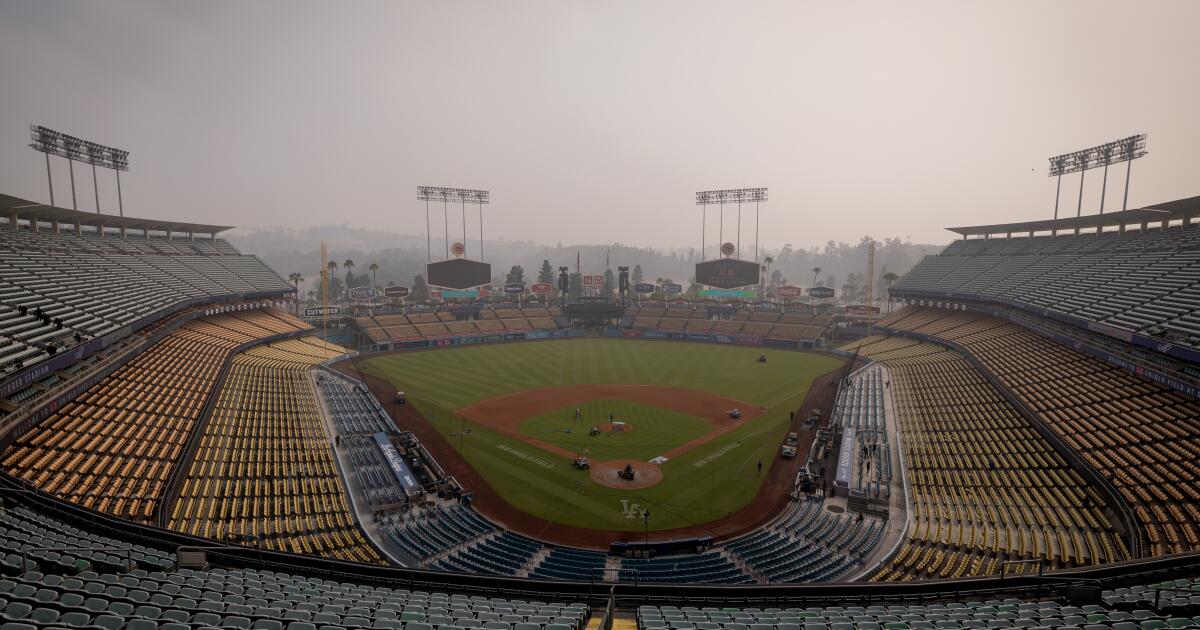
Hazy conditions were visible at Dodger Stadium, where manager Dave Roberts told reporters the Dodgers’ game against the Baltimore Orioles was expected to start on time as long as air quality did not deteriorate.
Wil Blake, who lives a block from Walt Disney Concert Hall in downtown Los Angeles, said he woke up Sunday morning to the smell of “soot and smoke” in the air, which reminded him of last year’s wildfires.
Blake said he keeps his windows open because his air conditioner has been out of service in recent weeks. He needed to shut them after noticing the smoke. He also wore a mask outdoors and went to a nearby Planet Fitness because he “needed to get some filtered air.”
At the city’s smoke relief center at Pecan Recreation Center, Ashley Campos, 18, said her family left their home on Hicks Ave. near the fire because of health concerns. Campos said her 44-year-old mother has asthma, her 9-year-old brother has epilepsy, and her 68-year-old grandmother is battling cancer.
Campos said the family lives about two blocks from the warehouse and could smell smoke inside their home. They looked into buying an air purifier but found them either too expensive or unavailable for immediate delivery.
“We didn’t want to even risk it,” Campos said of staying home. Her father has remained at the family’s house “just in case anything happens,” she said.
Campos said the family has struggled to obtain a purifier and has heard similar concerns from neighbors. “It’s really hard,” she said. “My dad tried looking for one, but he couldn’t find them.”
A Boyle Heights resident keep a watchful eye on the fire at the 500-square-foot building, warehouse that continues to burn in the Boyle Heights on Saturday June 20, 2026.
(Genaro Molina / Los Angeles Times)
Michael Kleinman, a toxicologist and professor at UC Irvine’s Wen School of Population and Public Health, said the danger zone from the smoke is dependent on how fast the wind is blowing and in what direction. He warned that throat irritation, stinging or watering of the eyes, or a runny nose can indicate a more serious reaction.
The potential biohazard posed by millions of pounds of spoiling food is “something that’s really unprecedented,” Kleinman said.
“It’ll certainly be smelly and noxious, and bacteria and things are going to be growing in it,” he said. “Obviously not getting in contact with it is an issue, but if the stuff starts to burn, it adds this biological material to the plumes, and you’re going off into territory that really is very untested.”
Robbie Munroe, meteorologist with the National Weather Service in Oxnard, suggested that one of the reasons the reach of this particular fire seems so broad is that light winds continue shifting directions from morning to afternoon.
“The location of Boyle Heights, in the middle of the L.A. Basin, usually experiences morning winds from the south or southeast, which might impact a larger portion of the downtown area, depending on how widespread the smoke has been,” he said. “It could get up to Glendale or the West Hollywood area.
“As it turns toward the afternoon, you get the sea breeze kick in, that’s southwest to west usually, that would take it further inland or away from the coast.”
A reporter for The Times noted that traces of smoke were evident Sunday morning in Simi Valley.