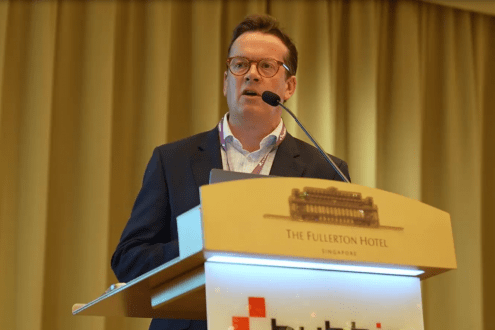
At the Hubbis Independent Wealth Management Forum – Singapore 2026, James Cook, Executive Director, Head of Investment Directors & Specialists at Federated Hermes, set out a contrarian case for investing in Asia ex Japan equities.
His presentation introduced the Federated Hermes Asia ex Japan strategy as a differentiated, bottom-up approach focused on where the team sees the most attractive price relative to value opportunities. Rather than concentrating only on the highest-quality or fastest-growing companies, the strategy is willing to invest across the quality spectrum when valuations are compelling.
The message was not that cheapness alone is sufficient. It was that valuation discipline, patience and stock selection remain critical in a region where market outcomes have diverged sharply, sentiment has become heavily concentrated, and many investors have crowded into the same quality and growth exposures.
Cook framed the approach in simple terms: buy companies when they are cheap, remain patient when the thesis remains intact, add into weakness when appropriate, and sell when the market moves closer to fair value.
Key Takeaways
Federated Hermes Takes A Contrarian, Bottom-Up Approach: The strategy focuses on price relative to value, including in companies, sectors and markets others may overlook.
The Strategy Has A 17-Year Track Record: Cook said the strategy has delivered absolute annualised returns of just over 11% and annualised alpha of just over 5%.
Stock Selection Is The Main Source Of Alpha: The approach is not driven by broad market calls, but by identifying individual companies that appear mispriced.
The Team Invests Across The Quality Spectrum: Cook said the strategy is willing to own both high-quality companies at attractive prices and lower-quality companies where the valuation is compelling.
Contrarian Investing Requires Patience: The team often invests after share prices have already fallen and may add into further weakness if the thesis remains unchanged.
The Portfolio Is Positioned Away From Consensus: The strategy is overweight China, Thailand and Korea, and underweight India, Taiwan and technology.
Korea Has Been Trimmed After Its Re-Rating: Cook said the team had reduced its relative overweight as Korea became more fashionable and the market rallied.
China Has Become Attractive Again: After being left behind this year as investors returned to AI-related hardware names in Taiwan and Korea, China now looks cheap across the quality spectrum.
Thailand Is Deeply Overlooked: Cook described Thailand as heavily oversold but home to some high-quality companies trading at depressed valuations.
India And Non-TSMC Taiwan Technology Remain Areas Of Caution: Cook said India has not become cheap enough, while many Taiwan technology companies are trading at peak multiples and peak earnings.
Looking For Price Relative To Value
Cook opened by describing the Federated Hermes Asia ex Japan strategy as a different way of investing in the region.
The strategy is rooted in a contrarian, bottom-up process. Its focus is on identifying companies where the price being paid is attractive relative to the value the investment team believes is present.
This means the strategy is willing to look where others are less comfortable. Cook said the team does not mind investing in companies that others overlook, and that the most compelling opportunities are often found in the most hated markets and unloved sectors.
“The negative news flow is often where the valuation opportunity starts,” said the speaker.
For Cook, this is what makes the fund differentiated. Many investors in Asia ex Japan are concentrated in similar areas of quality and growth. By contrast, the Federated Hermes approach can produce a portfolio that looks very different from peers and can therefore sit alongside more conventional regional allocations.
He said the strategy has been running for 17 years, and in UCITS form since 2012. Over that period, it has delivered absolute annualised returns of just over 11% and annualised alpha of just over 5%. Cook attributed that alpha primarily to stock selection and to the simple discipline of buying companies when they are cheap and selling them when they become more expensive.
Moving Across The Price-Quality Spectrum
Cook used a price-quality spectrum to explain how the strategy identifies opportunities.
Most companies, he said, sit along a line of fair value, where price and quality are broadly aligned. The Federated Hermes team is looking for companies below that line – where the price does not properly reflect the value available.
He used a car analogy to make the point. A high-quality car bought at an unusually low price would be the ideal investment. In his example, a Ferrari at USD100,000 would be highly attractive. But the strategy is also willing to own a lower-quality car, such as a Ford, if the price is sufficiently compelling.
The key distinction is that Federated Hermes is willing to move up and down the quality spectrum depending on where the opportunity lies.
“We would love a portfolio full of Ferraris at the right price,” said the speaker. “But we are not going to pay fair value for them when a cheaper Ford offers better upside.”
Cook contrasted this with many peers, which he said are mainly looking for quality and growth. That can restrict their opportunity set and leave them vulnerable to overpaying for the quality or growth they are buying.
In the history of the strategy, Cook said the portfolio has owned more “Fords” than “Ferraris”. However, he also noted that markets such as China, following indiscriminate negative selling, have allowed the team to find some attractively priced quality companies.
The point was not to avoid quality. It was to avoid overpaying for it.
A Demonstrably Contrarian Process
Cook then pointed to analysis of all buy and add decisions taken across the strategy’s 17-year history.
The analysis showed that the team has typically invested in companies after their share prices had fallen. Cook said this demonstrates the strategy’s contrarian nature. On the other side of the purchase point, he said the strategy has gone on to deliver annualised relative returns over three years of close to 15% across those decisions.
For Cook, the important question is whether the reason for the share price fall is temporary or permanent.
The ideal situation is a company at a cyclical trough in its earnings cycle. Other examples might include a change in product mix, or a company reaching the end of a period of heavy capital expenditure. In each case, the team must become comfortable that the de-rating is not structural.
“We are not buying weakness for its own sake,” said the speaker. “We are buying when the market has overreacted to something we believe is temporary.”
Cook acknowledged that contrarian investors are often early. He said the team does not look for catalysts, because if a catalyst is already known, it is likely to be reflected in the price.
Instead, the strategy relies on patience. If the share price continues to fall but the investment thesis remains intact, the team may add into weakness. Conversely, if a company rises towards fair value, the team will trim into strength or sell.
This is the second major distinction Cook identified: the strategy is demonstrably contrarian at a time when many others are momentum-driven.
The Backdrop For Value Investing
Cook then set the strategy against the long-term backdrop for value relative to growth.
He described the life of the strategy as a difficult period for value investing. With the exception of a brief phase from 2021 to 2022, value has largely underperformed growth.
This explains why the team has often found more attractively priced “Fords” than “Ferraris”. Growth and quality have been rewarded by markets, while cheaper areas have remained overlooked.
For Cook, this does not invalidate the process. Instead, it reinforces the importance of valuation discipline and stock selection. The strategy has survived not by being a deep value fund, but by selectively owning higher-quality companies when the price is attractive, while also investing in cheaper areas where the risk-reward is compelling.
“The last 17 years have not been an easy environment for value,” said the speaker. “The reason the strategy has survived is that it has never been purely deep value.”
Wide Dispersion Across Asian Markets
Cook highlighted the significant dispersion in returns across major Asia ex Japan markets over the past decade.
Taiwan has been the standout performer, closely correlated with the S&P 500, with technology playing an important role in both markets. India has also delivered a strong result for investors over the period and remains the consensus overweight for many of Federated Hermes’ peers.
By contrast, Korea had gone nowhere for a long period until last year, while China has delivered disappointing returns for investors.
This dispersion helps explain the strategy’s current positioning. As a contrarian Asia manager focused on price relative to value, the fund is overweight the underperforming markets of China, Thailand and Korea. It is very underweight the outperforming markets of India and Taiwan.
The sector positioning follows from the same bottom-up process. The most notable feature is a 10% underweight to technology.
Korea: From Deep Discount To Fashionable Market
Cook described Korea as a market that had long appealed to the strategy because of its cheapness.
The Korean market has historically traded at a discount, reflecting concerns over poor corporate governance and the cyclicality of the market. Around 12 months earlier, after Korea had finished 2024 as the worst market in Asia, Federated Hermes had a 20% relative overweight to the market.
Cook said two developments then drove a re-rating.
The first was AI-related super earnings from the semiconductor majors, including Hynix and Samsung. The second was government action to address the Korean discount, following the election of a new government led by Lee Jae-myung, who had run on a platform of getting the KOSPI to 5,000.
Cook also pointed to a change in the commercial act, giving boards of Korean companies a legal duty in relation to shareholders.
As Korea became more fashionable and the KOSPI reached a record high, the team began trimming into strength and aggressively reducing its relative overweight.
“Korea was attractive when it was cheap and neglected,” said the speaker. “As the market re-rated, our discipline was to take money off the table.”
The example reflected the strategy’s broader sell discipline. When a market or company moves closer to fair value, the team reduces exposure rather than chasing momentum.
China: Cheap Again After Being Left Behind
Cook said the team had also been cutting its overweight to China after the market outperformed last year.
This year, however, China has been left behind as investors pivoted back into AI-related hardware names in Taiwan and Korea. China has some hardware companies, but Cook said it does not have companies of the same size or leadership as those in Taiwan and Korea.
That has left China looking very cheap across the quality spectrum.
Cook said the team has therefore been adding back into China, consistent with its contrarian process. The opportunity is not based on a broad call that all Chinese equities should be bought, but on the bottom-up observation that valuations now look attractive in a market that investors have again neglected.
“China has been left behind, and that has created opportunities across the quality spectrum,” said the speaker.
For Cook, China illustrates the importance of separating sentiment from valuation. Negative sentiment can be justified by real concerns, but the relevant investment question is whether the price already reflects those concerns.
Thailand: Oversold, Overlooked And Selectively Attractive
Thailand was presented as another important contrarian overweight.
Cook noted that ASEAN is a much smaller part of the Asia region and is often overlooked by investors. Thailand, in particular, has suffered multiple headwinds, including a change in government, trade tariff uncertainty, geopolitical tensions with Cambodia, the earthquake in Myanmar, weak consumption and weak tourism.
These pressures have left the market heavily oversold. Cook said Thailand was the worst-performing market in Asia last year.
However, he argued that Thailand still contains high-quality companies. He highlighted CP All, the operator of 7-Eleven stores in Thailand, as an example. Cook described the company as having 14,700 stores and a ubiquitous position on Thai high streets, while trading on around half its historical multiple.
“Thailand is exactly the sort of market most investors are not looking at,” said the speaker. “That is why we can find quality businesses at valuations we think are compelling.”
Thailand is now a 10% overweight in the portfolio. Cook added that very few Asian equity peers would have that kind of exposure.
India: Strong Story, Difficult Price
Cook then turned to India, where the strategy remains very underweight.
India has underperformed over the past 18 months, so the underweight has not hurt performance recently. However, Cook said the market has still not become cheap enough.
Despite that underperformance, India continues to trade at a premium to still-cheap Korea, China and Thailand. Cook also said it trades almost at a premium to America, which he described as the best market in the world.
The issue, therefore, is not necessarily the quality of the India growth story. It is the valuation.
“We struggle with the price in India,” said the speaker. “It remains one of our highest-conviction underweights.”
This is central to the Federated Hermes approach. A strong market narrative is not enough if the price does not provide sufficient upside relative to downside.
Taiwan: TSMC And The Rest
Cook drew a clear distinction between TSMC and the rest of Taiwan’s technology market.
He said Federated Hermes likes TSMC, describing it as the best company the strategy can own in Taiwan, if not in the world. He noted that Nvidia cannot do what it does without TSMC.
However, the team is much more cautious on non-TSMC technology companies. Cook said these companies are trading at peak multiples and peak earnings, with the market pricing in perfection. He also pointed to margins already coming off.
For a strategy focused on positive asymmetric risk-reward, this creates a problem. The potential downside looks more significant than the upside.
“We like TSMC,” said the speaker. “We do not like non-TSMC technology priced at peak multiples and peak earnings.”
This underpins the fund’s very underweight position in Taiwan and its broader underweight to technology. The issue is not technology as a theme. It is the price being paid for that exposure.
A Cheap Portfolio In A Crowded Peer Group
Cook said the portfolio remains very cheap relative to its benchmark on price-to-book and price-to-earnings multiples.
He also contrasted the strategy with the 10 largest Asia ex Japan peers by assets under management. On the Morningstar style framework, Federated Hermes sits in large-cap value, while the largest peers sit in a crowded area of mega-cap quality and growth.
Cook acknowledged that those peers became large because they were right to be in growth. Federated Hermes, by contrast, was wrong to be in value over much of the period.
However, he said the strategy survived because it was never a deep value fund. It has owned selective high-quality companies bought at attractive prices alongside cheaper, lower-quality opportunities.
The portfolio is cheaper than the benchmark and cheaper than peers. Cook acknowledged that the price of being cheaper is lower quality, but argued that the gap is not significant.
“We are cheaper than the benchmark and cheaper than peers,” said the speaker. “The price we pay for that is slightly lower quality, but not dramatically so.”
The resulting portfolio is differentiated. It is not designed to replicate the benchmark or mirror the largest peer funds. It is designed to provide exposure to mispriced companies and markets where the team believes the market has become too pessimistic.
Asymmetric Risk-Reward And Downside Protection
Cook concluded by emphasising asymmetric risk-reward.
The strategy seeks to invest in companies that can deliver decent upside, while importantly protecting on the downside. This is a central part of the approach, particularly because contrarian investing often means owning companies before sentiment has improved.
Cook said that in every negative return year over the strategy’s 17-year history, the fund has delivered a better outcome for investors. In his view, that downside protection matters because it helps investors avoid being shaken out at the most disadvantageous time.
“The objective is not just to find upside,” said the speaker. “It is to protect enough on the downside that investors can stay invested.”
The presentation ended with Cook returning to the simplest expression of the strategy: buy things when they are cheap and sell them when they get a little more expensive.
For Federated Hermes, that means being willing to own what others dislike, trim what has become fashionable, and remain disciplined when markets reward momentum. In Cook’s framing, the opportunity in Asia ex Japan is not found by following the crowd. It is found by applying patience, valuation discipline and a willingness to be greedy when others are fearful, and fearful when others are greedy.