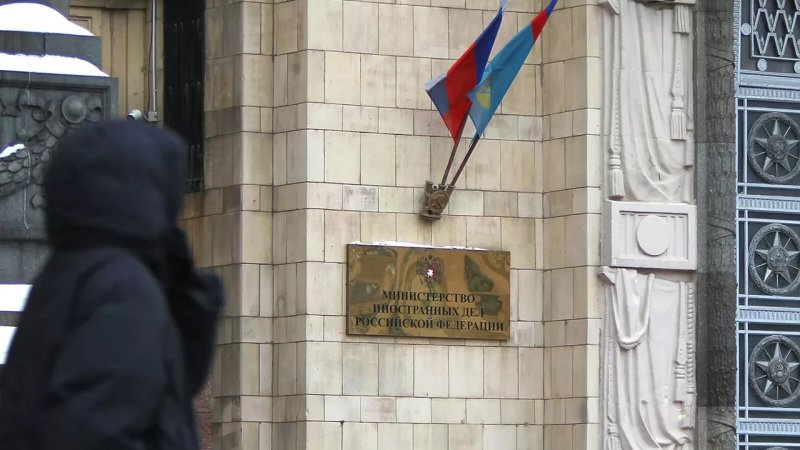
Diplomatic tensions between Russia and Moldova have escalated once again after Moscow summoned Moldova’s ambassador over the alleged detention of Russian diplomatic couriers at Chisinau International Airport.
Russia claims the incident violated international law and has accused Moldova of interfering with protected diplomatic communications. The dispute comes at a time when relations between the two countries are already at one of their lowest points in decades, News.az reports.
Why did Russia summon Moldova’s ambassador?
Russia summoned Moldovan Ambassador Lilian Darii after accusing Moldovan authorities of violating the Vienna Convention on Diplomatic Relations by allegedly detaining Russian diplomatic couriers at Chisinau International Airport. According to the Russian Foreign Ministry, the couriers were carrying official diplomatic correspondence when they were stopped by Moldovan officials, who allegedly attempted to inspect diplomatic materials and asked them to voluntarily surrender their mobile phones.
Moscow described the incident as a “gross violation” of international diplomatic law and delivered a formal protest to Ambassador Darii during his meeting at the Russian Foreign Ministry. Russia further alleged that despite notifying Moldova in advance about the couriers’ arrival, they were ultimately denied entry into the country and forced to return to Russia. The incident has become the latest source of friction in an already strained bilateral relationship.
What exactly happened at Chisinau International Airport?
According to Russia’s version of events, the diplomatic couriers arrived in Moldova on an official mission carrying diplomatic correspondence intended for the Russian Embassy in Chisinau. Upon arrival, Moldovan authorities allegedly detained them for inspection instead of allowing them to proceed under the protections guaranteed to diplomatic couriers.
Russia claims airport officials demanded access to diplomatic correspondence and requested that the couriers hand over their mobile phones. The Russian Foreign Ministry also stated that diplomatic staff from the Russian Embassy were prevented from entering the airport’s restricted zone, making it impossible to provide assistance to the couriers. After several hours, the couriers reportedly abandoned their mission and returned to Russia.
Moldovan authorities had not publicly presented their own account of the incident at the time Russia announced the diplomatic protest.
Who are diplomatic couriers and why are they important?
Diplomatic couriers are specially designated government officials responsible for transporting official diplomatic correspondence, classified documents and diplomatic pouches between embassies, consulates and foreign ministries. They play a vital role in ensuring secure communication between governments.
Unlike commercial mail or ordinary passengers, diplomatic couriers operate under internationally recognized legal protections because the materials they carry often contain highly confidential political, military or intelligence-related information. Their work allows governments to exchange sensitive documents without fear of interception or unauthorized access.
Diplomatic couriers are routinely used by virtually every country in the world and remain an essential part of international diplomacy despite advances in encrypted digital communication.
What is the Vienna Convention on Diplomatic Relations?
The Vienna Convention on Diplomatic Relations is the cornerstone of modern diplomatic law. Adopted in 1961, the treaty establishes internationally accepted rules governing diplomatic missions, embassy staff and official communications between states.
The convention guarantees that diplomats can perform their duties without intimidation or interference from the receiving country. It also establishes diplomatic immunity, protects embassy premises and ensures the confidentiality of diplomatic correspondence.
Nearly every country in the world, including both Russia and Moldova, is a party to the convention. Violations of its provisions often trigger formal diplomatic protests and may further damage bilateral relations.
What protections do diplomatic couriers receive under international law?
Under the Vienna Convention, diplomatic couriers enjoy special legal protections while carrying out official missions. They cannot ordinarily be arrested or detained during the performance of their duties and must carry official documentation confirming their status.
Perhaps even more important is the protection afforded to diplomatic bags or diplomatic pouches. These containers are considered inviolable under international law and generally cannot be opened, inspected or confiscated by customs officers, border guards or airport authorities.
These protections exist because governments must be able to communicate confidentially with their diplomatic missions abroad regardless of political disagreements or international crises.
Why is diplomatic correspondence protected?
Diplomatic correspondence often includes confidential instructions from governments to embassies, classified reports, intelligence assessments, treaty negotiations and sensitive political communications.
If receiving states were allowed to inspect diplomatic communications whenever they wished, governments could no longer trust that confidential information would remain secure. This would undermine diplomatic relations worldwide and make negotiations between countries significantly more difficult.
For this reason, the protection of diplomatic correspondence has long been regarded as one of the fundamental principles of international diplomacy.
Why did Russia object to the alleged inspection of mobile phones?
Russia also criticized what it described as requests for the diplomatic couriers to surrender their mobile phones during the airport inspection.
Modern diplomatic personnel rely heavily on encrypted mobile devices to communicate securely with embassies and foreign ministries. These devices may contain confidential government communications, contact lists, diplomatic schedules and sensitive operational information.
Although the Vienna Convention predates smartphones by several decades, many governments consider official electronic devices used by diplomats to fall within the broader principle of protecting diplomatic communications. Consequently, requests to inspect or confiscate such devices often become matters of diplomatic concern.
Russia and Moldova become so tense?
The airport dispute reflects much broader political disagreements that have developed over recent years. Relations between Moscow and Chisinau have deteriorated steadily since late 2020 as Moldova adopted a more pro-European foreign policy while reducing its political and economic dependence on Russia.
The outbreak of the war in Ukraine accelerated this shift. Moldova has deepened cooperation with the European Union, strengthened security ties with Western partners and repeatedly expressed concern over regional security developments.
Russia, meanwhile, has criticized Moldova’s political leadership, accusing it of pursuing policies hostile to Moscow. Russian officials have repeatedly described Moldova as becoming an “unfriendly state,” reflecting the growing political divide between the two countries.
What other issues divide Russia and Moldova?
The diplomatic courier dispute is only one element of a much broader deterioration in bilateral relations.
Major areas of disagreement include Moldova’s efforts to join the European Union, energy disputes involving Russian natural gas supplies, concerns about alleged foreign interference, reciprocal diplomatic restrictions and the unresolved conflict involving the separatist region of Transnistria, where Russian troops remain stationed.
The war in neighboring Ukraine has further complicated these issues, increasing regional security concerns and making diplomatic dialogue between Moscow and Chisinau increasingly difficult.
What happens when an ambassador is summoned?
Summoning a foreign ambassador is one of the strongest diplomatic measures available short of expelling diplomats or breaking diplomatic relations altogether.
During such meetings, officials from the host country’s foreign ministry usually deliver a formal protest, seek explanations or communicate dissatisfaction over another government’s actions. The ambassador typically reports the meeting and the host country’s position back to their own government.
Although ambassadors are not detained or sanctioned during these meetings, diplomatic summonses serve as official warnings that bilateral relations have entered a more confrontational phase.
What could happen next?
Whether the dispute escalates will largely depend on how both governments respond in the coming days. If Moldova rejects Russia’s accusations or provides a different account of the airport incident, diplomatic exchanges may continue through official channels.
Additional protests, reciprocal diplomatic measures or further restrictions on embassy activities cannot be ruled out if tensions continue to rise. However, both countries also retain the option of resolving the disagreement through diplomatic consultations.
The incident demonstrates how procedural disputes involving diplomatic personnel can rapidly become major international issues when political relations are already under significant strain.
Why is this incident significant beyond Russia and Moldova?
The case highlights the continuing importance of diplomatic immunity and international legal protections in an increasingly complex geopolitical environment. Despite advances in technology and modern security procedures, countries continue to rely on longstanding diplomatic rules to ensure confidential communication between governments.
The dispute also illustrates how international law, airport security, national sovereignty and geopolitical rivalry can collide during routine diplomatic operations. As tensions between Russia and several European countries remain high, similar disputes involving diplomatic personnel and official communications may become more frequent, making adherence to established diplomatic norms increasingly important for maintaining international stability.