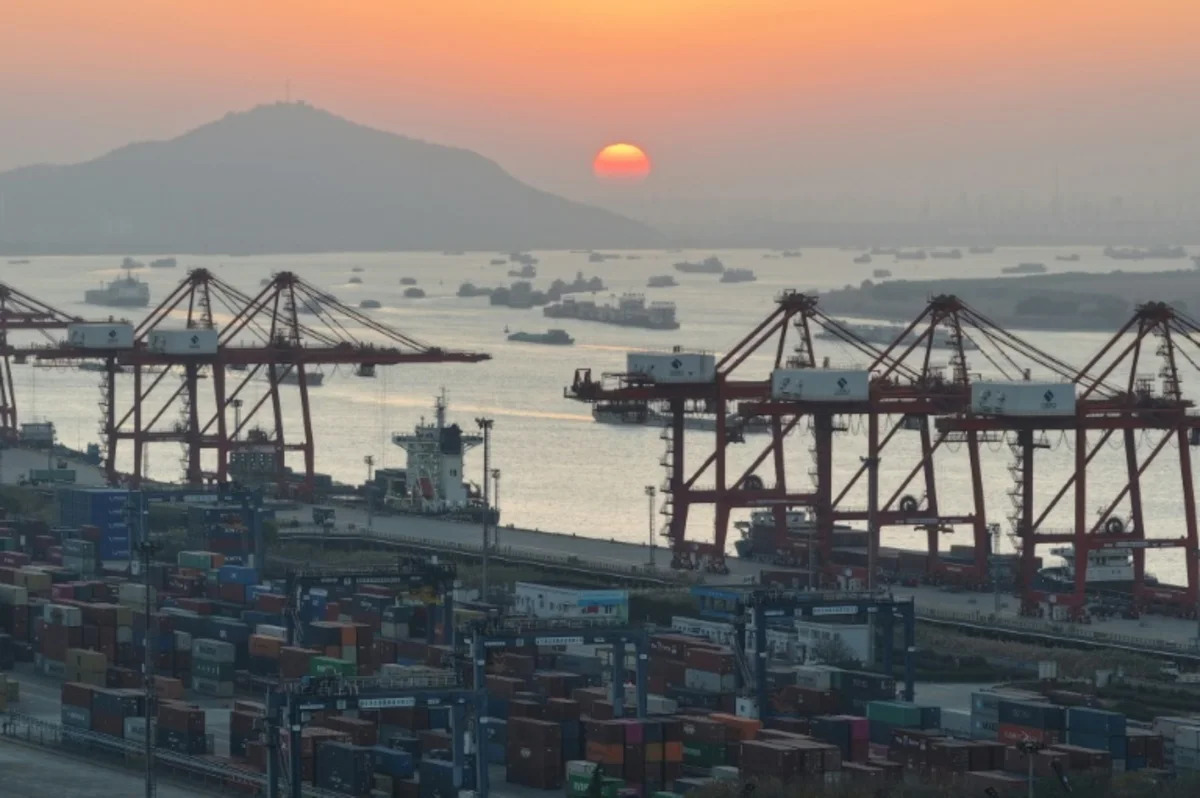

The European Union has turned its attention to China as Brussels frets over increasing trade imbalances (-)
Europe and China will gauge whether trade frictions can be resolved through talks Monday when top EU trade official Maros Sefcovic hosts his Chinese counterpart Wang Wentao in Brussels for day-long discussions.
The European Union has turned its attention to China as Brussels frets over increasing trade imbalances between the 27-nation bloc and the Asian powerhouse.
The issue is existential for the EU.
Brussels fears it will lose certain industries entirely if it does not act against a glut of cheap goods made in China threatening manufacturers in Europe.
Wang’s visit comes less than two weeks after EU leaders tasked the European Commission with tackling the issue through talks with Beijing — while simultaneously preparing beefed-up defence measures to protect key sectors.
Sefcovic will tell Wang the current imbalances are unsustainable for the EU before hosting the Chinese minister for a special dinner on Monday evening.
The EU’s trade deficit in goods hit around 360 billion euros ($410 billion) in 2025, meaning the bloc imported way more from China than it exported there.
In turn, Wang will likely seek to understand how serious the EU is in threatening to deploy its trade defence armoury against Beijing.
But the EU still hopes to avoid a trade war with its second-largest trading partner for goods alone, according to the European Commission — with China making clear it will retaliate against actions it views as unfair.
– Following Trump’s playbook? –
Europe insists on the need for a level-playing field, pointing out that Chinese firms have an unfair advantage because of massive state subsidies.
The numbers support Brussels’ argument. Between 2005 and 2024, Chinese companies received around three to eight times more government support than businesses in the Organisation for Economic Co-operation and Development, according to the OECD, which called it “a conservative estimate”.
The EU has an arsenal of trade defence tools it can use to address the issue.
These include imposing higher tariffs if investigations prove companies are selling goods at unfairly low prices or if there is state support that gives an unjust advantage to the manufacturers.
Brussels could also slap restrictions known as safeguard measures — including quotas — if there is a sudden surge in imports.
New measures are likely also on the way.
The European Commission, which leads EU trade policy, is working on an instrument that would force businesses to diversify their suppliers in critical sectors like chips and rare earths.