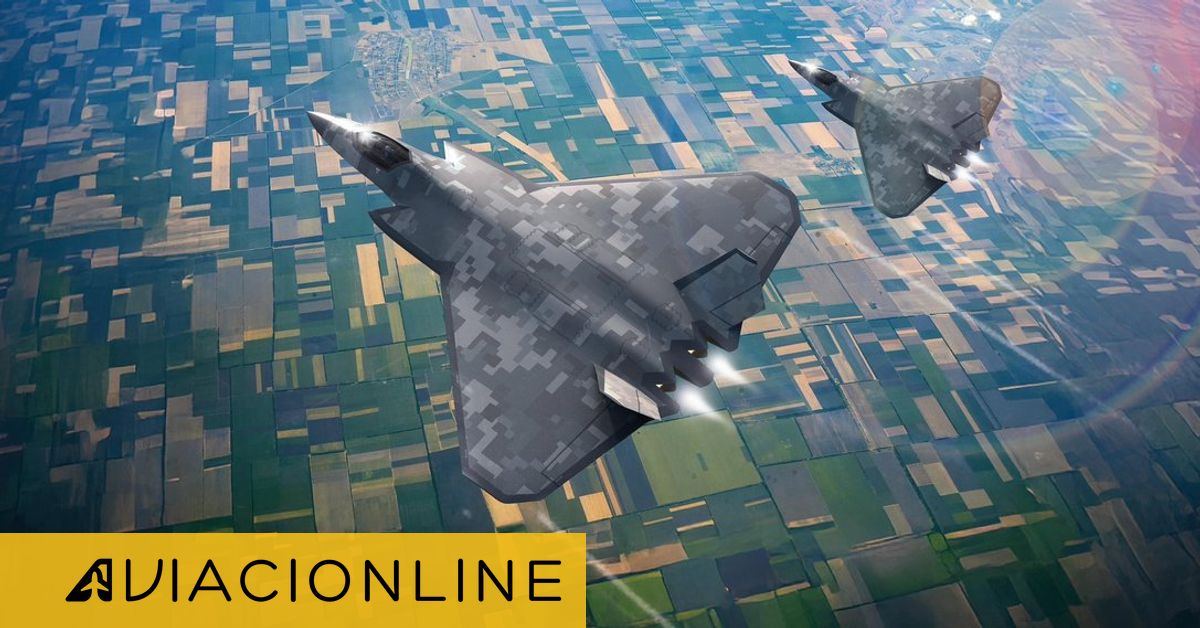
The partners of the Global Combat Air Programme (GCAP) have taken another step forward in developing their future sixth-generation fighter with the award of a £4.6 billion international contract to Edgewing, the company responsible for the design and development of the aircraft. The agreement will allow the completion of the advanced concept phase and drive detailed design work over the next 18 months, reinforcing the timetable set by the United Kingdom, Italy and Japan to introduce the new combat system around 2035.
The contract was awarded by the GCAP Agency, the body representing the three participating governments and overseeing the programme’s development. It is the second international contract awarded to Edgewing, following the initial £686 million agreement signed in April of this year, which marked the start of joint design and engineering activities.
The programme moves beyond the most conceptual stage
Beyond the financial magnitude of the announcement, the key milestone is the technical maturation of the programme. The new funding will allow the advanced concept phase to be completed and detailed aircraft design to be deepened, a critical step before moving into subsequent development and technology integration stages.
In major aeronautical programmes, this transition means beginning to consolidate engineering decisions that will shape a significant portion of the project. Aerodynamic configuration, sensor integration, internal fuel and weapons distribution, mission architecture, and numerous aspects related to low observability begin to be defined with a much higher level of detail than during the initial design phases.
The contract will run for 18 months, a timeframe consistent with the phased funding approach typically used in large development programmes. Rather than committing all resources upfront, governments release new investments as previously established technical milestones are reached, allowing progress to be evaluated and technological and financial risks to be reduced without altering the ultimate goal of entry into service.
During the signing ceremony, the CEO of the GCAP Agency, Masami Oka, stated that the new funding will allow the programme’s development to continue accelerating and highlighted that cooperation among the three countries strengthens common security, facilitates technology exchange, and contributes to the growth of their respective defence industries.
Edgewing consolidates an industrial cooperation model
Although the announcement once again places Edgewing at the centre of the programme, the company was created barely a year ago and already holds the responsibility for the full development of the future fighter.
Officially launched in June 2025, the company brings together BAE Systems, Leonardo and Japan Aircraft Industrial Enhancement Co. (JAIEC) as a joint venture tasked with designing the aircraft and acting as the design authority throughout its lifecycle.
However, Edgewing’s significance extends beyond its industrial composition. As its CEO, Marco Zoff, explained, GCAP represents the first time three countries have created a single prime engineering contractor that works on behalf of national industries and reports to a single customer, the GCAP Agency.
This model seeks to simplify programme governance and reduce industrial friction that has historically affected numerous multinational developments, concentrating technical coordination and decision-making within a single organisation from the earliest stages of the project.
In addition to Edgewing, the programme continues to rely on other specialised trinational industrial teams. One of them is GCAP Electronics Evolution (G2E), responsible for developing sensors and advanced communications systems. The other is the Power and Propulsion Consortium, made up of Rolls-Royce, Avio Aero and IHI Corporation, which is developing the new propulsion system for the future fighter.
A new milestone within the planned schedule
The contract award also confirms the timeline that the British government had recently anticipated when presenting its Defence Investment Plan 2026, a document that identifies GCAP as the UK’s primary aeronautical bet for the coming decades.
As previously reported, London plans to allocate £8.6 billion between 2026 and 2030, in addition to the £2.7 billion already invested since 2024, with the goal of making the Royal Air Force the first European air force equipped with a sixth-generation fighter.
UK Defence Investment Plan 2026 drives RAF transformation with GCAP, F-35A, and autonomous fighters
The new contract demonstrates that this planning continues to advance according to the expected timeline and that the institutional structure created to manage the programme is beginning to translate into concrete development milestones.
An increasingly evident contrast with FCAS
The announcement also gains relevance given the current state of European cooperation in combat aviation.
While GCAP continues to advance through a fully operational institutional structure, the FCAS programme recently lost its core component following the collapse of the joint development of the New Generation Fighter (NGF), a consequence of disagreements between Dassault Aviation and Airbus Defence and Space over industrial leadership, responsibility sharing, and intellectual property.
That scenario led Spain and Germany to initiate talks to explore a new joint project that would preserve the industrial capabilities developed over nearly a decade of work.
Spain and Germany Launch Talks on a Future Sixth-Generation Fighter Following Split with France
In this context, the contract awarded by the GCAP Agency far transcends its financial value. More than a new injection of resources, it confirms that the programme maintains a stable roadmap, a consolidated governance structure, and an industrial cooperation model that, at least so far, has sustained the coordinated development of one of the most ambitious aeronautical projects currently underway.