
A Government scheme for councils to provide 900 new homes for asylum seekers is in limbo with local authorities still waiting to hear about the funding.
Under the plan, the Government had vowed to provide town halls with funding to buy or build properties for migrants, which would be added to the country’s social housing stock.
Around 200 local authorities expressed an interest in joining Asylum Dispersal Pilots as part of the Government plan to move away from paying private contractors for taxpayer-funded migrant hotels, which between April 2024 to March 2025 cost £2.1bn.
A smaller number of councils are being chosen to take the scheme forward after £500m in Government funding was allocated for the new asylum accommodation model.
However, councils have expressed frustration at a lack of progress over the plans, which were first revealed by The i Paper last December.
One of the local authorities that expressed interest, Powys County Council, said “there has been no progress or decisions made by the Home Office to date in respect of this”.
Bella Sankey, the leader of Brighton & Hove City Council, which applied to take part, said the local authority was “enthusiastic about the potential” for the pilot scheme.
She said: “We’re keen to get started on the pilot and would encourage the Home Office to start rolling this out as soon as is practical.”
Local authorities should be “empowered to invest in their housing stock”, which the funding would allow the council to develop further, she added.
Newcastle City Council expressed an interest and held initial talks with the Home Office and MHCLG about the proposals, but discussions are no longer ongoing.
Hackney Council said it expressed interest in the pilot last year and had exploratory conversations with the Home Office, but hadn’t received any update.
Medway Council expressed an interest in the pilot but wasn’t selected, while Peterborough’s initial interest was also not taken forward.
Oxford City Council said it was interested in a pilot scheme to provide support rather than housing, but the Home Office advised they weren’t going to move forward with this plan.
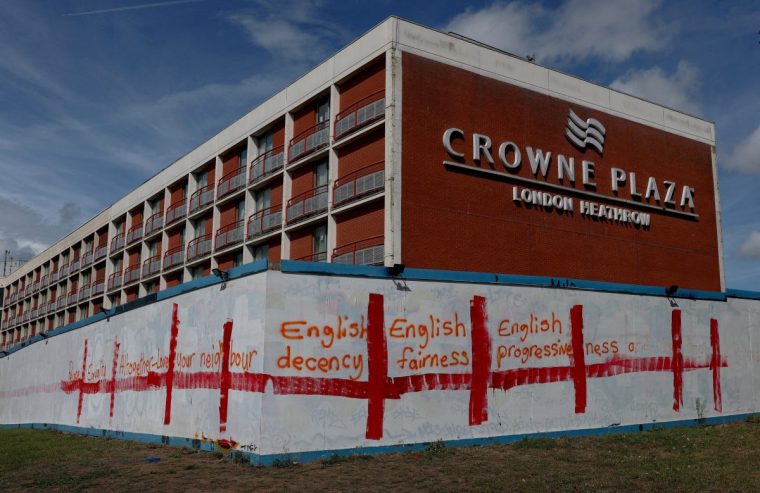 The Labour Government has promised to phase out hotels as accommodation for asylum seekers (Photo: Hannah McKay/Reuters)
The Chartered Institute for Housing (CIH), which helped develop the proposals, has admitted progress on the pilot scheme to acquire and adapt accommodation had been “slow”.
“Spending of the £500m earmarked for the pilot has not yet been decided, despite the fact that various councils have expressed a strong interest,” the CIH said in an update in April.
The Government says the funding will support councils to provide basic alternative accommodation that can be used on a temporary basis to house asylum seekers waiting for their cases to be processed.
Properties would initially be leased to the Home Office, but could then become social housing.
The Home Office has said new council housing will not be used by illegal migrants under any circumstances.
The Government hopes the investment will provide long-term social housing for local communities and reduce pressure on housing markets.
Soha Housing chief executive, Kate Wareing, who campaigned for the scheme, said in January the plan “provides the potential to prove that investing in homes in council and housing association ownership will both save the country huge sums of money and deliver much-needed additional social housing”.
Around £4bn was spent on supporting asylum seekers in the year ending March 2025, according to the Home Office, £2.1bn of it on hotels.
 Far-right protests against asylum seekers at the Bell Hotel in Epping resulted in vandalism and clashes with police. The Government ended its contract with the hotel and relocated the residents (Photo: Carlos Jasso/AFP via Getty Images)
By March this year, there were 93,653 asylum seekers in taxpayer-funded accommodation, with around 22 per cent – 20,885 – in hotels. The average nighty hotel cost is £144 .
The average nightly cost of housing an asylum seeker for private-rented temporary accommodation – often Houses in Multiple Occupation (HMO) – is £23.25.
The Home Office has also announced plans to use three more military bases to house thousands of asylum seekers as it looks to move away from hotels.
Until 1999, councils had been responsible for asylum seeker accommodation, but a dispersal system was then introduced which saw private contractors manage this housing, spreading the cost and responsibility of support across local authorities .
In 2019, the Home Office-designed Asylum Accommodation and Support Contracts (AASCs), which saw contractors Mears, Serco, and Clearsprings managing housing in seven regions.
The National Audit Office reported that the AASCs are estimated to cost £15.3bn, more than than triple the original £4.5bn projection.
The current 10-year AASC contracts run out in 2029, but there is a break clause this year ,which, the CIH says, provides an opportunity to launch the proposed pilot schemes.
The Independent Chief Inspector of Borders and Immigration (ICIBI) has launched an inspection into how the Home Office plans, prepares, and engages with local authorities in developing asylum accommodation, with the report due to be submitted in August.
Consideration of the impact on local services and community cohesion during site selection processes are among the key focuses of the ICIBI probe.
A government spokesperson said: “We have committed to closing every asylum hotel, and work is well underway, with more suitable sites, including military bases, being brought forward to ease pressure on communities.
“The Home Office is working with MHCLG to explore a model of asylum accommodation that achieves value for money and supports asylum system reform. Further detail will be provided in due course.
“New council housing will not be used by illegal migrants under any circumstances.”