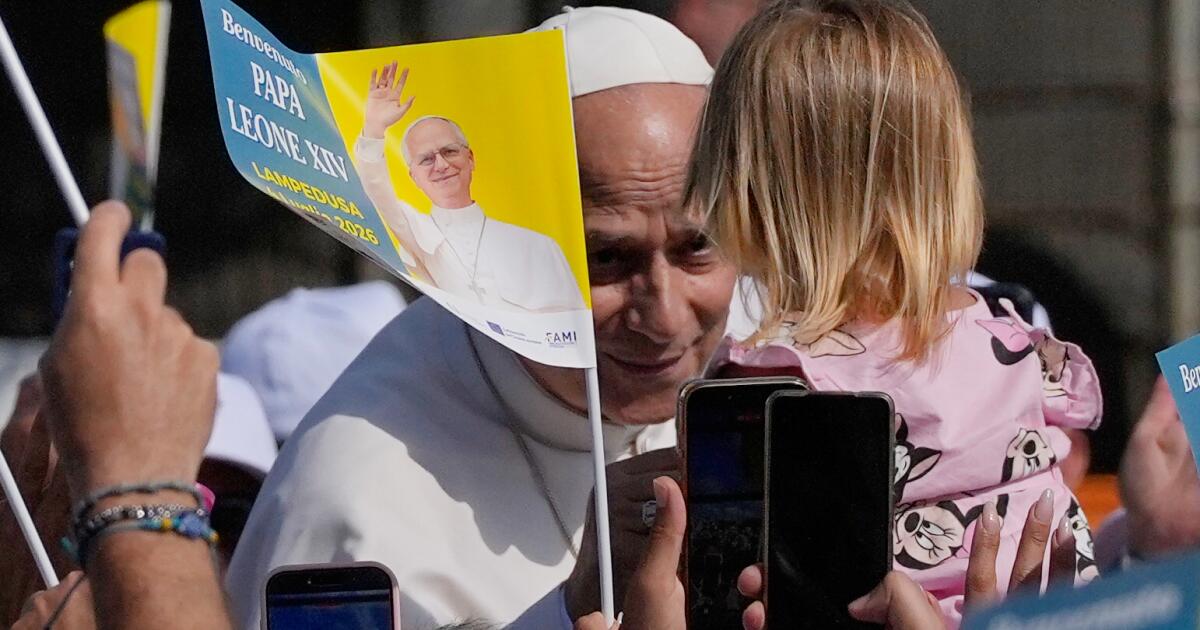
ROME — Pope Leo XIV began a summer break on Sunday, capping a whirlwind finale to the first half of 2026 in which he emerged as a powerful global statesman on issues including artificial intelligence and war and flexed decisive papal muscle to govern internal church problems.
Leo acknowledged in the summer of 2025, after the church’s cardinals elected him pope, that he had a big learning curve on being a head of state. The last few weeks have shown his governing style and a remarkable run of papal decision-making where Leo has set the agenda, rather than merely fulfill the appointments set by his predecessor.
“Many people last year would have predicted a quiet papacy on the world stage and a focus on internal reform and governance,” said Austen Ivereigh, who is the biographer of Pope Francis. “But the first half of 2026 has shown the opposite: ironically, the one area where Leo had least confidence, as international statesman, is where his pontificate has really taken off.”
July 4 spent at migrant graves
Leo spent July 4 — the 250th anniversary of U.S. Independence — on the Sicilian island of Lampedusa, praying at a migrant cemetery to honor the thousands of migrants who died trying to reach Europe to find freedom and prosperity.
The visit came after Leo ended a visit to Spain last month with a similar gesture, delivered from a dock in the Spanish Canary Islands that was once known as the “dock of shame” for the dreadful conditions migrants endured during a spike in arrivals.
In both places, Leo focused his message to Europe to uphold the dignity of migrants. But on Saturday, Leo also reminded the U.S. that it was founded by immigrants and that Christians have an obligation to welcome, protect and integrate those people seeking shelter from hardship.
For the Chicago-born Leo, who has clashed with the Trump administration over its immigrant crackdown, the choice to spend Independence Day at ground zero of the European migration debate was symbolically significant.
That’s especially true given Leo’s opposition to the U.S.-Israel war in Iran and the April sparring between President Trump and Leo, delivered via Truth Social posts (Trump) and in-flight comments traveling around Africa (Leo), that turned the American pope into the poster child of the anti-war movement.
Ivereigh recalled that the Trump administration first perked up to Leo’s pacifist messaging during his January speech to the Holy See diplomatic corps, when Leo denounced how nations were using force to assert their dominion worldwide, “completely undermining” peace and the post-World War II international legal order.
“The January speech to diplomats that alarmed the Trump administration turned out to be the launchpad,” Ivereigh said. “The Iran war and Trump’s reaction to his remarks in Africa propelled Leo overnight to guardian of the global conscience, which was cemented by the encyclical.”
An encyclical on AI and much more
In Leo’s first encyclical, “Magnifica Humanitas” (Magnificent Humanity), which was released to great fanfare in late May, he called for robust regulation of artificial intelligence, especially as the tech industry creates ever more sophisticated methods of remote warfare.
The text declared that it was “not permissible” to entrust irreversible, lethal decisions to AI systems, setting up another flash point between Leo and the Trump administration, which had worked aggressively to deregulate AI development.
But that encyclical contained more than just a manifesto promoting the common good over profit in the AI race. Nestled inside was a historic apology for the Holy See’s own role in facilitating slavery, all the more remarkable since it was delivered by an American pope whose own family history includes both enslaved people and slave owners,
Former popes have apologized for Christians’ involvement in the trans-Atlantic slave trade. But no pope had ever publicly acknowledged, much less apologized for, the role that 15th century popes played in giving European sovereigns explicit authority to subjugate and enslave “infidels.”
Leo called the Vatican’s record a “wound in Christian memory” and asked “in the name of the church” for pardon — an apology that now opens the question of reparations owed to the descendants of slaves.
‘An enforcer with clarity’
Leo showed similar courage in recent days by taking a decision no pope takes lightly or has taken for the past half-century: With Leo’s clear approval, the Vatican on Thursday declared a traditionalist group of Catholics in schism, or in formal rupture from the Catholic Church, for having consecrated four bishops without papal consent.
The Vatican excommunicated the bishops and priests of the Society of St. Pius X (SSPX), which celebrates the ancient Latin Mass and opposes the modern reforms of the Catholic Church.
After five decades of negotiations to try to bring the society back under Rome’s wing, the Vatican warned its lay faithful — who by SSPX estimates may number around a half-million worldwide — that they too risk excommunication for participating in the schism.
“Pope Leo has demonstrated that his emphasis on dialogue does not come at the expense of decisive governance,” said Andrew Chesnut, professor of religious studies at Virginia Commonwealth University.
“While the decision undoubtedly deepens the divide with the SSPX, it may ultimately strengthen cohesion among Catholics who accept Vatican authority, even when they disagree about liturgy or pastoral priorities,” he said.
The Rev. Robert Gahl, an ethics expert at the Catholic University of America, said the SSPX episode crystalized how the pope remains the center of the church and a sign of unity — a position that has come into clear focus for Leo in recent weeks.
“With this decree he’s shown that he has the clarity and also the courage to inflict clear penalties on those who violate this communion,” Gahl said. “So we not only see Leo who is kind and level-headed, but he’s also an enforcer with clarity.”
Nicole Winfield writes for the Associated Press. The AP’s religion coverage receives support through its collaboration with the Conversation US, with funding from Lilly Endowment Inc. The AP is solely responsible for this content.