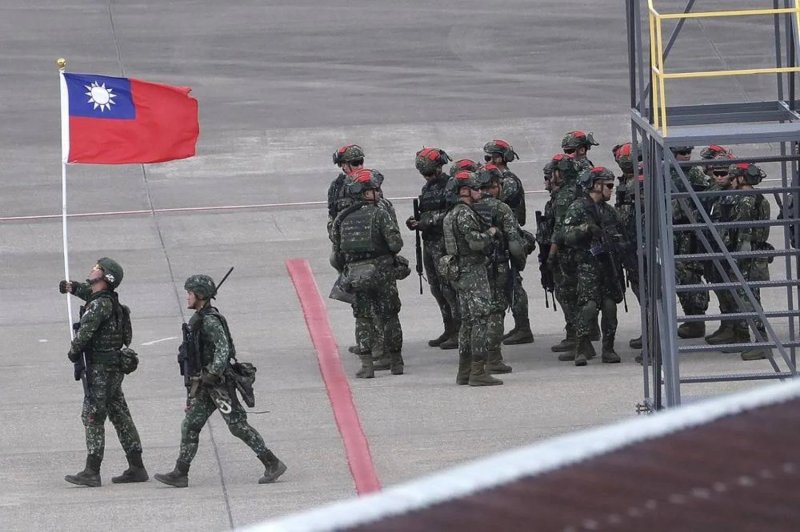
Taiwan’s military has officially reinstated anti-communist patriotic education for graduates of its military academies after a 24-year suspension.
The decision marks a significant shift in the island’s military education policy and reflects growing concern over what Taipei sees as an increasingly hostile security environment News.az reports.
According to Taiwan’s Ministry of National Defense, the renewed curriculum is intended to strengthen officers’ understanding of their mission, reinforce national identity, and prepare them for the challenges posed by China’s expanding military and political pressure.
Officials say the classes will help future officers understand not only military tactics but also the broader purpose of defending Taiwan’s democratic system and constitutional order. The defense ministry has emphasized that military personnel must have a strong sense of duty and a clear understanding of the threats facing the island in order to maintain effective national defense.
Why were these classes originally discontinued?
Anti-communist education was once a central feature of Taiwan’s military and public education system. During the Cold War and the decades following the Chinese Civil War, Taiwan’s government portrayed the People’s Republic of China as its primary ideological and military adversary. Military academies regularly taught officers about the communist system, the importance of defending the Republic of China, and the political motivations behind potential conflict.
In 2002, however, Taiwan formally removed the anti-communist curriculum as relations across the Taiwan Strait entered a comparatively less confrontational period. The courses were replaced with broader patriotic education focusing on constitutional values, democratic governance, military ethics, and civic responsibility. The shift reflected Taiwan’s democratic development and attempts to reduce ideological confrontation while maintaining military professionalism.
Why is Taiwan bringing the classes back now?
Taiwanese officials argue that the strategic environment has changed dramatically over the past several years. China has significantly increased military exercises around Taiwan, expanded naval and air operations near the island, and intensified what Taipei describes as political, military, economic, and psychological pressure. At the same time, Taiwan says it has uncovered a growing number of espionage and infiltration cases involving current and former military personnel.
Against this backdrop, the defense ministry believes future officers require a stronger understanding of the nature of the challenge posed by Beijing. Officials say the renewed curriculum is designed to ensure officers recognize “why we fight, and for whom we fight,” while reinforcing their commitment to protecting Taiwan’s democratic institutions and national security. The move is intended to complement military modernization rather than replace conventional combat training.
What will the new curriculum include?
The updated curriculum expands beyond traditional patriotic instruction by incorporating lectures from several of Taiwan’s leading national security and policy institutions. Representatives from the Mainland Affairs Council, which oversees cross-strait policy, the Ministry of Justice, and Academia Sinica—the country’s premier research institution—will provide instruction on national security, China’s political system, foreign influence operations, and strategic challenges facing Taiwan.
The courses are expected to cover issues such as information warfare, espionage prevention, legal responsibilities, democratic governance, and the importance of maintaining public confidence during periods of heightened tension. Taiwan’s military says the objective is to give officers a comprehensive understanding of both conventional military threats and the increasingly complex forms of hybrid warfare that characterize modern security competition.
What concerns does Taiwan have about Chinese infiltration?
Taiwan has repeatedly warned that Beijing is using a wide range of non-military methods to influence Taiwanese society and weaken the island’s security from within. Authorities have investigated numerous alleged espionage cases involving retired military officers, government officials, and individuals accused of collecting sensitive information or attempting to recruit serving personnel on behalf of China.
Officials also warn about cyberattacks, disinformation campaigns, political interference, economic coercion, and efforts to influence public opinion through social media and other channels. Taiwan considers these activities part of a broader strategy aimed at undermining confidence in its institutions without resorting to direct military conflict. By strengthening ideological education, defense officials hope to improve officers’ ability to recognize and resist such influence operations.
How has Chinese military activity changed?
Taiwan says China’s military presence around the island has grown rapidly in recent years, both in frequency and scale. Chinese fighter aircraft, bombers, surveillance planes, naval vessels, and Coast Guard ships now operate near Taiwan on a regular basis. Many of these activities involve crossing the median line of the Taiwan Strait or conducting exercises that simulate blockades, amphibious assaults, and joint military operations.
According to Taiwan’s National Security Council Secretary-General Joseph Wu, Taiwan recently monitored a record deployment of more than 110 Chinese military and Coast Guard vessels operating across the first island chain. Officials described the deployment as one of the largest maritime mobilizations observed in the region and interpreted it as evidence of Beijing’s expanding military ambitions. The deployment coincided with new Chinese Coast Guard patrols near Taiwan’s eastern coast, raising additional concerns about China’s ability to project power beyond the Taiwan Strait.
What is the first island chain, and why is it strategically important?
The first island chain is a geopolitical concept referring to the arc of islands extending from Japan through Taiwan and the Philippines toward Southeast Asia. The chain occupies a central position in the Indo-Pacific and serves as one of the world’s most strategically significant maritime regions. It contains vital commercial shipping lanes and provides access between the East China Sea, the South China Sea, and the wider Pacific Ocean.
For China, operating freely beyond the first island chain is considered essential for expanding its naval reach into the Pacific. For Taiwan, Japan, the United States, and several regional partners, maintaining stability within this area is regarded as crucial for preserving regional security and preventing unilateral changes to the status quo. Increased Chinese military activity along the chain is therefore closely monitored by governments throughout the Indo-Pacific.
How does China view Taiwan?
The Chinese government considers Taiwan an inseparable part of China under its long-standing “One China” policy. Beijing maintains that reunification is a historic objective and insists that Taiwan has no right to declare formal independence. Chinese leaders have repeatedly stated that peaceful reunification remains their preferred approach but have consistently refused to renounce the possible use of military force if they believe it becomes necessary.
Taiwan rejects Beijing’s sovereignty claims and maintains that the Republic of China already functions as a self-governing democracy with its own government, military, constitution, and elections. Most Taiwanese political leaders argue that only the people of Taiwan have the right to determine the island’s future, making the issue one of the most sensitive geopolitical disputes in Asia.
Does this mean conflict is becoming more likely?
The restoration of anti-communist education should not automatically be interpreted as evidence that war is imminent. Rather, it reflects Taiwan’s assessment that the overall security environment has become more challenging and unpredictable. Defense officials believe that preparing officers mentally and ideologically is an important component of military readiness alongside investments in advanced weapons, reserve forces, cyber defense, and civil preparedness.
Security analysts note that both Taiwan and China continue to expand their military capabilities while seeking to deter one another. Although tensions remain high, governments across the region continue to emphasize the importance of avoiding miscalculation and preserving stability through deterrence, diplomacy, and crisis management.
Why is this development significant?
The revival of anti-communist patriotic education represents one of Taiwan’s most important symbolic changes in military policy since the early 2000s. It demonstrates that Taipei increasingly views ideological resilience, national identity, and resistance to foreign influence as essential elements of national defense alongside conventional military strength.
The decision also illustrates how Taiwan’s defense strategy has evolved in response to changing regional dynamics. Rather than focusing solely on battlefield capabilities, the government is placing greater emphasis on preparing military personnel to confront hybrid threats, including information warfare, espionage, cyber operations, and psychological pressure. The move underscores Taiwan’s belief that future security challenges will require not only advanced weapons and professional armed forces but also a well-informed and resilient military leadership capable of responding to an increasingly complex strategic environment.