
Company Logo
Key opportunities in AI-driven materials discovery include increasing demand for rapid advanced materials development, growth in AI-based modeling adoption, and collaborations between academia and industry. Additionally, innovations like autonomous labs and cloud platforms enhance results. Rapid growth is expected, especially in Asia-Pacific.
AI in Materials Discovery Market
AI in Materials Discovery Market
Dublin, July 06, 2026 (GLOBE NEWSWIRE) — The “AI in Materials Discovery Global Market Report 2026” has been added to ResearchAndMarkets.com’s offering.
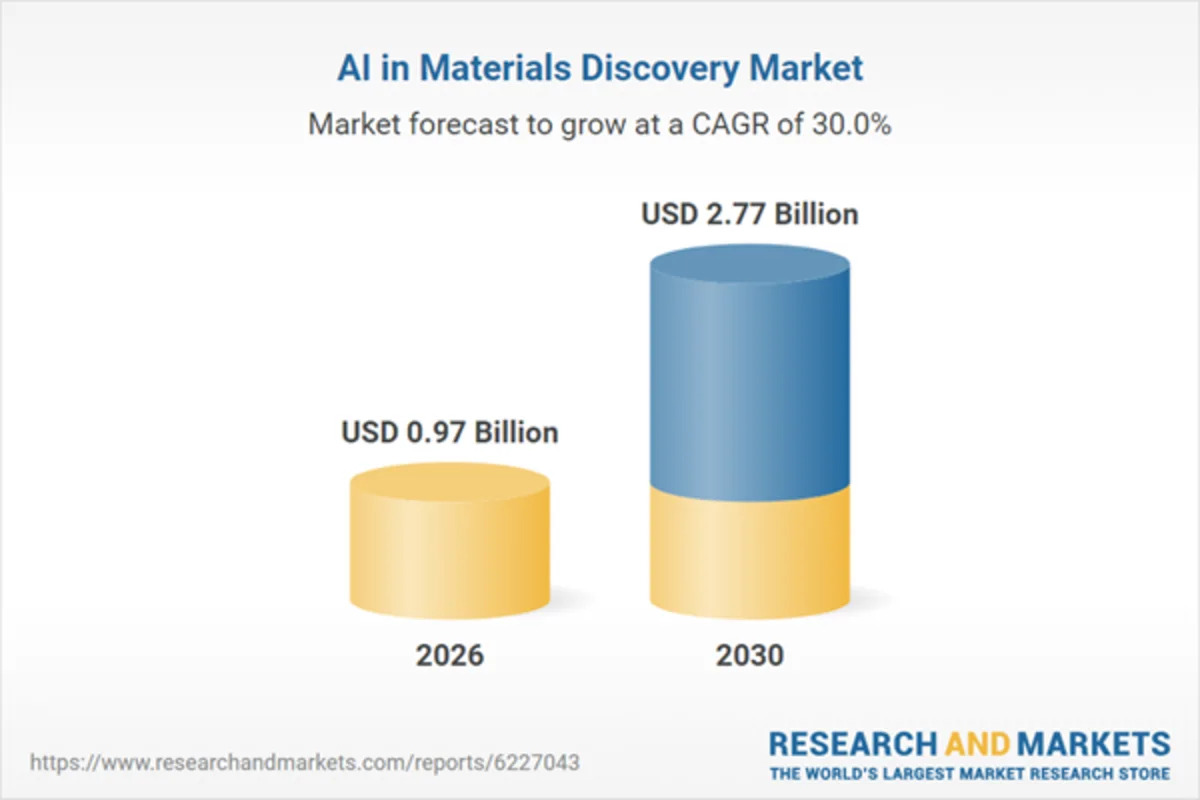
The artificial intelligence (AI) in materials discovery market is experiencing exponential growth, projected to increase from $0.74 billion in 2025 to $0.97 billion in 2026, with a compound annual growth rate (CAGR) of 30.3%. This growth is driven by the rising adoption of computational modeling, the availability of digital materials datasets, investment in AI-based research, the use of machine learning in laboratories, and industry-academia collaborations. Looking ahead, the market is estimated to reach $2.77 billion by 2030, maintaining a CAGR of 30%.
Factors fueling this anticipated growth include the urgent need for rapid discovery of advanced materials, demand for high-performance energy storage solutions, and adoption of generative AI models. Additionally, the deployment of cloud-based simulation platforms and pressure to shorten research and development cycles contribute to this trend. Key advancements expected include multimodal AI models, high-throughput computational screening, autonomous lab systems, and quantum-enhanced materials simulations.
AI-driven computational modeling and simulations are pivotal to market expansion. These technologies predict material properties, design compounds, and optimize structures, minimizing traditional experimentation. There is increasing pressure on research institutions to accelerate innovation and cut costs, which AI is helping to address by enabling high-throughput virtual screening and accurate property prediction. A prime example is Ames National Laboratory’s AI-based modeling, which achieved a 100x speed-up over traditional calculations, leading to the identification of new compounds.
Industry leaders are focusing on large-scale crystal structure prediction to expand chemical space and accelerate material identification. For instance, Google DeepMind’s GNoME system predicted 2.2 million new crystal structures, identifying 380,000 as potentially stable. This system employs graph neural networks and integrates active learning to refine predictions and validate structural stability, marking significant progress in computational materials discovery.
Story Continues