Enabling & Support
10/07/2026
8 views
0 likes
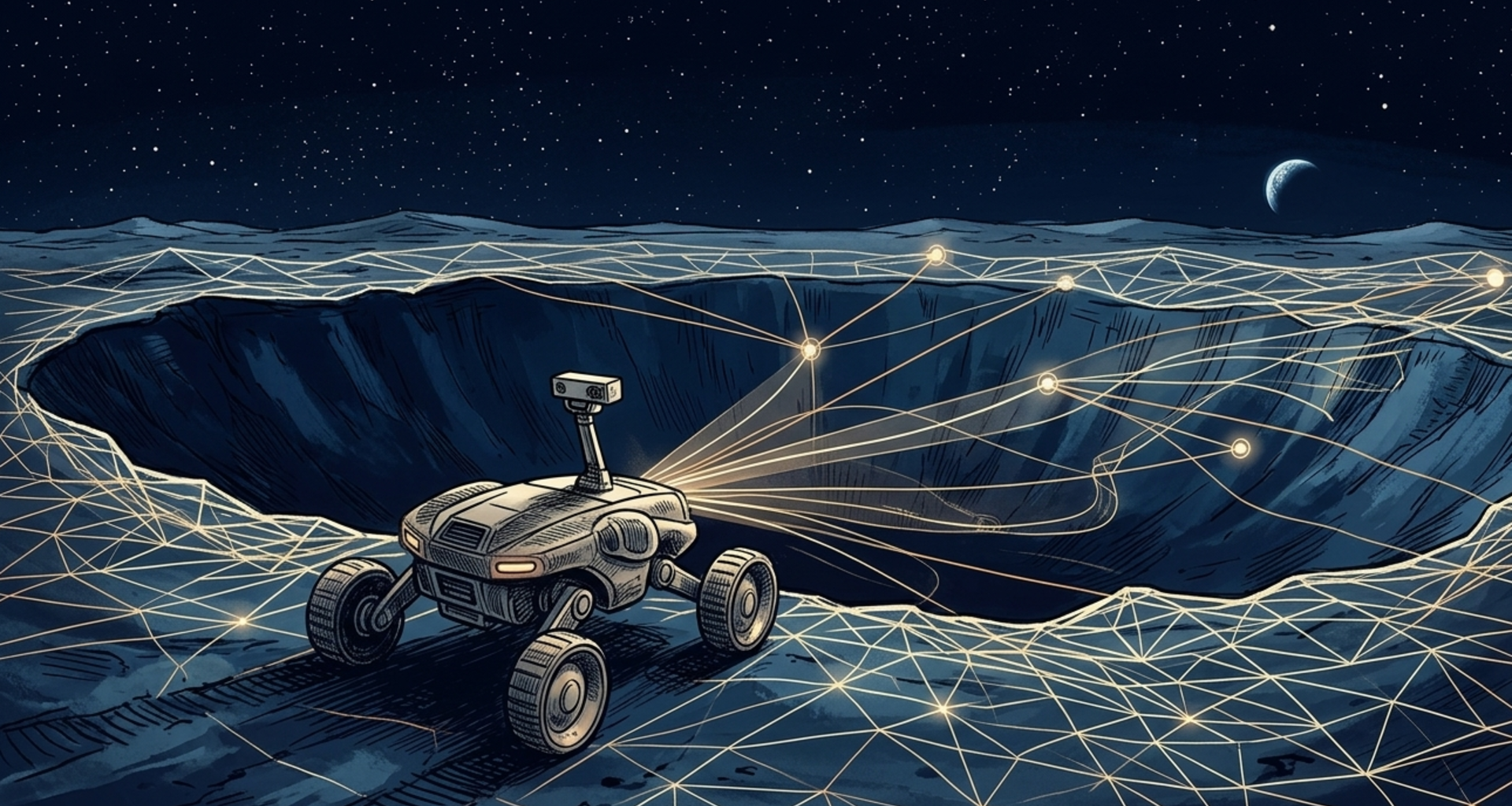
A rover exploring a permanently shadowed lunar crater cannot phone home for instructions – there is no signal to phone home on. It has to sense its surroundings, decide what to do, and act, all without a human in the loop. Today’s space robots are not built for that level of independence, and ESA’s new Embodied Intelligence for Autonomous Space Systems campaign is calling for ideas to change that.
Launched on 30 June 2026 through the Open Space Innovation Platform (OSIP), the campaign invites researchers and industry to submit early-stage concepts, feasibility studies, enabling technologies and mission concepts that bring embodied intelligence to autonomous space robotics.
Autonomy in space has, until now, largely meant automating individual functions. This campaign asks for something more ambitious: robotic systems in which perception, decision-making, control and adaptation are tightly integrated.
“Autonomy in space is not about adding more AI components to a robot,” says Lisa Denzer, AI-Lab Lead. “It’s about creating integrated systems that can understand their environment, make sound decisions and act efficiently within the tight constraints of space missions – from limited power and computing to restricted communications.”
The distinction matters because the environments ESA has in mind – permanently shadowed lunar craters, lava tubes, unstructured planetary terrain – often rule out teleoperation altogether. Communication latency, blackout windows and GNSS-denied conditions mean the robot itself must close the loop between what it senses and what it does.
The campaign targets three scenarios where this kind of autonomy is needed. The first is autonomous exploration: long-traverse science missions, surveys of permanently shadowed regions, and opportunistic science that requires a robot to spot something interesting and act on it without waiting for instructions. The second is fully autonomous in-situ resource utilisation (ISRU), covering everything from prospecting and excavating regolith to coordinating teams of specialised robots building surface infrastructure. The third is support for long-term human presence, where robots work alongside astronauts – inspecting habitats, maintaining life-support systems, and operating safely in close proximity to people.
To address these, ESA has identified two complementary approaches. The first, embodied co-design, jointly designs a robot’s body – its morphology, sensors and actuators – together with its ‘brain’, so that physical form and cognitive capability shape and enhance each other. The second, physical intelligence, pairs emerging robotic platforms with advanced AI techniques such as planetary foundation models, world models and multi-agent cooperative systems, giving robots the ability to reason about and adapt to unfamiliar environments.
“Through this campaign, ESA seeks to start laying the foundations for the new technologies required to realise the ESA Technology and Strategy 2040 vision,” says Luis Mansilla, AI System Engineer. “Achieving this ambitious vision demands equally ambitious technological advances that go beyond today’s isolated autonomous capabilities.”
The campaign follows a two-step process. Ideas submitted via OSIP are first evaluated on their innovation potential – how clearly they describe a new capability and how convincingly they go beyond what has already been published or demonstrated. The idea phase closes on 10 August 2026, with evaluation following later that month. Authors of retained ideas will then be invited to submit a full proposal, with proposal evaluation expected in October 2026.
From there, successful proposals can follow several implementation paths. Within ESA’s Discovery element, these include co-sponsored research (supporting PhD and postdoctoral work), studies of early-stage concepts, and early technology development up to Technology Readiness Level 4. Within the Preparation element, up to two parallel small system studies can be funded to take a mission concept through pre-Phase A analysis, each lasting no more than six months. All selected activities are expected to conclude around a common final presentation day in late 2027.
Orbital applications and function-level automation are out of scope, as are isolated AI components that are not clearly tied to a broader system-level architecture – ESA is looking for tightly integrated, system-level autonomy for lunar and planetary surface robotics, not standalone algorithms or in-orbit concepts.
Researchers and industry with ideas for embodied intelligence in space robotics can submit them via the Embodied Intelligence for Autonomous Space Systems campaign page on OSIP before the campaign closes on 10 August 2026.
“Our goal for this campaign is to lay the groundwork for intelligent, autonomous systems that will make Europe’s future exploration and resource-utilisation missions safer, smarter, and inherently sustainable,” says Jai Grover, Scientific Coordinator, Advanced Concepts Team at ESA.