Change was in the air before the start of 1971/72 season at Cappielow.
Morton had finished the previous First Division campaign in a very respectable eighth place, qualifying once more for the Texaco Cup tournament.
The squad had a good balance, with talented youngsters like George Anderson and Davie Hayes, and experienced campaigners including Joe Mason, Erik Sorensen and player-coach Bobby Collins.
However, both Collins and head coach Stuart Williams were moving on, Williams to Southampton, Collins to Melbourne, Australia with Ringwood City.
Chalmers (left) and Clark (second right) in action for Morton against Motherwell at Cappielow in April 1972. (Image: Contributed by Niall McGilp)
Hal Stewart produced a masterstroke by signing Celtic sweeper John Clark as player-coach in June 1971, followed soon afterwards by Stevie Chalmers, also in a dual playing and coaching role, in September.
Both were Parkhead legends, having won multiple trophies under Jock Stein. And in 1967, both had been part of the Lisbon Lions squad that had famously defeated Inter Milan in the Portuguese capital, becoming the first British club to win the European Cup.
Subsequently, their Celtic playing careers wound down, and in season 1970/71 they’d made only five appearances between them.
Chalmers’ most famous momoent came when he scored the winner against Inter Milan in the 1967 European Cup final. (Image: Contributed by Niall McGilp)
Clark was still only 30, an accomplished wing-half, having joined Celtic, aged 16, from Larkhall Thistle in 1957. He’d played more than 300 games, as well as being awarded four Scotland caps, making his debut against Brazil in 1966.
Chalmers was four years his senior. He’d also joined Celtic from the juniors – in his case, Ashfield – in 1959, aged 22.
He was an exciting attacking player and prolific goalscorer; in 413 games for Celtic, he’d scored 242 goals, including the winner against Inter Milan. Like Clark, he’d won Scotland caps, five in total, scoring three international goals, including Scotland’s first-minute strike in that Brazil match in 1966.
READ MORE:
The Greenock man who captained the USA to its greatest World Cup win – so far
The eight fraught months that came after Morton were put in administration
One of the most intriguing, confusing but entertaining signings Morton ever made
We look back to Morton’s Texaco Cup adventures against English greats in the 1970s
Look back to the Morton team who reached two cup finals during the Great War
A young George Anderson considered himself “lucky to play with these guys”, adding that “you couldn’t fail to learn from them.”
Clark made his Morton debut against Glentoran in a short pre-season tour of Northern Ireland, match reports stating “he had a good game”. He also featured against Leeds United at Cappielow in Bobby Collins’ testimonial game, the Telegraph confirming that “newcomer John Clark was a fair sweeper.”
Chalmers soon joined his former team-mate at Cappielow, making his debut against Falkirk on September 18. That was also Clark’s first league game for his new club after his recovery from a pre-season injury.
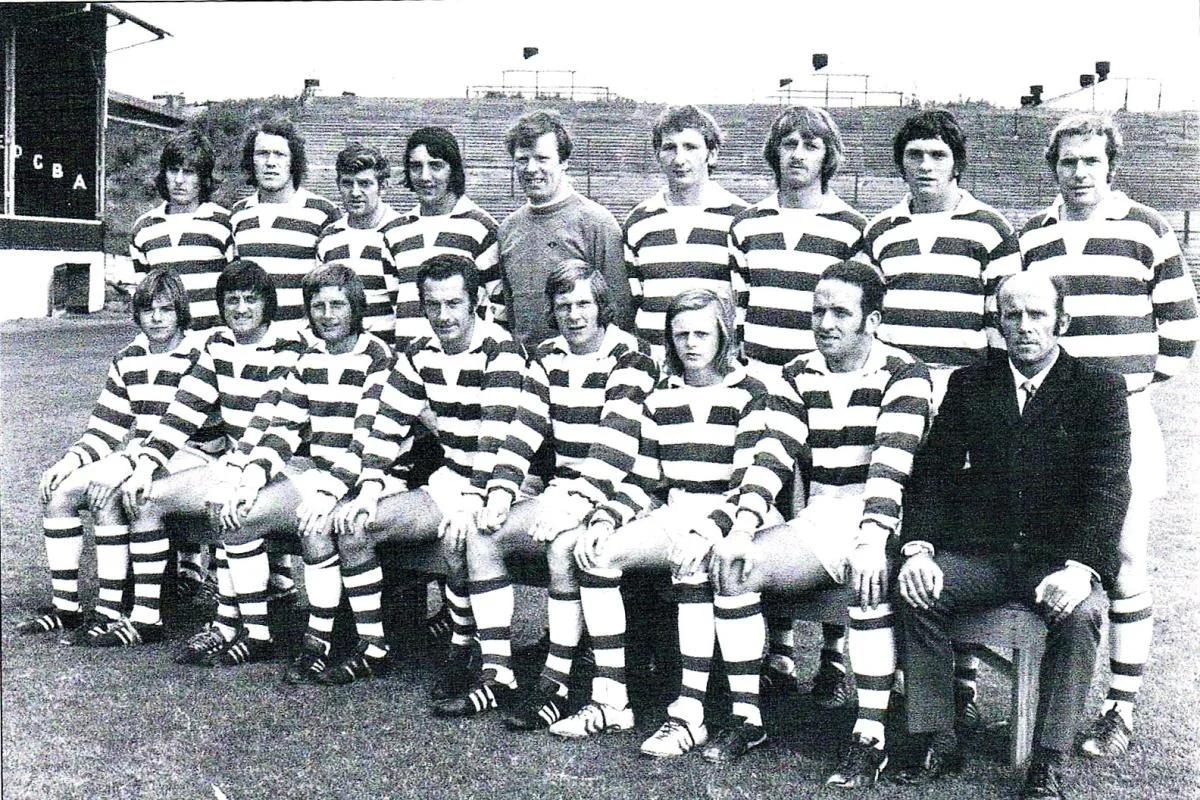
Chalmers and Clark in the Morton squad at the start of the 1972/73 campaign. (Image: Contributed by Niall McGilp)
The Telegraph’s reporter said Chalmers had made a ‘class debut’, adding that his skill produced clever intricacy, clever passing and good goals, giving Morton a memorable victory.
Clark also impressed; his league debut for Morton was excellent. He was tremendous under pressure and instilled confidence into his defensive colleagues.
A week later, the two ex-Celts lined up against their former club at Parkhead , wearing hoops of the blue and white variety. It was a tough afternoon, Celtic winning 3-1; for Clark there was disaster just before half-time, when Macari’s low cross spun off him, ending up in the net for an own goal.
Clark and Chalmers in action for Morton against their old club at Parkhead in 1971. (Image: Contributed by Niall McGilp)
Chalmers scored his first Morton goal later that month in a Texaco Cup tie against Huddersfield Town at Cappielow, watched by a 12,000 crowd. Sadly, it was little more than a consolation goal, Morton trailing 3-0 on aggregate at that point.
By March, with Morton struggling in the bottom half of the league, there was a welcome victory at Ibrox; trailing 1-0 at half time, Chalmers sparked the comeback with a 71st-minute goal, which he undoubtedly enjoyed, before Colin Jackson put through his own goal with just four minutes left.
The two player-coaches had added crucial quality and experience to the Morton side, Clark made 28 appearances, Chalmers 38, scoring eight goals.
Stevie Chalmers at Cappielow. (Image: Contributed by Niall McGilp)
However, moving into 1972/73, Morton appointed a new manager, Eric Smith returning to Cappielow, with Hal Stewart stepping back from management.
Initially, both players continued in their existing roles, but Chalmers opted to switch to Partick Thistle in October 1972, citing irritation with the daily commute to Cappielow.
His spell with Morton had been successful both as a coach and as a player, scoring 12 goals in 41 appearances.
READ MORE:
Few Morton games sparked as much controversy as this Cappielow clash with Rangers
The day more than 2,000 Morton fans were locked out of Cappielow promotion decider
The controversial clash 30 years ago that set up Morton for tilt at Premier promotion
We look back 18 years to the dramatic day Morton ensured First Division survival
The greatest day in Morton’s history recalled as we look back to 1922 cup final
He played on at Firhill for two more seasons, making a further 57 appearances, before retiring at the age of 38.
Inducted into the Scottish Football Hall of Fame in 2016, he passed away three years later at the age of 83.
Clark, meanwhile, continued as player-coach at Cappielow until the end of 1972/73 season, having racked up 64 Morton appearances.
John Clark during his Morton days. (Image: Contributed by Niall McGilp)
He returned to Parkhead as a youth coach, before joining Billy McNeill as assistant manager at Aberdeen and subsequently, once again, at Celtic.
He later managed Cowdenbeath, Stranraer and Clyde, finally returning to Celtic as long-serving kit man for almost two more decades.
Clark was inducted into the Scottish Football Hall of Fame in 2017; he passed away just last year, aged 84.
The duo were consummate professionals with Celtic and with Morton.