There’s no single formula for building a successful investment portfolio. Some investors favor dividend-paying companies, others focus on high-growth opportunities or undervalued stocks, while many rely on quantitative data to guide their decisions.

TipRanks Welcomes a New ETF – NYSE:RANK

That’s where TipRanks’ Smart Score comes in. The tool analyzes a wide range of market data and evaluates every publicly traded stock against factors that have historically been associated with future outperformance. Each stock is then assigned a score from 1 to 10, with a Perfect 10 indicating the strongest overall profile based on those metrics.

This screen has turned up two stocks that don’t often make headlines but have earned Perfect 10 Smart Scores. While the spotlight tends to shine on the biggest tech names, some of the market’s most compelling opportunities can be found beyond the mega-cap stocks.

It also doesn’t hurt that both under-the-radar names not only carry a Perfect 10 Smart Score but also have the backing of Wall Street analysts. Let’s see what makes them stand out.

CECO Environmental (CECO)

We’ll start in the world of environmental and industrial technologies, where CECO develops and builds out solutions that protect people, their industrial equipment, and the overall environment around the world. The company serves transitional markets – markets that are shifting to more environmentally conscious operations – in air, water, and energy industries. CECO has two primary business segments, Engineered Systems and Industrial Process Solutions.

CECO has built a widespread network, including some 25 facilities across the US and in 8 other countries, and employs over 1,600 people. On the engineered systems side, CECO meets the large demand for environmental and equipment protection in power generation work, in fuel refineries, and in the water and wastewater segments of the midstream oil and gas markets. The company’s array of emissions management, product recovery, and water and gas separation solutions is built to the highest engineering standards.

Turning to industrial process solutions, we find that CECO’s products and services are used in an even wider range of end markets. These include such fields as industrial air pollution control, fluid handling, electric vehicle production, semiconductor manufacturing, process filtration, petrochemicals, wastewater treatment, and the desalination and aquaculture markets. Working in these fields, CECO protects our air and water while also maintaining clean and safe worksites, lowering energy consumption, and minimizing generated waste. The company also helps its customers meet regulatory requirements and compliance standards for fumes, volatile organic compounds, odors, and other toxic emissions.

A look at CECO’s last quarterly report, for 1Q26, shows that the firm is on solid footing. CECO’s 1Q revenue, at $205.9 million, was up 17% from the prior year and was $7.04 million better than had been anticipated. The company realized a non-GAAP net income of $13.9 million, for a 297% increase year-over-year – and the non-GAAP EPS of $0.36 was 21 cents per share better than the forecast. Looking ahead, the company has a work backlog of $1.04 billion, up 72% from 1Q25.

However, the biggest recent development for CECO came on February 24, when the company unveiled its $2.2 billion acquisition of Thermon Group in a stock-and-cash deal. The transaction brings under CECO’s umbrella a global leader in industrial process heating solutions, significantly broadening its reach into mission-critical thermal management markets.

Investors initially weren’t convinced. To fund the deal, CECO paid $329.4 million in cash and issued 22.53 million new shares to Thermon shareholders, fueling concerns about shareholder dilution and the challenge of integrating a business of Thermon’s size. Those fears sent the stock tumbling in the days following the announcement. But as confidence in the strategic rationale has grown, so has the share price, with CECO not only recovering its losses but rebounding strongly in the months since.

That rebound is no coincidence, according to JPMorgan analyst Tomohiko Sano, who believes the acquisition meaningfully enhances CECO’s long-term prospects.

“A $1.0B backlog and $7B+ pipeline, paired with exposure to AI-driven data center power demand, electrification, and U.S. reshoring should support durable, multi-year growth. Thermon is transformative, lifting recurring short-cycle revenue to roughly 40% of the mix, effectively doubling adjusted EBITDA, and making CECO a ‘Rule of 30’ company with a path to ‘Rule of 40’ by 2027,” Sano opined.

“Over five years, CECO delivered stronger revenue growth than peers, while its EBITDA growth trailed only Power & Electrification. Adjusted free cash conversion also surpassed all groups. Although margins currently lag, we see a path to peer-group averages by 2028. Further, CECO’s share price performance YTD trails only its Electrification peers and comfortably exceeds Environmental & Filtration and Water Flow/Platform peers, reinforcing our view that CECO should trade closer to electrification peers,” the analyst added.

Put it all together, and Sano sees plenty to like. The analyst assigns an Overweight (i.e., Buy) rating on CECO and sets a $130 price target, implying the stock could climb 54% over the next 12 months. (To watch Sano’s track record, click here)

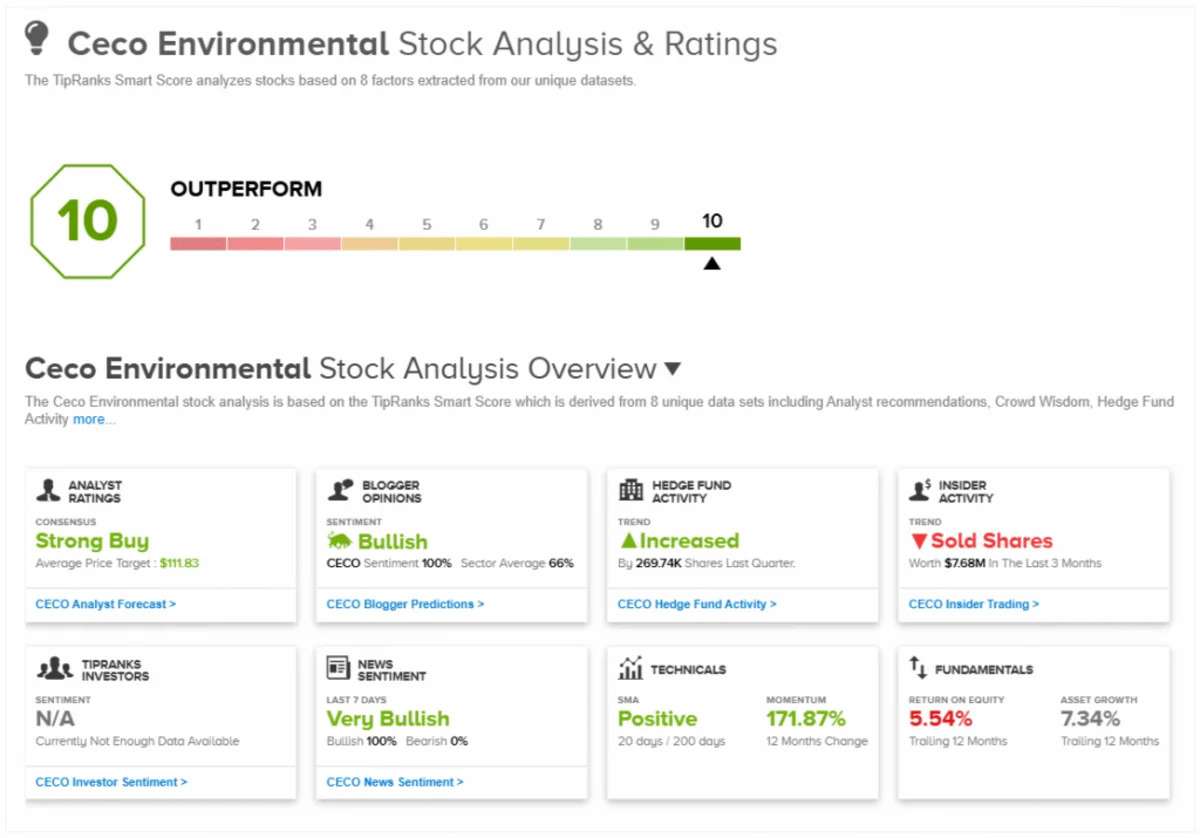
The rest of the Street isn’t arguing; all 6 recent analyst reviews on CECO are positive, giving the stock a unanimous Strong Buy consensus rating. At $83.63 per share, the $111.83 average price target points to ~34% upside over the coming year. Rounding out the bullish picture, CECO earnes a Perfect 10 Smart Score from TipRanks. (See CECO stock analysis)

Tapestry (TPR)

From environmental industry, we’ll shift gears and look at a leading luxury retailer. Tapestry, based out of New York City, is the holding company behind two well-known brands: Coach and Kate Spade. The company describes itself as a global house for iconic brands and boasts world-class capabilities to develop its workforce, grow its brands, and serve its customers and their communities.

Among Tapestry’s strengths are its deep pockets – the company has a market cap value of more than $28 billion – and its digital expertise. The company knows how to use them both to promote its brands and maintain a global reputation. Tapestry’s business strategy builds on innovation and craftsmanship to meet consumer demand so that customers can show their own styles and stories.

Tapestry has been making strides in its use of tech to manage the business and the customer base. Since 2022, the company has been using a proprietary AI platform, Mira, to improve trend analysis, track customer behavior, and inform its decision-making. In May of this year, Tapestry announced that it had received a US patent for the Mira platform, protecting its intellectual property in the tech, particularly the core system architecture.

This is an important step, as the tech helps the company reshape its customer base. In recent years, Tapestry has been actively pursuing younger customers in both Europe and China. Over the past two years, the company has noted a double-digit increase in its sales activity in China.

In its last quarterly report, covering fiscal 3Q26, Tapetry’s revenue came in at $1.92 billion. This figure was up 21% year-over-year and beat the forecast by $135.4 million. The company’s Coach brand was the revenue leader, with a 31% year-over-year gain. At its bottom line, Tapestry realized a non-GAAP EPS of $1.66, marking a 62% year-over-year gain and beating expectations by 36 cents per share.

Covering this retail leader for Morgan Stanley, analyst Alex Straton believes the market is still overlooking a key part of Tapestry’s growth story.

“Our Overweight view reflects our conviction that, while the market has largely priced in continued Coach North America strength, it continues to underestimate the long-term opportunity in Coach International. We believe international can become a key driver of growth, supporting a +HSD % TPR growth algorithm vs. the Street’s +MSD % expectation, & sustainable EPS power of ~$12+ vs. consensus closer to ~ $11. As Coach International continues to outperform, we expect a gradual positive earnings revision cycle that isn’t yet appreciated by the market, & for further valuation expansion despite TPR’s already-elevated multiple.”

Straton’s stated Overweight (i.e., Buy) rating supports her $164 price target, indicating that the shares have room to gain 16.5% over the next 12 months. (To watch Straton’s track record, click here)

Overall, TPR checks all the boxes; the stock has earned a Strong Buy consensus rating from Wall Street, with 14 Buys and just 1 Hold. At $140.73 per share, the average price target of $177.92 implies a 26% upside over the coming year. And, of course, it carries a ‘Perfect 10’ Smart Score from TipRanks. (See TPR stock analysis)

Disclaimer: The opinions expressed in this article are solely those of the featured analysts. The content is intended to be used for informational purposes only. It is very important to do your own analysis before making any investment.

Disclaimer & DisclosureReport an Issue