The ‘Day After’ the Truce: The Multinational Force for Ukraine
The Financial Engine of the New Common Defense
War of Attrition on the High Seas: Checking Russia’s ‘Shadow Fleet’
Maturity Forced by Circumstances
The military parade this July 14 in Paris was not a mere display of national sovereignty. With delegations from up to 35 countries in attendance, the event served as the visual manifestation of a profound paradigm shift: what is now formally referred to in Brussels and Strasbourg as Europe’s “strategic awakening.”
This doctrinal shift, accelerated following the recent NATO Summit in Ankara, marks a major turning point. For the first time in the Alliance’s history, all 32 partners have explicitly recognized the existence of a European defense pillar.

NATO Secretary General Mark Rutte, French President Emmanuel Macron, and Turkish President Tayyip Erdogan attend a summit of NATO leaders in Ankara, Turkey, on July 8, 2026 – REUTERS/ UMIT BEKTAS
Under the premise that a stronger Europe strengthens the overall structure of NATO, the continent has embarked on a process of assuming responsibility that seeks to balance the transatlantic scale once and for all.
This is not a decoupling from Washington, but rather an exercise in geopolitical realism: in the face of a Russia settled into a prolonged confrontation, Europe needs its own shield.
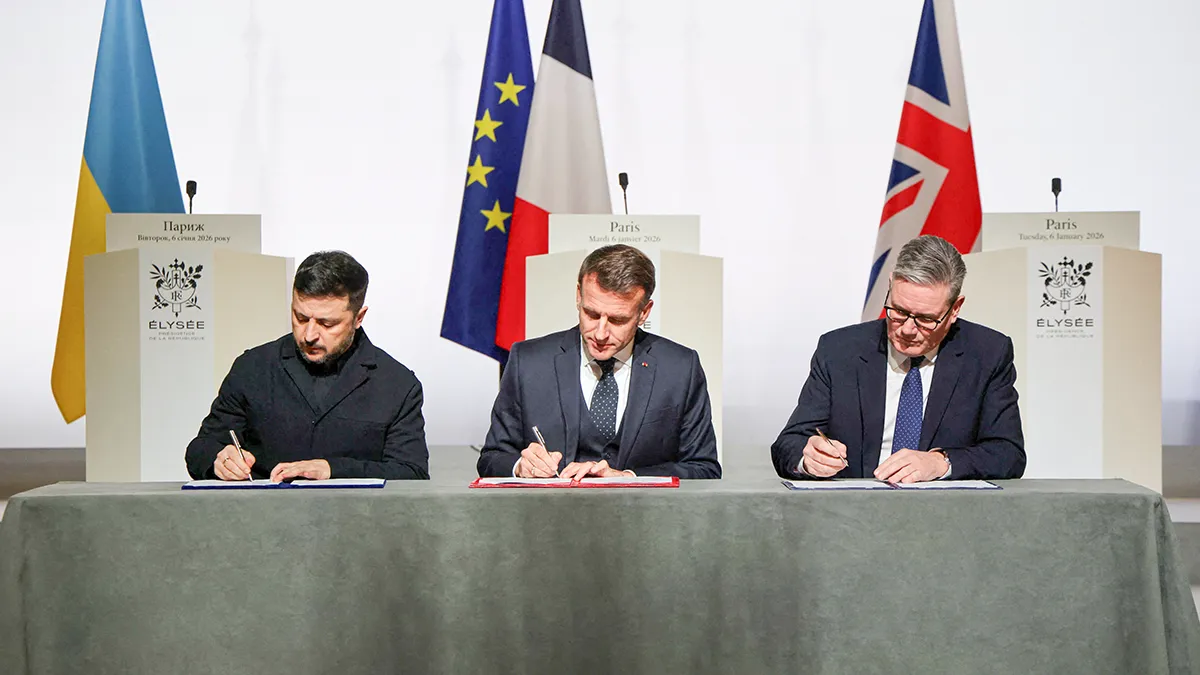
The ‘Day After’ the Truce: The Multinational Force for Ukraine
The architecture of this new security space is not limited to declarations of intent. The operational core of the strategy is concentrated in the so-called Coalition of Volunteers, a platform that already groups 35 states and is actively working on the post-conflict scenario.
The plan envisages the deployment of the Multinational Force for Ukraine (MNF-U), a joint military contingent designed to deploy on sea, land, and air as soon as a durable ceasefire is consolidated. Coordinated from an international headquarters, this force will act at Kyiv’s request to secure the stability of its borders.
To ensure this peace is not short-lived, the program relies on two fundamental pillars:
The REGEN plan: A comprehensive military regeneration program focused on rebuilding and modernizing Ukraine’s Armed Forces, providing them with autonomous deterrence capabilities against future Kremlin aggression.
The EUMAM mission: The European Union’s military assistance mission has already trained more than 93,000 Ukrainian soldiers, achieving significant milestones such as the complete training and equipping of the Anne de Kiev motorized brigade and advanced fighter pilot instruction.

President of Ukraine Volodymyr Zelensky (L) and President of France Emmanuel Macron (R) pose during a bilateral meeting on the sidelines of a European Council meeting gathering the 27 EU leaders in Brussels, Belgium, October 23, 2025 – PHOTO/ NICOLAS TUCAT via REUTERS
The Financial Engine of the New Common Defense
Strategic autonomy requires a financial mechanism capable of matching the challenge. In recent months, the European Union has transformed its military funding tools into a long-term structural support system.
In addition to the €12 billion already mobilized through the European Peace Facility, a qualitative leap in crisis management has now been introduced: utilizing the interest from frozen Russian assets for the direct purchase of heavy weaponry and ammunition, with tranches already executed exceeding €3.3 billion.
The consolidation of this financial model has been secured by the approval of an extraordinary loan of €90 billion by the EU for the 2026-2027 period. The most relevant aspect of this package is that two-thirds of the funds will be allocated to joint procurement under European preference criteria, a strategic move designed to revitalize and cohere the continent’s defense industry.

(From L to R) British Prime Minister Keir Starmer, Polish Prime Minister Donald Tusk, French President Emmanuel Macron, Italian Prime Minister Giorgia Meloni, and German CDU leader Friedrich Merz speak during a diplomatic meeting – PHOTO/French Presidency
War of Attrition on the High Seas: Checking Russia’s ‘Shadow Fleet’
The geopolitical struggle is not only being fought on land or in budget rooms; it has moved directly to maritime trade routes. Europe has decided to go on the legal and operational offensive against the “shadow fleet,” the network of unflagged or falsely flagged tankers that Moscow uses to bypass the international energy embargo and continue financing its war effort.
Backed by Article 110 of the United Nations Convention on the Law of the Sea (UNCLOS), European military vessels and missions such as the naval operation IRINI have begun conducting systematic boarding operations. Recent interceptions of tankers linked to this network — such as the Boracay, the Nelsa, or the Oneiroi — prove that the Baltic Sea, the English Channel, and the Mediterranean are no longer safe zones for Russian smuggling.
This constant pressure is suffocating the Kremlin’s logistics across multiple fronts:
Russian Navy attrition: To protect its exports, Moscow is being forced to military-escort its tankers in European waters, diverting warships from other critical fronts.
Costly evasion routes: Vessels in the shadow fleet avoid tight control zones, lengthening transport routes and sending freight costs skyrocketing.
Surplus private security costs: The need to board militarized security teams (linked to firms like Morane Security Group) significantly increases the operational costs of each voyage.

The Russian Navy features nuclear-powered attack submarines such as those of the Yasen class (project 885) shown at the 2023 naval parade in the major base of Kronstadt, near Saint Petersburg – PHOTO/Kremlin
Maturity Forced by Circumstances
The convergence of economic pressure at sea, billion-dollar investments in the defense industry, and military force planning for the post-war scenario paints a clear picture. Europe seems to have understood that the best way to preserve the transatlantic relationship is not through submission, but utility.
By presenting itself as a partner capable of securing its own geographical space and suffocating its adversary’s funding avenues, the continent not only shields its immediate security but also claims its place as a top-tier geopolitical actor in the new international order.