
The Houthis Strike Saudi Arabia and Threaten the Skies: The Second Chokepoint, Bab el-Mandeb
The UK Changes Pilots: Burnham on His Way to Downing Street
Brief Introduction
The world wakes up, once again, with the Strait of Hormuz turned into a powder keg and the Persian Gulf as the epicenter of a crisis that has long ceased to be regional to become global. We are witnessing yet another violation of the Memorandum of Understanding between Washington and Tehran — which I call the Islamabad Memorandum in these reports — by the Iranian Revolutionary Guard. This is not an isolated incident or a nautical misunderstanding: it is a deliberate, calculated, and brutal message. Behind it stands General Ahmed Vahidi, commander-in-chief of the Islamic Revolutionary Guard Corps (IRGC), a wanted terrorist pursued internationally by Interpol for various terrorist attacks over three decades. Vahidi is tightening the rope to send a clear message to his adversaries within the regime.
We must call things by their real names: this is clearly an internal struggle for power. This is the sole reason why Mojtaba Khamenei, the son of the late Supreme Leader Ali Khamenei, is nowhere to be seen. Seriously injured, he is nothing more than a puppet in the hands of the most brutal faction of the regime. The Revolutionary Guard fears that his physical incapacity will trigger the election of a new leader from an opposing faction, stripping them of their current influence.
To this is added the reopening of the Houthi-Saudi front, with massive attacks by the Houthi terrorist militia against Saudi Arabia and their threat to international airlines against overflying Saudi airspace. Whoever controls the coast dominating the Bab el-Mandeb Strait holds one of the main arteries of global commerce. If the ayatollahs are allowed to control Hormuz, they will control the Middle East once more.
While the Gulf burns, the United Kingdom prepares to change pilots in the middle of a storm: Andy Burnham has secured the Labour leadership and is headed to Downing Street. Three stories, one common thread: a lack of leadership in a West that too often buries its head in the sand like an ostrich.
Hormuz, on Fire Again: The Umpteenth Violation of the Memorandum and the IRGC’s Internal Power Struggle
Facts
The United States executed a third consecutive night of strikes against Iran (July 12-13) in response to new IRGC aggressions against merchant vessels in the Strait of Hormuz. According to the United Arab Emirates (UAE), Iranian cruise missiles hit two Emirati tankers, the Mombasa and the Al Bahiyah. The IRGC claimed it disabled two “violating tankers” for ignoring warnings.
President Trump reinstated the blockade on Iranian shipping and proclaimed the US as the “Guardian of the Strait of Hormuz,” demanding a 20% transit fee on all cargo. Iranian Foreign Minister Abbas Araghchi responded that Iran is the guardian of the strait “forever.” The International Maritime Organization (IMO) flatly rejected any tolls.
Tehran struck US assets in Kuwait and Jordan. Internally, Mojtaba Khamenei has not appeared in public since February 28, and the Institute for the Study of War (ISW) documented on April 21 the split between Vahidi, who opposes negotiations, and Parliament Speaker Mohammad Bagher Ghalibaf, who favors dialogue.

Drone view of anchored vessels in the Strait of Hormuz, seen from Musandam, Oman, May 25, 2026 – PHOTO/ REUTERS
Implications
This makes sense under the decapitation paradox: Vahidi is now the de facto primus inter pares of the Revolutionary Guard triumvirate, but his dominance rests on fear, not on institutional or religious authority. The ships attacked are those refusing to pay the regime’s terrorist extortion. This racketeering is designed to fund their military nuclear program, hypersonic ballistic missiles, and regional terrorist proxies: Hamas, Hezbollah, and the Houthi militia, which uses Iranian-made weaponry.

New Iranian supreme leader Mojtaba Khamenei shown on a screen in Tehran, Iran, March 9, 2026 – Majid Asgaripour/WANA/Via Reuters
Perspectives and Scenarios
Scenario A (35%) — Negotiated containment. A fragile ceasefire is restored under US military pressure; Hormuz remains semi-open.
Scenario B (40%) — Persistent, contained systemic fracture. Attack-and-retaliation cycles over months. This is the most likely outcome, serving Vahidi’s consolidation interests.
Scenario C (25%) — Major escalation. A high-casualty incident triggers a wider US campaign, without any post-collapse plan.
The Houthis Strike Saudi Arabia and Threaten the Skies: The Second Chokepoint, Bab el-Mandeb
Facts
On July 13, the Houthi terrorist militia targeted Abha International Airport in southwestern Saudi Arabia with ballistic missiles and drones, which were intercepted. Houthi military spokesman Yahya Saree warned global airlines against overflying Saudi airspace.
Implications
The Houthis control the coast of the Bab el-Mandeb Strait, the gateway to the Suez Canal. We face a simultaneous double-strait chokepoint: Hormuz and Bab el-Mandeb, with Tehran pulling the strings.
Perspectives and Scenarios
Scenario A (35%) — Mediation via Oman to restore a tense calm.
Scenario B (40%) — Low-resolution, high-destruction maritime conflict in the Red Sea, driving up global shipping rates.
Scenario C (25%) — Full reactivation of the Yemen war following a serious strike on Saudi soil.
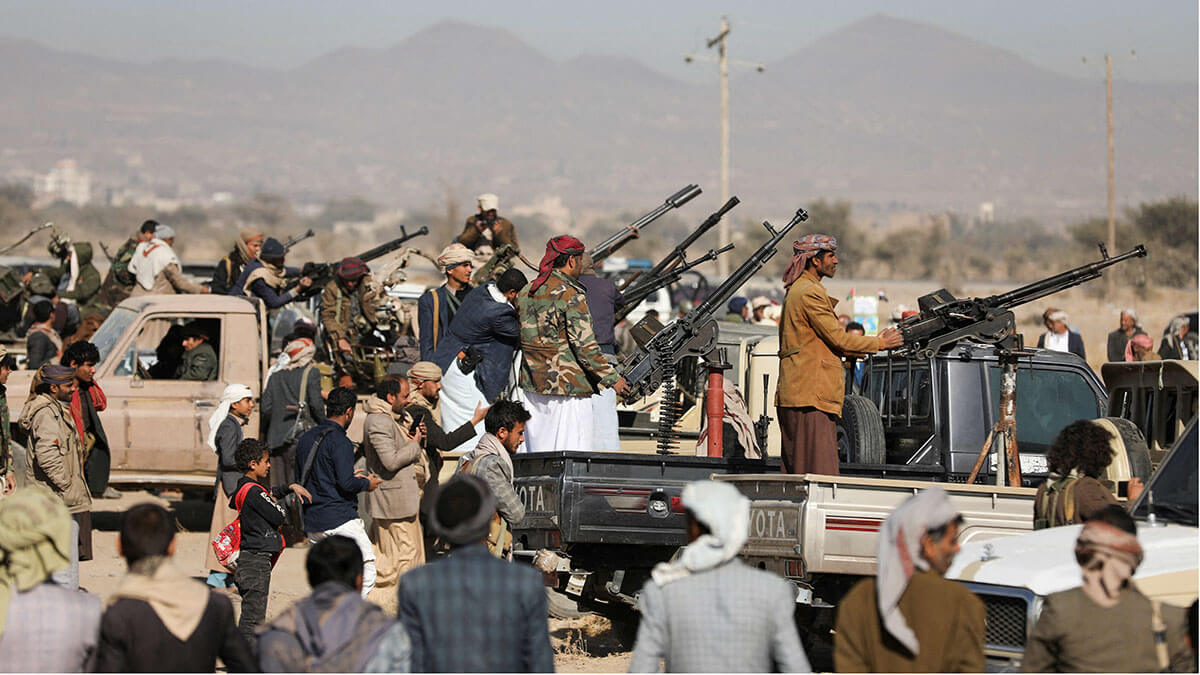
Houthi-aligned armed tribesmen near Sanaa, Yemen – REUTERS/KHALED ABDULLAH
The UK Changes Pilots: Burnham on His Way to Downing Street
Facts
Andy Burnham, the former Mayor of Greater Chancellor, has secured the Labour Party leadership. He will be proclaimed leader on July 17 and sworn in as Prime Minister of the United Kingdom on July 20, 2026.
Implications
It remains to be seen whether Burnham has a structured roadmap to pull the UK out of its deep economic, social, and political crisis after consecutive ineffective administrations.
Perspectives and Scenarios
Scenario A (30%) — Confidence bounce. Burnham presents a credible economic plan, reassuring markets.
Scenario B (40%) — Brief honeymoon followed by quick wear-and-tear against fiscal realities.
Scenario C (30%) — Drift accelerating the rise of Nigel Farage.

Andy Burnham walking at Manchester Piccadilly station en route to London, June 22, 2026 – REUTERS/ TEMILADE ADELAJA
It is unacceptable for European nations to deny US military aircraft overflight rights. The attacks by the Iranian regime and the Houthis require a unified Western response, to be brought before the UN Security Council. Tactically, the military deployment of A-10s and Apache helicopters was a success (scored 10), but undermined by a premature political truce (scored 0). The strategic sanity of US Secretary of State Marco Rubio must prevail against Tehran’s State terrorism.