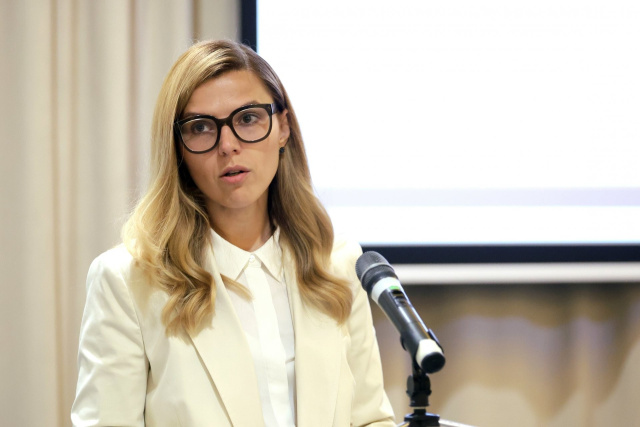
Bulgaria will continue to view the European Union and NATO as the most suitable framework for protecting its national interests and will not accept a world based on spheres of influence or the use of force to redraw borders, Foreign Minister Velislava Petrova said at the opening of the Annual Conference of Bulgarian Ambassadors Extraordinary and Plenipotentiary and Permanent Representatives in Sofia.
Petrova said the government had received a clear mandate from Bulgarian citizens to end a period of uncertainty, move away from externally influenced foreign policy decisions and present the country as a reliable international partner. “Bulgaria must defend its own national interests, while at the same time sharing the values and contributing to the alliances of which it is part,” she said.
According to the foreign minister, Bulgaria’s international partners have already recognized the government as a stable interlocutor capable of developing long-term cooperation. She stressed that the country has the potential to contribute to security in Southeast Europe, regional energy and transport connectivity, the protection of the European Union’s external borders, and broader European efforts to strengthen its role on the global stage.
Petrova warned that the current generation is unlikely to experience the same level of stability and predictability that characterized previous decades. “It seems that our generation will not have the luxury of living in a world with clearly defined camps and common interests,” she said, describing today’s international environment as increasingly unstable, turbulent and multipolar.
The minister argued that global affairs are increasingly shaped by the logic of power rather than diplomacy and cooperation. In this context, she highlighted the importance of diplomacy as a tool for achieving practical results, including attracting investment, improving Bulgaria’s competitiveness and strengthening the country’s international position.
Among the government’s foreign policy priorities, Petrova pointed to the protection of the rights of both historical and modern Bulgarian communities abroad, as well as improving consular services. “Our duty is to create conditions for everyone who wishes to return to their homeland,” she said.
She also identified cultural diplomacy as another area that requires further development and thanked Bulgarian diplomats for their efforts to protect and promote the country’s interests around the world.
Petrova also addressed long-standing issues within the Ministry of Foreign Affairs, including financial limitations and staffing concerns. She acknowledged that years of accumulated problems cannot be resolved immediately, especially under conditions of fiscal pressure, but said the government was aware of the concerns of diplomatic employees.
“The most valuable asset of the Ministry of Foreign Affairs is its people. We are committed to gradually overcoming these problems within the framework of the upcoming regular annual budgets,” Petrova said.
The foreign policy direction of the government has sparked public debate, particularly regarding Bulgaria’s position on the war in Ukraine and the balance between pro-European commitments and domestic political expectations. Analysts said the cabinet has been sending mixed signals, with some questioning whether the government is trying to satisfy both pro-Western and more Russia-oriented voters.
Journalist Ruja Raicheva argued on Nova TV that recent decisions had created difficulties mainly on the domestic political level rather than internationally. According to her, the government’s approach has caused uncertainty among voters who supported President Rumen Radev because they are unsure how he balances his previous positions with Bulgaria’s commitments to Western alliances.
“The ambiguity is beginning to irritate some people,” Raicheva said, adding that opposition parties are attempting to use the situation to their advantage.
Darik Radio journalist Bozhidar Rusev said the government appears to be searching for a middle ground. He noted that even political observers have difficulty determining the exact foreign policy direction of Prime Minister Radev.
According to Rusev, the government is currently avoiding decisions that would alienate either side of the political spectrum. He said pro-Russian voters see that Bulgaria does not want to participate in certain military initiatives, while pro-European voters point to Petrova’s participation in support of Ukraine-related diplomatic efforts.
Journalist Plamena Ignatova from Club Z compared Bulgaria’s foreign policy signals to a vehicle using both left and right turn indicators at the same time, leaving European partners uncertain about the country’s intended direction. She said contradictions had accumulated in Bulgaria’s approach toward Ukraine from the beginning.
Raicheva said the mixed messages make Bulgaria appear hesitant rather than influential. She also expressed doubts that Petrova would be replaced as foreign minister, describing her political position as unstable.
Rusev suggested that if another figure with a stronger ideological profile had occupied the foreign ministry post, Bulgaria’s foreign policy messages would have been significantly different. Ignatova argued that such a change could have led to a sharp shift in one direction, while Rusev said avoiding such polarization was likely one of the government’s objectives.
The analysts also discussed the recent visit of former Interior Minister Ivan Demerdzhiev to the United States. Raicheva said she hoped the trip would lead to concrete results and questioned the effectiveness of previous sanctions linked to the Magnitsky framework.
Rusev said he expected clearer actions against what he described as the “Borisov-Peevski model,” while Ignatova suggested the visit could mainly result in an exchange of information between institutions.
Raicheva stressed that Boyko Borissov and Delyan Peevski should be considered separately, saying that measures appear to be focused more heavily on Peevski than on the GERB leader. Ignatova and Rusev agreed with this assessment, with Ignatova adding that Borisov understands he is unlikely to return to power and that political forces are beginning to prepare alternatives to the current government.
International analyst Vladimir Vladimirov said the foreign minister’s main responsibility is to represent Bulgaria internationally and noted that Petrova’s name appears in the Kyiv Declaration. He argued that there is no indication Bulgaria has withdrawn its support and warned against using foreign policy disputes for domestic political battles.
Journalist Valery Todorov also said Petrova’s presence in the declaration demonstrates that Bulgaria remains committed to the agreement. He explained that such documents are coordinated in advance and argued that claims of a possible foreign policy reversal are largely part of domestic political disputes.
Todorov noted that Bulgaria’s decision not to participate in certain military aspects of international agreements reflects a selective approach based on the country’s capabilities rather than a rejection of its commitments. “We do not have to say yes to everything,” he said.
Vladimirov said Bulgaria’s signals are being closely monitored by its EU and NATO partners and that some reactions have already been negative. He emphasized that Europe remains united regarding support for Ukraine.
Todorov added that Bulgaria has already chosen its strategic partners and alliances, and that individual decisions would not fundamentally change this position.
Vladimirov said negotiations aimed at ending the war in Ukraine could become more likely in the coming months, while Todorov pointed out that both Russia and Ukraine are facing internal political pressures related to the conflict.