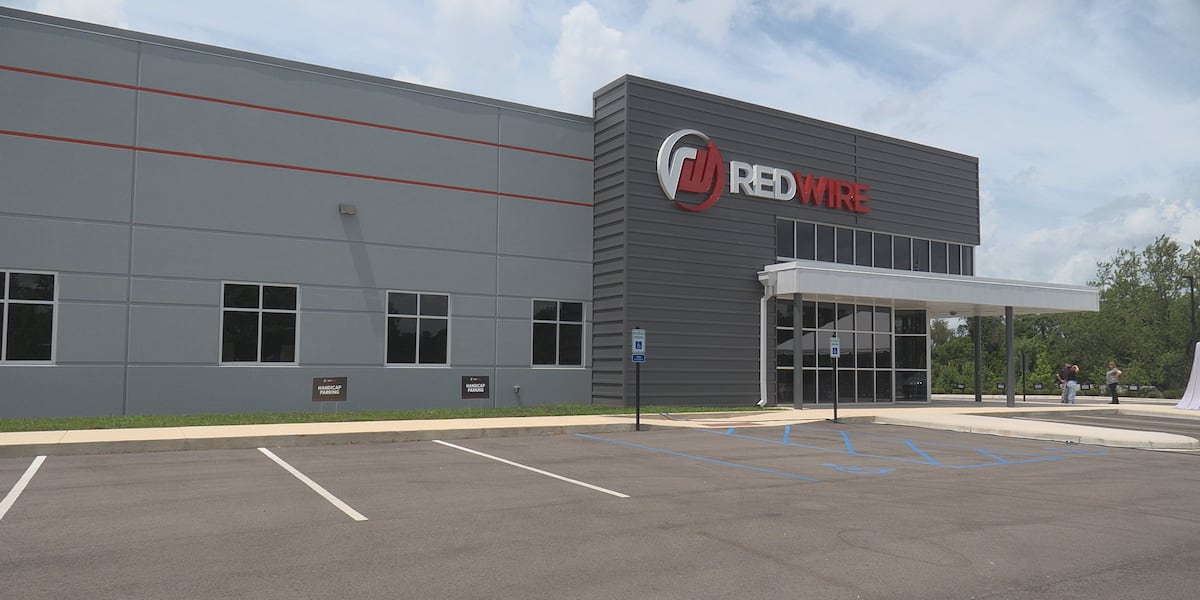
GEORGETOWN, Ind. (WAVE) – After more than two years of construction, Redwire’s new research and manufacturing facility is now officially open in Georgetown, Indiana.
Redwire leaders, former astronauts and Indiana Governor Mike Braun all marked the occasion on Monday.
The 30,000-square-foot facility is home to a new age of space exploration right in the heart of Southern Indiana.
Inside the building, scientists and engineers are developing technology that will make it easier for astronauts to maintain muscle mass and bone density in space and support the future of commercial space stations. They’re also helping with pharmaceutical research that is done up in space, and then taken back to earth to help humans.
For example, a Redwire bio-printer that is is up on the International Space Station is helping create blood vessels. The hope is one day a whole organ could be made in space using someone’s own stem cells and then transplanted into a human back on Earth.
It begs the question, why does an organ need to be bio printed in space?
Well the answer seems to be simple.
“If you tried to print on earth, without adding any kind of thickeners or any kind of chemistry like that, everything would settle out, the heavy cells would be not where you wanted them.” Rich Boling, Senior Vice President with Redwire explained. “In space, we print with only bio-inks because it’s a bio printer, everything stays exactly where you put it nothing settles out, but if you just brought it right back down to earth no benefit it would just flatten out.”
Boling went on to explain that they have experimented and and found a minimum two weeks of culturing and conditioning in space is needed, where the organ can withstand gravity and can then get sent back to Earth.
Other pharmaceutical research the company is doing, aims to have an impact on diabetes and cancer treatment.
Executive Vice President, John Vellinger, also commented on the innovation.
“A lot of times the pharmaceutical industry has drugs that don’t ever make it to market that could be utilized for a lot of these radical diseases and so by coming up with a new crystal structure in space we can help them develop new drugs.”
About four or five times a year, the company sends their products from Indiana, down to Florida and loads them onto manned and unmanned trips to the International Space Station. In their new building, the mission control room has grown in size.
“We are able to talk directly with the astronauts who are conducting our experiments, and so it’s super exciting because we get to help them optimize their time and say ‘no, no you need to activate the button to the right not the one to the left,’” He said. “It helps the crew optimize our experiments more efficiently, but it’s so cool because you’re talking live to space from right here in Georgetown, Indiana,”
Among other things they’re researching, scientists are looking for ways to sustain life in space by figuring out how to grow food and how to supply energy.
Vellinger said the possibilities are endless.
“Reach for your dreams, reach for the stars, don’t ever give up,”
With the opening of the new building, it puts Indiana’s role in space exploration back in the spotlight. Several astronauts were born in the state, others like Neil Armstrong graduated from Purdue University.
Gus Grissom, from Mitchell, Ind. was one of NASA’s original seven astronauts.
Grissom tragically passed away in a fire in an Apollo 1 pre-launch test in 1967. But retired astronauts, Charles Walker and Ken Bowersox, fellow Hoosiers, draw their inspiration from Grissom. Walker flew on three space shuttle missions, Bowersox on four.
“It was in my ear and my eyes while I was growing up the whole time, reading about him hearing about him and it’s the beginning of the space age,” Walker said.
Bowersox moved to Southern Indiana as a young boy and also remembers learning about Grissom and being inspired.
“I remember thinking well if a kid from right down the street in Mitchell, Indiana could go into space and a guy like Charlie Walker could be an astronaut, well maybe I have a chance too.” Bowersox added.
The two made the trip to Georgetown to mark the exciting occasion on Monday, where the energy surrounding the opening was filled with hope and optimism for the future.
“Southern Indiana had a foothold at the beginning of the space age and now here with Redwire it’s back here in a bigger and better way.”
Redwire’s next launch to the International Space Station is expected in September.
For more information, click or tap here.
Copyright 2026 WAVE. All rights reserved.