
The first thing people do when they walk into Batya Vintage House isn’t shop.
They take a deep breath and exhale.
Some wander slowly from shelf to shelf, running their fingers over painted ceramics, old books, weathered maps and forgotten treasures. Others stop in the doorway, smiling with the unmistakable look of someone who has just stumbled into a memory.
“It’s like my grandmother’s house,” they’ll tell owner Batya Ezri.
For Ezri, that reaction is the entire point.
Tucked in the center of Jerusalem on Shlomzion HaMalka Street, Ezri’s colorful shop feels less like an antique store and more like a living room assembled from generations of stories.
There is always good music playing — Ella Fitzgerald, Nina Simone, Joan Baez — a table where visitors are invited to sit, and shelves crowded with objects that seem to have arrived from a dozen different lifetimes. Unlike many antique shops, which can feel heavy with history, Batya Vintage House is bright, welcoming and full of conversation.
“I don’t think people come here only to buy,” Ezri says. “They come to feel.”
WATCH this week’s Peoples of Israel here:
That relationship with the past began long before she opened the shop.
Ezri’s parents owned an antique store in the very same space during the 1980s, specializing in Persian art and jewelry. Before she was even old enough to start school, Ezri spent her days climbing the stairs, examining objects in display cases and accompanying her father to flea markets.
“At Jaffa flea market, everyone knew my dad, and he knew everyone. So, he’d walk around between the stalls, and I would wander by myself looking for things,” says Ezri. “I remember one day I found a small sculpture of a girl spreading her hands as wide as possible. Written on the statue was the sentence ‘I love you this much.’ I bought this statue knowing that I would give it to the woman I would marry one day. I’ve had it almost 30 years. It’s still with me.”
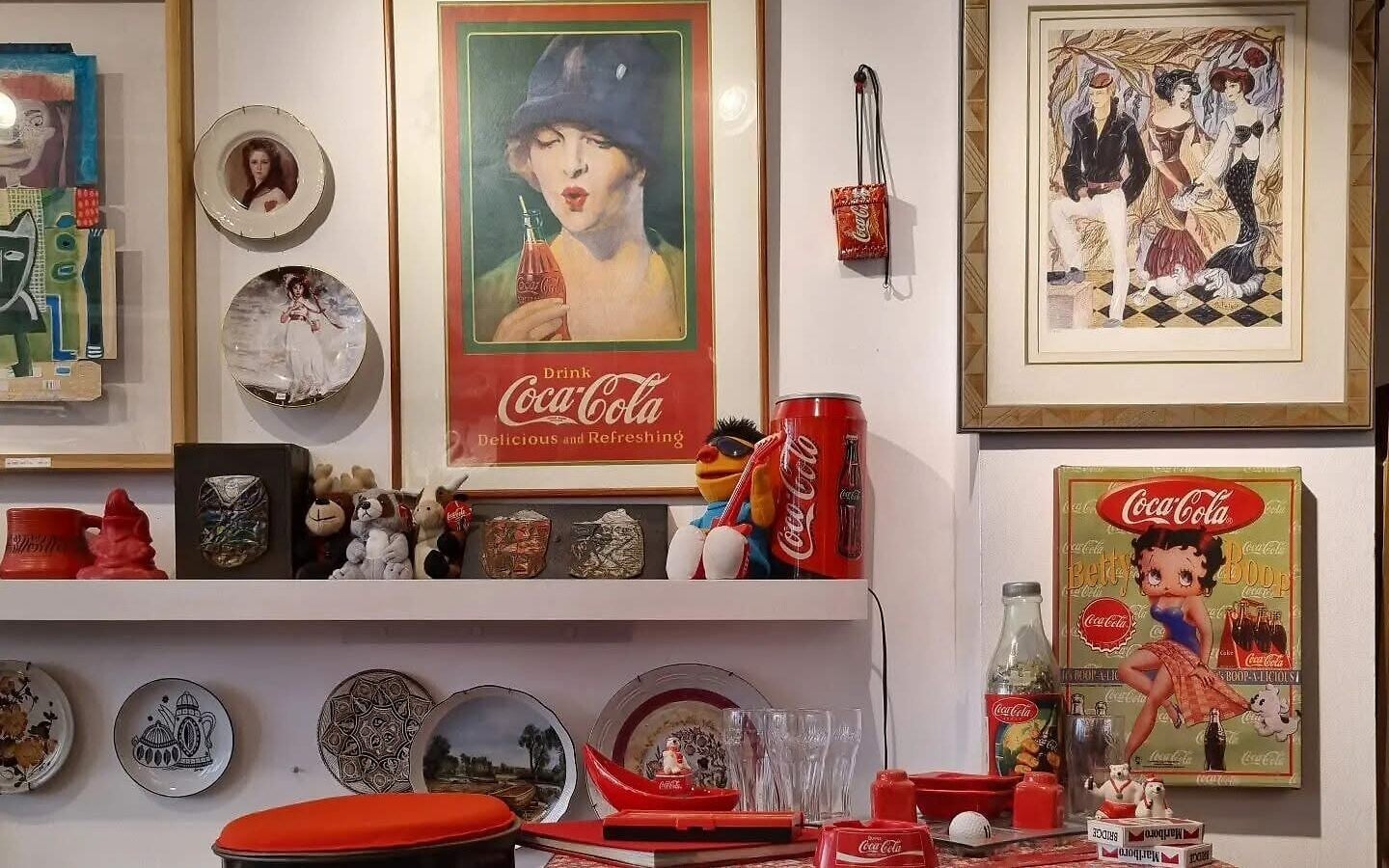
A colorful wall in Batya’s Vintage House, 2025 (Courtesy)
Ezri says she used to sit with her brother and father going through old art auction catalogs. Some of her fondest childhood memories are of turning the pages one by one, enchanted by the art and learning about it.
For years, she filled her own home with vintage treasures but never imagined turning her passion into a profession.
That changed during the coronavirus pandemic.
After nearly a decade living in Tel Aviv, Ezri returned to Jerusalem, uncertain about what came next. She found herself unemployed for almost a year and weighed down by uncertainty. At the same time, the family storefront sat empty after its previous tenant left.
“It was my mother’s idea to open a new store in the old location,” she says. “And all the stars aligned.”
Ezri filled the space with pieces from her own collection, adding items inherited from her parents as well as discoveries from flea markets, private homes and collectors who now seek her out. Alongside vintage objects, she brings years of experience working in her brother’s art gallery, giving Israeli art a prominent place among the eclectic mix.
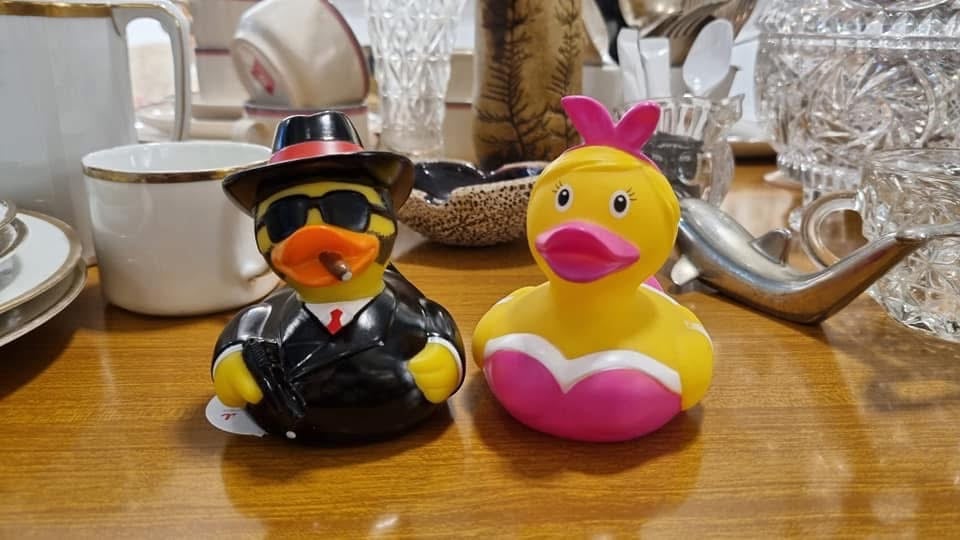
Rubber Duckies at Batya’s Vintage House add a whimsical touch, 2026 (Courtesy)
The store specializes primarily in vintage pieces — roughly 30 to 100 years old — rather than formal antiques, giving it a lighter, more playful atmosphere filled with colorful ceramics, artwork, glassware and furniture.
More importantly, Ezri believes these objects preserve something increasingly rare.
“Today everything is manufactured,” she says. “Thousands of the same cups. Millions of the same plates. Here you can hold something and see the hand that painted it.”
“I’m not the best salesperson,” she says. “People come in and say, ‘Can I just look?’ Of course you can. You can look, smell, touch. You don’t have to buy anything.”
Among her favorite discoveries are centuries-old books and maps that reveal how borders, place names and political realities have shifted over time. One of her prized possessions is a 350-year-old medical text documenting remedies from long before the era of modern hospitals.
“I wasn’t very good at history in school,” she admits. “Now I feel like I’m learning history every day.”
Ezri says she’d especially love to visit the early 18th century, because she’d love to see the world before so many of the modern narratives took shape. “But I don’t really need a time machine,” she says, because each object on her shelves offers a doorway into another era, and the feelings that come with it.
Visitors arrive from across Jerusalem, throughout Israel and around the world. Australians, Americans, South Africans, Brazilians and Europeans wander through the shop, many becoming friends who still send her “Shabbat shalom” messages years after their first visit.
“It doesn’t feel like work,” she says. “People come to see me. It’s like I’m going out with my friends every day.”
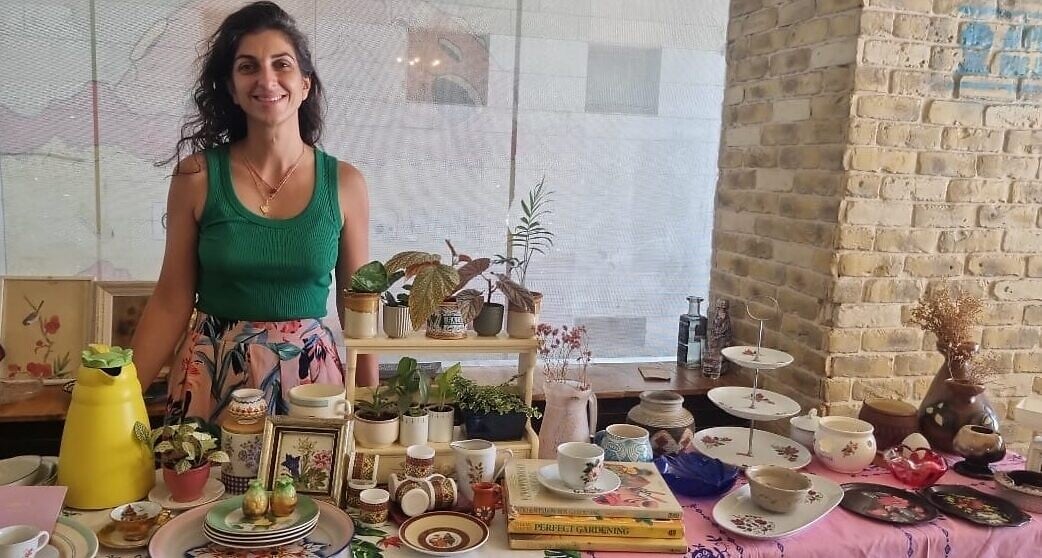
Batya ‘Betty’ Ezri stands in front of an array of vintage items, 2026 (Courtesy)
During our interview, several people came in just to say hello, including a mother and her teenage son.
“I’m teaching my son how to interact in a store,” the mother tells Ezri. “Could we look around?
Ezri welcomes them with a warm smile.
“I like that one,” the teenager says, pointing to a cherry red dinner plate straight out of my childhood kitchen in the 1980s.
“You can hold it!” Ezri replies. “Everything here was once used and is meant to be used again!”
We can’t do this work alone.

The war with Iran has been draining for all of us in Israel. But when I heard about a high casualty incident – ballistic missile impacts in Arad and Dimona that left nearly 200 people wounded – I drank a cup of coffee, packed a bag, and headed south.
There, I spoke with Shilgit, the head of an after-school program for underprivileged youth. Standing outside her destroyed center, Shilgit said it was a miracle that no children were hurt and spoke about the community coming together in the hours since.
As a Times of Israel reporter, I’m committed to telling stories of resilience like Shilgit’s. But my colleagues and I can’t do this alone. If you value work like this, please consider joining our reader support group, The Times of Israel Community. Your financial support is essential to keep real human reporting like this going.
— Stav Levaton, military reporter