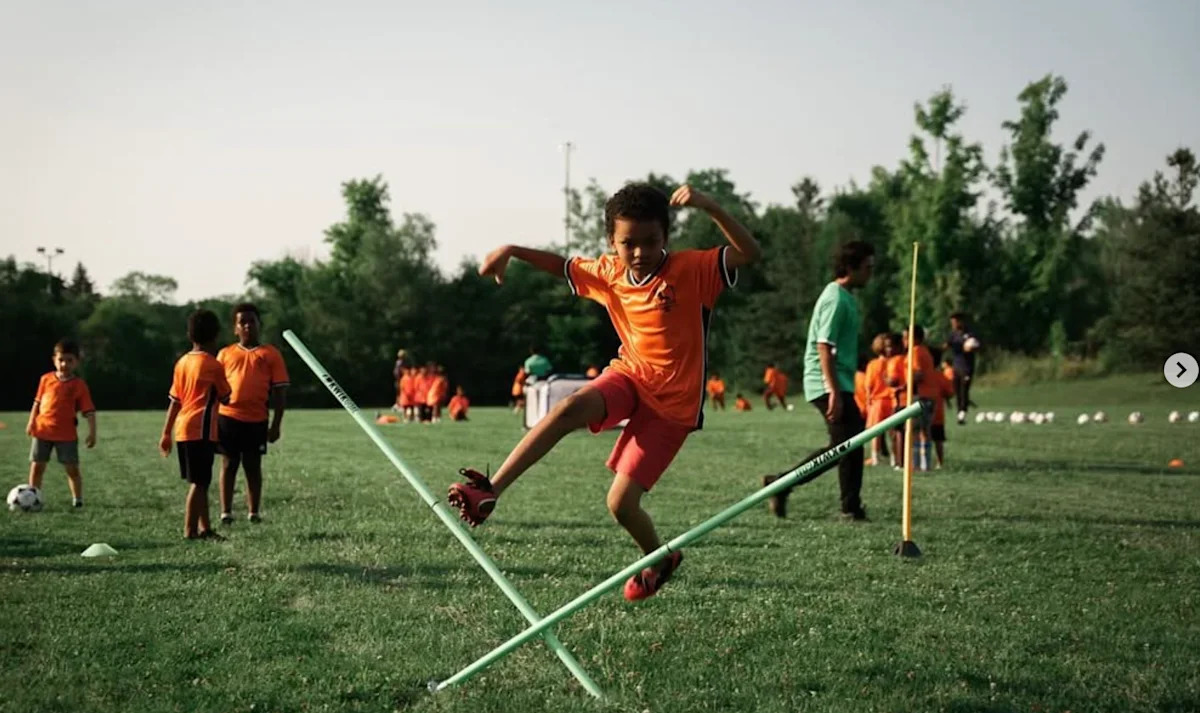
Children run across the turf chasing soccer balls while parents chat along the sidelines. Grandparents settle in beside them while team members weave through orange cones.
Nobody seems to be in much of a hurry to leave once practice wraps. That is what Mohazzama Muhtaj says she notices most.
Families who arrive in Canada knowing no one, often begin by sitting quietly at opposite ends of the field. But as weeks go by, she said she watches those small circles slowly grow. Parents start sharing food, swapping phone numbers and making plans to meet outside the program.
“What you’ll see isn’t just a soccer program,” says Mohazzama, better known to players and parents as Coach Mo, in an interview with Yahoo News Canada.
“I describe the Simbas as a family.”
Getting people to safety is only the beginning, Coach Mo said. Learning to belong is another journey altogether. That is the space the Scarborough Simbas have stepped into with bi-weekly practices being held at Terraview Park in Scarborough, located on Toronto’s eastern flank.
The free, community-led program, run through Muslim Children’s Aid and Support Services (MCASS), uses soccer, shared meals, mentorship and wellness supports to help refugee and newcomer families rebuild their lives after displacement, war and trauma.
As Canada spends the summer talking about the FIFA World Cup, packing stadiums and sparking conversations about the future of soccer in this country, the Simbas offer a very different picture of the game’s impact.
On this pitch, success is not measured in championships or trophies. It is measured in if a child who arrived frightened and isolated begins to smile, whether a parent finds a friend and whether a family starts to feel at home.
For co-founder and pro-soccer player Farkhunda Muhtaj, that mission is deeply personal.
A soccer ball and a new life
Farkhunda came to Canada from Afghanistan when she was two years old after her parents fled during the Afghan Civil war during 2000. Growing up in Scarborough, soccer became the bridge between her family’s past and a new life in Canada.
“It gave us a sense of belonging,” she says in a phone interview with Yahoo News Canada. “It enabled us to really connect with our community members.”
Today she is a professional footballer, an advocate and former captain of Afghanistan’s women’s national team, but she still talks about the game with the same gratitude she felt as a child.
“I’m really proud to be Canadian and very proud to be Afghan,” she says. “My Afghan heritage gave me the work ethic and resilience to take advantage of opportunities, and Canada gave me the resources and opportunities to actually live out those dreams.”
She often finds herself pausing and reflecting on how different her life might have been if her family had never left Afghanistan. She says she most likely would have grown up surrounded by conflict, with rare opportunities for education and sport.
“I wouldn’t have the freedom that I have today,” she says. “I have two bachelor’s degrees, and I certainly would not have been able to pursue that if I was in Afghanistan.”
That awareness of what could have been shaped everything that came next.
The phone call that changed everything
In the summer of 2021, as the Taliban swept back into power, Farkhunda said she received a call from officials connected to Afghanistan’s football federation. Players and coaches were in danger, and they needed help getting out of the country.
She had never organized an evacuation before.
“I had no clue how to start on this mission. I did know that their lives were at risk.”
Farkhunda Muhtaj, Afghan footballer and Scarborough Simbas co-founder
For weeks, conversations crossed continents over WhatsApp as she helped coordinate routes, documents and communications while Taliban checkpoints increased across the country and commercial flights disappeared. Many of the women, girls and their family members placed their trust in someone they had never met in person because the federation had told them she was the national team captain and could be trusted.
Against all odds, Muhtaj helped evacuate more than 300 Afghan footballers and their family members to Portugal. When she finally travelled there and surprised many of the families, the emotion that hit her first was not celebration.
“Relief,” she says. “Relief and sadness at the same time.”
She was relieved they were alive and safe, but she also understood what had been lost.
“You’re being forced to leave your country,” she says. You’re leaving memories behind and friendships and so much that now you have to rebuild from scratch in a country you’re unfamiliar with.”
That experience changed the way she thought about refugee resettlement. Safety, she realized, was not the finish line.
It was the starting point.
Building the program they wished existed
The Scarborough Simbas had begun the year before, during the isolation of the COVID-19 pandemic. Farkhunda could see that refugee and newcomer families were losing more than just access to sports. Many were becoming cut off from community, support networks and the connections that help people settle into a new country.
“Their mental health was deteriorating,” she says. “Sport is such a uniting factor.”
Together with co-founder Karen Scott, she launched the program in the same Scarborough neighbourhood that had helped shape her own family after they arrived in Canada.
What started as a soccer program quickly grew into something much broader. Players receive coaching from former varsity and professional athletes, families stay for a shared meal after practice, grocery gift cards help ease food insecurity, and participants are connected with tutoring, mentorship and wellness programs through MCASS.
“We wanted them to feel dignified. They come in, they have quality kits, experienced coaches, community circles, skill sessions, competition, friendships and then a shared meal at the end of the day.”
Farkhunda Muhtaj, Afghan footballer and co-founder of Scarborough Simbas
The meal, she says, is often where the real magic happens, as the after-practice tradition allows families to gather to eat together and connect away from the field.
“At the end of the day, you have a shared meal where you get to connect off the pitch as well with community members,” Farkhunda said “That’s when we’ve had the families genuinely feel a part of something bigger because they get to have those socializing moments while they’re eating.”
The field where parents heal too
Coach Mo has watched the program grow from a small pandemic initiative into a community that now reaches across generations.
“One of the biggest things I’ve noticed is that parents need this just as much as the kids do,” she says. “Sometimes they’re the ones who feel the most isolated.”
She describes arriving at the field and seeing grandparents, cousins, aunts and uncles spread out across the grass while the children play. By the end of the season, those separate family circles have usually merged into one larger gathering.
The transformations are not always dramatic, Coach Mo says. Sometimes they are as simple as a child raising their hand to answer a question for the first time or introducing themselves to a teammate without looking at the ground.
Other times, the impact is unforgettable.
She said she remembers a five-year-old boy whose siblings were enrolled in the program. Because of injuries caused by an explosion in his home country, he needed support to walk and had not been registered to participate. The coaches offered to work with him individually and help him join the activities in whatever way he could.
“I have never seen a smile so bright on a kid’s face,” she says. “His mom was standing there crying.”
That moment pushed the Simbas to become more accessible, adding training for coaches and connecting the family with organizations that support children with disabilities. Today, the boy is involved in several programs across Toronto.
“It was about him feeling normal,” Coach Mo says. “Feeling like his siblings and feeling like he belonged there too.”
‘It feels like safety’: What belonging means
The program has grown in ways that show how carefully the coaches listen to the children. They stopped using whistles after realizing the sharp sound could be triggering for some players who had recently arrived from war zones.
Practices are centred on encouragement, routine and trust, with weekly themes focused on leadership, grit and confidence alongside soccer drills.
For Coach Mo, belonging is not an abstract concept.
“It feels like safety,” she says. “Somewhere you don’t have to change who you are.”
As the sun begins to set, the soccer balls are eventually packed away, but the conversations linger.
On the other end of the phone, Farkhunda says those ordinary moments are the clearest sign that the program is working.
Success, she says, is not measured by the medals or professional contracts.
“It’s the amount of lives that you positively impact.”
On a field in Scarborough, that number keeps growing, one family, one friendship and one shared meal at a time.