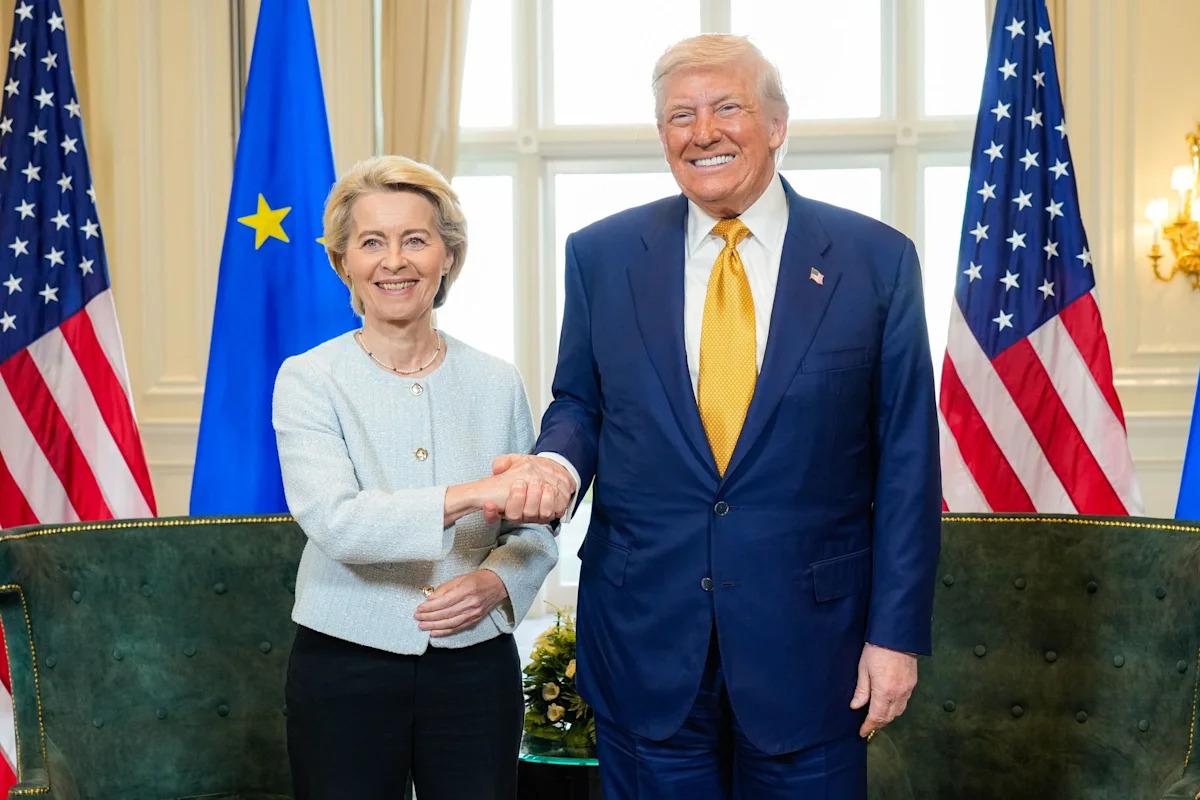

FILE PHOTO – US President Donald Trump and European Commission President Ursula von der Leyen shake hands after they reached an agreement to settle a trade dispute over tariff hikes, at the Trump Turnberry golf course. (is associated with: «New US tariffs provide ‘positive momentum’ for EU») Fred Guerdin/EU Commission/dpa
The European Commission has expressed relief over new tariffs of 10 to 12.5% announced by the United States following an investigation into forced labour in the supply chain of traded goods.
“The EU notes positively the fact that this outcome is in line with the US tariff commitments agreed under the EU-US Joint Statement,” a spokesman for the commission said on Friday, alluding to a tariff deal that set a ceiling for US tariffs at 15%.
The US announcement “establishes an all-inclusive tariff rate of 10% for the EU, and reintroduces the additional tariff exemptions for the EU, such as cork and diamonds, on top of those on aircraft and parts, generic medicines, and active ingredients,” the spokesman said.
The news “also provides positive momentum to continue the work on exploring further tariff exemptions and deepening cooperation across a broad range of areas,” he said, citing critical raw materials, economic security artificial intelligence and digital matters as examples.
On Thursday, the United States announced tariffs of 10% or 12.5% on imports from 60 trading partners, citing their failure to introduce and effectively enforce bans on goods made with forced labour. The decision had been widely anticipated.
The additional tariffs came into force at 12:01 am EDT on Friday (0401 GMT).
Most imports from the European Union have so far been subject to tariffs of up to 15% under the bilateral EU-US trade agreement known as the Turnberry deal.
European Commission President Ursula von der Leyen and Trump reached the agreement in August 2025 to avert a looming trade war. Brussels made further concessions, including abolishing EU tariffs on US industrial goods.
However, given the unpredictability of Trump’s trade policy, the EU also included safeguard clauses. Should the United States fail to fully implement its commitments or suspend parts of the agreement, the EU can withdraw its concessions, including by raising tariffs again.
According to EU sources, Washington has so far complied with the agreement in most cases.
An EU official said tariffs of no more than 15% applied to around 93% of EU exports to the United States.