
Real Madrid are about to make a major addition to their squad, nearing an agreement to sign Yan Diomande from RB Leipzig.
The winger’s arrival, especially at a price that will be well over €100million (more than £85m/$110m), leads to several questions. Does he give Madrid what they need? Where will he fit in? Does he suit Jose Mourinho’s style?
Here, The Athletic’s Guillermo Rai and Anantaajith Raghuraman answer some of the key questions.
Where will Diomande fit in at Madrid and is he the type of player Madrid need?
Diomande offers versatility as he is comfortable controlling, dribbling, passing and shooting with either foot. As his dashboard from the 2025-26 Bundesliga season shows, he played largely on the right for Leipzig but was a useful option on the left too.

This is welcome news for Madrid. Diomande is the type of winger the club have been searching for: capable of operating on either flank, but primarily on the right, an inconsistent position for them over several years.
Rodrygo — still recovering after rupturing the anterior cruciate ligament in his right knee six months ago — Federico Valverde, Jude Bellingham and Arda Guler have all moonlighted on the right wing.
Last summer, Madrid believed they had found the solution when 18-year-old Franco Mastantuono joined from River Plate for €63million. However, the Argentinian lost prominence as the season went on and his status is uncertain. Sources at Madrid, who, like all of those spoken to for this article, spoke anonymously to protect relationships, said the club would like him to spend next season at another European club to continue his development. However, people with knowledge of the situation add that Mastantuono’s preference is to return to River Plate, where he began his career.
Bernardo Silva’s arrival was announced in June, but he is not necessarily the answer either. Although the Portugal international regularly played from the right at Manchester City, Madrid see him playing a central role or in the inside channels, rather than as a traditional winger.
Diomande could be the long-term difference-maker they need on the right. Only five wingers across Europe’s top-five leagues attempted more take-ons than his 7.8 per 90 minutes last season. His 55 per cent success rate was better than anyone in the top 75 for take-on attempts — a marker of his effectiveness from these situations.
Moments like the one below against Eintracht Frankfurt should excite Madrid fans. Right-back Ridle Baku’s underlapping run leaves Diomande in a one-on-one situation. He races past his opponent on the outside and, with a quick trigger, sends a dangerous cross into the box.

Should Vinicius Junior depart, amid interest from Arsenal, Diomande can fit in on the left too. His 675 league minutes on the left last season brought three assists and 12 shots — eight with his right and four with his left — but he did not score.
What needs to improve in his game over time?
Diomande is fast and direct, with the speed and balance to carry the ball over large spaces. That helped him thrive in the Bundesliga, where transitions have reigned supreme for the better part of this decade.
La Liga poses a slightly different challenge, with more teams content with sitting deep, especially against a side of Madrid’s stature. Madrid have struggled to break these teams down — even with Vinicius Jr and Kylian Mbappe on the pitch.
Diomande has the composure to draw defenders and find the spare man. That will be tested to its limits when Madrid come up against low blocks.
Then there is the age factor. At times, the 19-year-old can look frustrated on the pitch when a team-mate fails to find him or if one of his skills doesn’t come off. That can lead to lapses in concentration, which will need to be ironed out.
Diomande’s out-of-possession role will also be of interest. When pressing higher up the pitch, Leipzig used Diomande in the second line, often to help the full-back against overloads. But when they dropped deeper, he was often the furthest forward to maximise his threat on the counter, as seen below.

Madrid used Vinicius Jr and Mbappe in a similar way last season. If that continues, Diomande will need to drop deeper and his defensive skills will need sharpening to ensure he remains attentive to the danger around him.
Does Diomande fit into the way Mourinho wants to play?
At Benfica, Mourinho typically set his team up in a 4-2-3-1 formation, which transitioned into a couple of different shapes.
In one of his final games in charge, a 2-1 win at Sporting CP in April, the left-back drops to create a three-man back line, with the double pivot in support. The right-back pushes ahead, the No 10 and striker occupy the opposing centre-backs, and the wingers stay high.

While it is possible to double up on the left-winger, the right-winger will be able to either isolate himself out wide or shift infield depending on the right-back’s run. Diomande’s best work is done closer to the touchline, but he is comfortable in tighter spaces too. That makes him a good fit on the right side, given Trent Alexander-Arnold or Denzel Dumfries require attention too.
Wingers staying high was a factor when Benfica built from deep too. Below, in the second half of the same game, the two holding midfielders (yellow) and full-backs (white) both stay deep, baiting the press.
That gives Benfica a spare man on the left and a four-on-three against Sporting’s last line.

Situations like these, which help create transition-like moments with quick passes, would suit Diomande, as well as Vinicius Jr and Mbappe, who have the pace and skill to get in behind.
Beyond the specific formations, sources at Valdebebas have described Mourinho’s early days at Madrid as being built around intensity and speed in attacking transitions. That has been one of the biggest demands of his first sessions, with players showing significant levels of fatigue — particularly after the opening training session against Alcorcon last Thursday. In that sense, Diomande also fits Mourinho’s footballing idea: a winger capable of producing explosive moments both with and without the ball.
Out of possession, Benfica looked to man-mark higher up the pitch but retreated into their customary 4-2-3-1 shape as teams got forward, with the wingers moving infield as seen below.
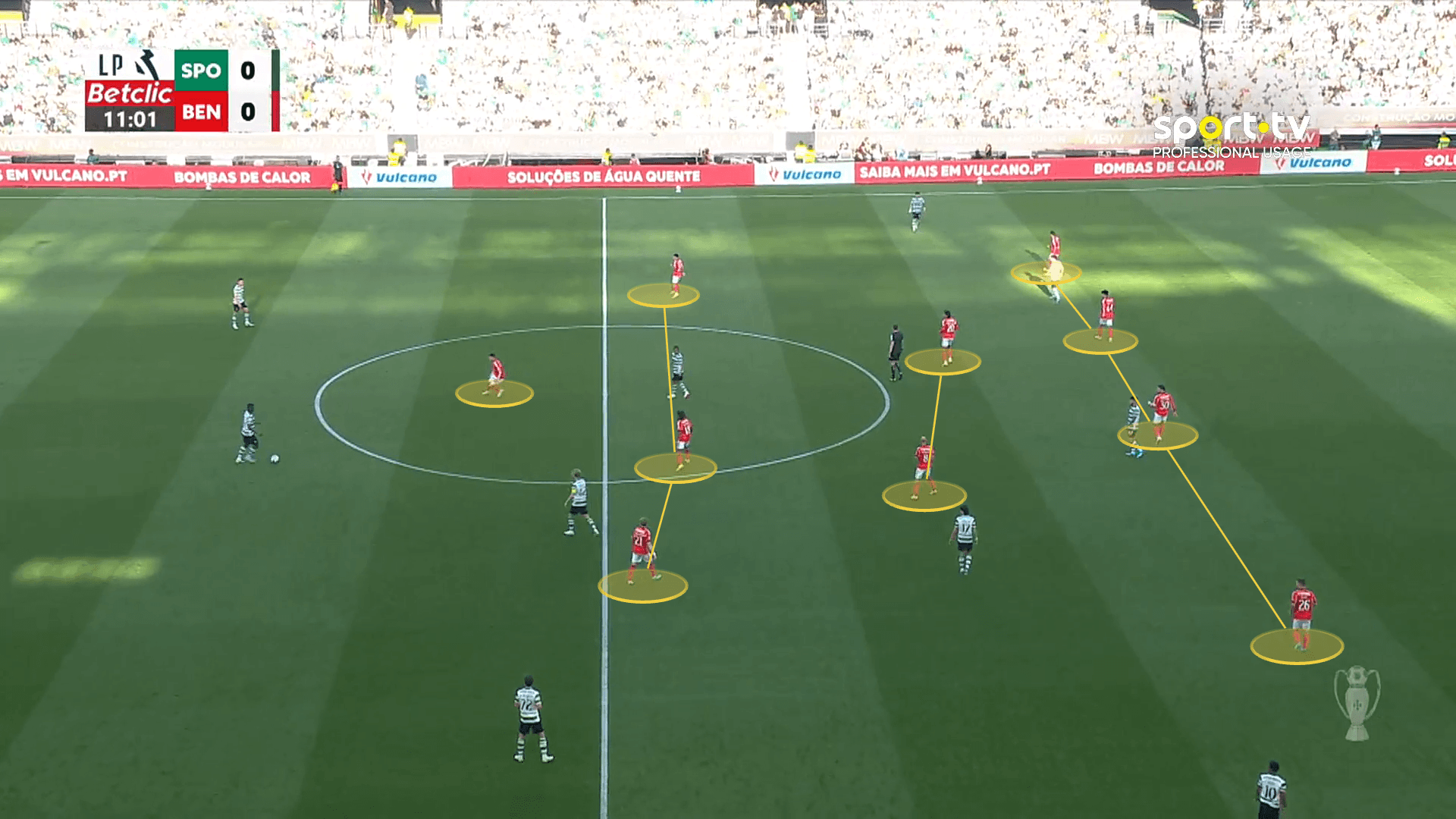
As teams attacked the box, they often fell into a 5-3-2 or 5-4-1, which required the wingers to help defend the edge of the box. It will be a departure from the system Diomande was a part of in Leipzig, so growing pains are par for the course.
Diomande’s suitability for Mourinho goes beyond his attacking output. He also helps address one of Madrid’s structural issues in recent years within their 4-3-3 system: the defensive imbalance created by the limited defensive contribution of their wide players, particularly Mbappe.
Mourinho’s teams traditionally demand more work from their wingers without the ball, and Diomande’s physicality, intensity and willingness to defend make him a natural fit for that approach.