
The educational excavation campaign that the University of Vienna has been conducting since mid-July in the municipality of Hannersdorf, in the Oberwart district southeast of Vienna, has brought to light the remains of two pottery kilns from the Roman era in the first fifteen days of work.
The work, led by archaeologist Basema Hamarneh, focuses on a cultivated plot located north of Burg’s bathing lake, an area long noted for the recurring presence of surface archaeological materials corresponding to the Iron Age and the Roman occupation period.
The novelty of the current intervention lies in the magnitude of the documented structures and in the projection that previous studies, through geomagnetic surveying, provide about the subsoil: the two kilns now uncovered would be only a minimal fraction of a complex that could exceed a hundred similar installations, still hidden beneath the layer of arable soil.
The sequence of discoveries dates back to 2021, when the renovation works of the B56 Geschriebenstein Straße, which runs along the eastern flank of the area, provided the first consistent indications of the importance of the site. At that time, numerous fragments of Roman pottery and the first traces of firing kilns appeared, prompting the preventive archaeology teams and the university researchers to begin a program of non-invasive surveys.
 The two open areas, F1 and F2. In the background is the village of Burg with its swimming lake. Credit: IKA_Burg_2026, Foto Th. Leutgeb
The results of the geomagnetic studies carried out in subsequent years were conclusive: beneath the fields, a dense network of anomalies compatible with kilns, building walls, and circular structures that specialists identified as flattened burial mounds emerged. However, until the opening of stratigraphic excavations in the current campaign, neither the nature nor the exact chronology of those indications could be confirmed.
The current intervention, which will continue until August 7, has allowed the documentation, just forty centimeters deep, of the combustion structures and work pits associated with two of the kilns. Alongside them, several other pits also appeared, which archaeologists interpret as clay extraction quarries and workshop waste dumps.
The fill of the kilns and the surrounding pits contains a significant amount of pottery, in many cases fractured but also with complete examples, a circumstance uncommon in ancient pottery production contexts. Excavation director Basema Hamarneh emphasized that the collection of finds points unambiguously to the existence of a large tableware production center, specialized in the manufacture of bowls, dishes, cups, and storage vessels.
Among the recovered materials, the abundance of pieces that have remained intact until excavation is noteworthy, a fact that contrasts with the usual fragmentation of domestic or dump contexts. Even more relevant is the presence of numerous failed examples, that is, pieces that suffered deformations, breakages, or incorrect vitrifications during the firing process and were discarded on-site.
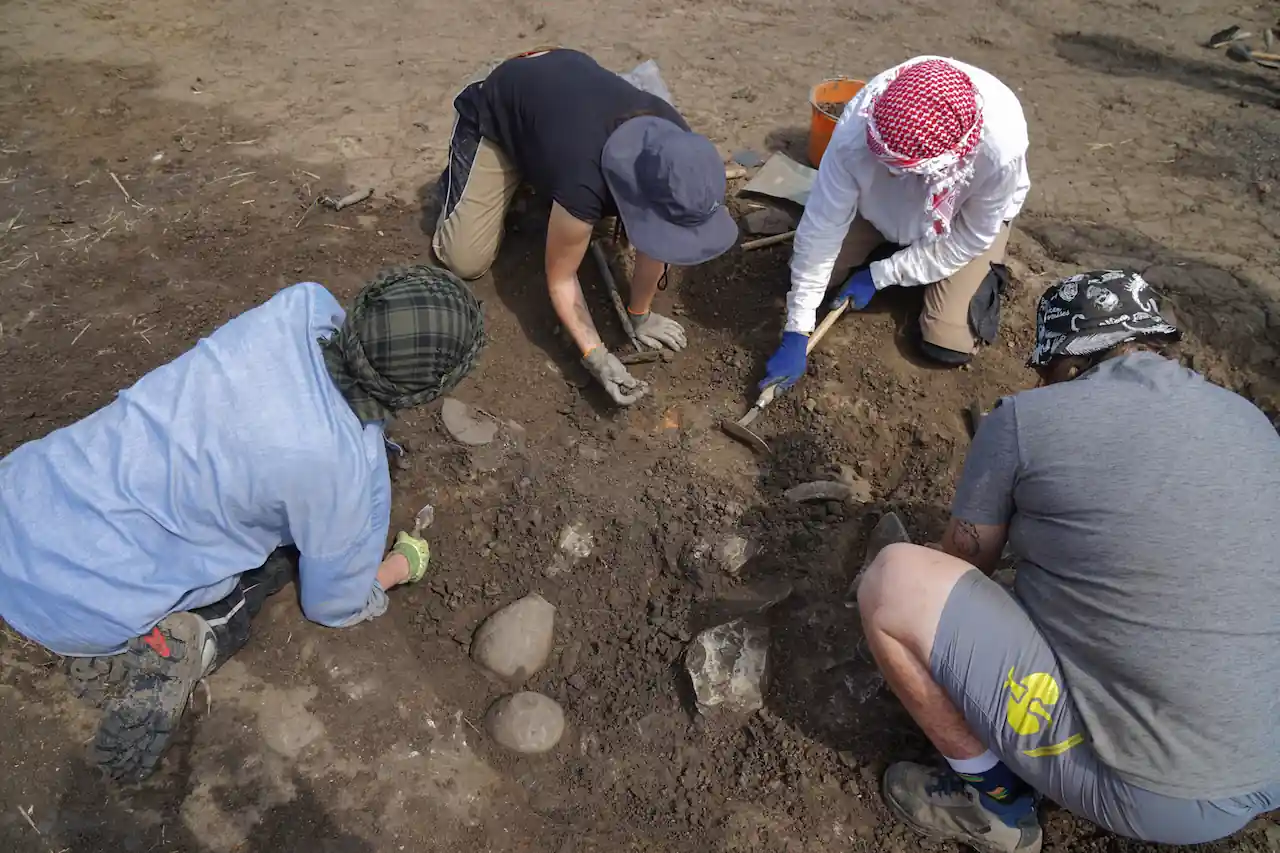 Students from the University of Vienna clearing Roman-era artifacts in Area F1. Credit: IKA_Burg_2026, Foto L. Schlamp
These so-called firing wastes offer researchers an exceptional window to reconstruct the operational chains of the workshop, from the kneading of the clays to the temperatures reached inside the kiln. The accumulation of production failures, combined with the size of the kilns and the density of the remains, leads the team to conclude that production was not solely intended to supply a small local market, but far exceeded the needs of nearby settlements.
Precisely, the absence of a Roman settlement of any significance in the immediate vicinity of the site reinforces this hypothesis. The nearest city is Savaria, present-day Szombathely, founded in the early 1st century AD and located about sixteen kilometers in a straight line, already in present-day Hungary.
The fact that no village or villa has been found so far that could absorb such a quantity of pottery in the immediate radius suggests that the Hannersdorf kilns were part of a regional or even interprovincial distribution network, in which the tableware would travel along the Roman roads that crossed western Pannonia.
This interpretation is also supported by the discovery of imports, in particular fragments of terra sigillata, the fine tableware pottery that came from the large workshops of Gaul or the Italian peninsula, and which in local production contexts is usually interpreted as an indicator of economic capacity and the workshop’s integration into long-distance exchange networks.
The Hannersdorf site, however, is not limited to the Roman stage. Surface survey work had collected Neolithic materials for years, including pottery and remains of post structures corresponding to longhouse-type buildings typical of the 6th millennium BC.
This superposition of occupations, which archaeologists call a multiperiod site, does not imply a direct continuity between Neolithic communities and Roman potters, separated by millennia, but it does indicate that the place offered exceptional environmental and strategic conditions for production and settlement. The availability of quality clay, proximity to water, and location at a natural crossroads would have made this small hill a recurrent space of human activity throughout the recent prehistory and protohistory.
Another element that reinforces the centrality of this point in the ancient landscape is the proximity, a kilometer and a half away, of the well-known Schandorf burial mound field, a monumental Hallstatt period necropolis that also saw use during the Roman period. The presence of these burials nearby, documented by the same geomagnetic surveys, adds a funerary and symbolic dimension to a territory that, in light of the new data, appears as a node of human relations extending for more than two thousand years.
Hamarneh highlighted that each find, from the complete vessels to the terra sigillata fragments and the remains of firing failures, contributes to reconstructing the economic landscape of Roman Pannonia in a region often considered peripheral, but which recent discoveries place as an active space of artisanal production and trade.
The excavation, which maintains a daily pace of extraction and recording, will continue in the coming days with the expansion of the trenches to try to delimit the exact extent of the pottery complex. The data obtained so far have far exceeded initial expectations, and the researchers are confident that the more than one hundred structures detected by geomagnetics will provide, in future campaigns, even more precise information on production capacity, workshop duration, and its possible connection with other known centers in the Danube basin.
For now, the graphic and planimetric documentation of the first two kilns, together with the recording of the associated materials, allows us to affirm that we are looking at a first-rate artisanal complex for understanding provincial Roman pottery in the central European area.