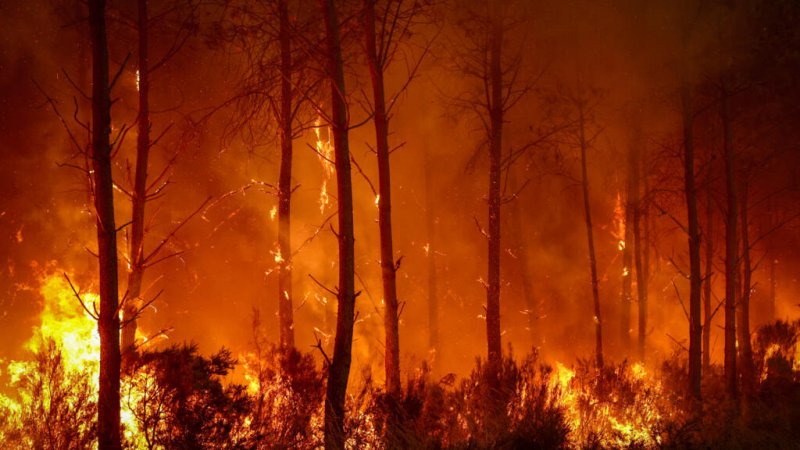
Greece is battling multiple wildfires that have claimed the lives of three firefighters and forced thousands of residents and tourists to flee as blazes spread across the country. Strong winds, extreme heat, and dry vegetation have created dangerous conditions for both emergency responders and civilians, complicating firefighting operations and evacuation efforts.
The latest fatalities occurred in Crete and the Peloponnese, where firefighters lost their lives while combating fast-moving fires. Meanwhile, large-scale evacuations have continued on several Greek islands and mainland regions as authorities struggle to contain multiple active fire fronts.
The worsening situation highlights the growing challenge Greece faces during increasingly severe wildfire seasons, which experts say are being intensified by prolonged heatwaves and changing climate conditions.
What happened in the latest wildfires?
The deadliest incidents occurred in Crete and southern Greece.
In Crete’s Rethymno region, two firefighters were found dead inside their vehicle after they apparently became trapped by rapidly advancing flames near Nea Krya Vrysi. According to Greek authorities, one of the victims was a seasonal firefighter, while the other had served for five years at the Agia Fotini fire station.
A third firefighter died in the Peloponnese after being discovered unconscious outside the wildfire perimeter near Ageranos in the Gythio area. He was transported to hospital but was pronounced dead shortly after arrival.
Authorities continue to investigate the exact circumstances surrounding the deaths while firefighting operations remain underway across several regions.
The loss of three firefighters in a short period has deeply affected Greece’s emergency services and underscores the dangers faced by crews battling increasingly unpredictable wildfires.
Why are the fires spreading so quickly?
Several weather and environmental conditions have combined to create exceptionally dangerous wildfire behavior.
Authorities said gale-force winds reaching eight on the Beaufort scale have significantly accelerated the spread of flames, allowing fires to move rapidly across dry vegetation and making containment far more difficult.
High temperatures, prolonged drought, and extremely dry forests have further increased fire intensity. Under such conditions, even relatively small fires can expand rapidly into large wildfires capable of overwhelming firefighting resources.
Strong winds also create additional hazards by carrying burning embers over long distances, allowing new fires to ignite far ahead of the main fire front.
These factors have forced emergency services to continuously adjust their strategies while prioritizing the protection of human life over property in the most dangerous areas.
Why have thousands of people been evacuated?
Authorities have ordered evacuations because fast-moving wildfires can quickly threaten homes, hotels, roads, and tourist areas.
In southern Crete, dozens of people attempted to escape advancing flames by sea, with emergency services evacuating 51 individuals from coastal areas after land routes became increasingly hazardous.
Civil Protection authorities have also issued emergency alerts to residents in affected regions, urging immediate evacuation where necessary.
Evacuations are often ordered before flames reach populated areas because smoke, rapidly changing wind conditions, and blocked escape routes can quickly place lives at risk.
Tourists visiting Greece during the busy summer season may also be affected, as many popular destinations are located near forested or coastal areas vulnerable to wildfire activity.
Why is Greece particularly vulnerable to wildfires?
Wildfires are a recurring challenge in Greece during the summer months because of the country’s Mediterranean climate.
Hot, dry summers combined with dense forests, mountainous terrain, and seasonal winds create favorable conditions for fire outbreaks. Once fires begin, steep landscapes can make access difficult for ground crews and firefighting vehicles.
Climate scientists also point to rising temperatures, more frequent heatwaves, and prolonged droughts as factors contributing to increasingly severe wildfire seasons across southern Europe.
In recent years, Greece has experienced several devastating fires that have destroyed thousands of hectares of forest, damaged communities, and claimed numerous lives.
The government has since invested in additional firefighting resources, early warning systems, and international cooperation, but extreme weather continues to present major operational challenges.
How are firefighters responding?
Thousands of firefighters, supported by aircraft, helicopters, and emergency volunteers, continue working to contain multiple active fires across the country.
Operations involve creating firebreaks, protecting residential areas, conducting evacuations, and preventing flames from spreading into new regions.
Aircraft play an especially important role by dropping water and fire retardant on inaccessible areas, while ground crews work to contain fires closer to communities.
Authorities also coordinate closely with police, ambulance services, local governments, and civil protection agencies to manage evacuations and emergency response.
The deaths of three firefighters serve as a reminder of the significant risks emergency personnel face while operating in rapidly changing wildfire conditions.
What could happen next?
The coming days will be critical as firefighters continue battling active blazes in Crete, the Peloponnese, Paros, and other affected regions.
The pace of containment efforts will depend largely on weather conditions. If strong winds persist and temperatures remain high, authorities may face additional fire outbreaks and further evacuations.
Emergency services are expected to continue issuing alerts through Greece’s emergency warning system whenever communities face immediate danger.
Longer term, the latest wildfires are likely to renew discussions about wildfire prevention, forest management, climate resilience, and investment in emergency response capabilities.
For now, protecting lives remains the priority as Greece confronts another severe wildfire season marked by dangerous weather conditions, widespread evacuations, and the tragic loss of firefighters on the front line.