
Author: Zuo Ye Wai Bo Shan
Finance Is a Means of Social Mobilization
The new Cold War has no Iron Curtain, only mutual entanglement.
The US-Soviet Cold War from 1945 onward is often depicted as localized hot wars under a total nuclear crisis, with both sides poised for a steel collision on the Eastern European plains at any moment.
However, setting aside the bloodshed of World War II, starting from the Great Depression of 1929, the Soviet Union had been absorbing American technology and capital all along, until after WWII London built up a vast pool of Eurodollars, whose main service object was also the Soviet-Eastern Bloc.
From this perspective, it only makes sense to view the Cold War as a “trade war.” The Soviet Union established the Comecon system, which was inherently weaker than the US and the West’s GATT (the predecessor of the WTO), the IMF, and the World Bank, because the latter contained full-fledged gamesmanship under a financial system.
When your enemy also cannot do without the dollar, that contest was already decided long ago.
Old Cold War Trade, New Cold War Finance
Economic crises are capitalism’s cyclical clearing mechanism, and the survivors of each crisis have continuously complicated the US financial system, laden with overreactions from each crisis.
The economic crisis of 1907 not only created the Federal Reserve; subsequently, in 1913, US GDP and industrial output had already surpassed Britain’s. The Great Depression since 1929, though originating from a grotesquely inflated stock market, truly stemmed from America’s inability, or failure, to sustain a US-centered global trading system.
In fact, the Soviet Union’s ability to attract American production capacity after the Great Depression was linked to the fact that ideology at that time was weaker than the reality of survival. Life is always above politics, both for the Soviet Union and for the United States.
This can be understood simply: the pre-WWII world system was centered on a trade system, i.e., the cross-border flow of physical goods. The supply chains, SWIFT, and the dollar we are familiar with were not important at that time; tariff regimes were the key to whether trade could take place.
Carrying this inertia of thought, the post-WWII Soviet Union chose the Comecon system, where trade settlements among countries used the “transferable ruble (TR),” essentially a form of accounting credits that was highly controlled and lacked sufficient flexibility.
The United States, however, did not at this point opt for financial laissez-faire or disordered freedom. To a considerable extent, the post-war Western trade system remained regulated. The heavy industry within Comecon could guarantee the most basic survival needs, and the Soviet Union’s external oil industry was always hard currency in the reconstruction of a devastated Europe.
The real pivot was the neo-liberalism that emerged from 1970 onward. Countries like the US and the UK took the lead in dismantling their own production lines, diverting them into private hands or to Asians, with the sole condition of accepting American technology controls, financial order, and the dollar system. This seemed suicidal in the eyes of the Soviet Union at the time: would America really rely on Disney and foreigners to defend itself?
 Caption: Challengers to the American System Across the Ages
Image Source: @zuoyeweb3
In the end, an America mired in the Vietnam quagmire and the oil crisis defeated the Soviet Union’s steel torrent with Disney.
It is hard to say exactly what the Soviet Union did wrong. The hollowing out of American industry still wounds the Rust Belt today; angry rednecks choose Trump, while the “Iron Lady” Margaret Thatcher chose to trample the Orgreave miners under iron hooves, leaving the UK with a collective trauma that remains unhealed to this day.
However, the legacy of the Soviet-Eastern Bloc was excessively rich. Aside from the continuous flow of markets and labor to Europe and America, Google co-founder Brin and Ethereum leader Vitalik are intangible gains. They are all prisoners of Disney’s war, not AK-47s forged by the oil trade.
Thus, you cannot think that the WTO defeated Comecon, nor simply that the Star Wars initiative dragged down the Soviet Union. The social mobilization power and penetrative force of finance have long been underestimated. U2 spy planes could not cross the Soviet MiG corridor, but dollars could, and so could Viktor Tsoi.
By exploiting and creating a Soviet demand for dollars, the Soviet Union ultimately bought the noose with which it hanged itself.
If the Soviet Union was an external financial war, then the US-Japan friction was about setting a new domestic standard.
At that time, precisely then, Japan was in a critical period of nationally supporting its DRAM industry;
Whether it was the 1985 Plaza Accord, or the subsequent hybrid use of US legislative, executive, and judicial powers to restrict the development of Japan’s semiconductor industry, the United States consistently put trade first and eventually landed the final blow on finance — US Treasuries.
In particular, using the pretext that Japanese companies like Mitsubishi and Hitachi were “stealing” US semiconductor IP, the Section 301 investigation was rolled out accordingly. In 1987, Reagan even sanctioned Japan’s semiconductor industry and began transferring semiconductor technology to allies like Taiwan, China and Korea.
At this present moment, ChangXin has simply replaced Toshiba, and Kimi K3 has encountered A\.
Compared to the Soviet Union’s trade demand for dollars, Japan’s demand for US Treasuries also skyrocketed after the Plaza Accord as part of the bilateral “macroeconomic” cooperation, and exchange rate liberalization was a direct product of that round of movement.
 Caption: The US Debt Race
Image Source: @zuoyeweb3
From the Soviet Union exchanging oil for dollars, to Japan exchanging semiconductors for US Treasuries, America’s financial maneuvers have always been a step ahead.
China is no special exception. It pushed its way into the WTO in 2001, lived the hard laborer’s life of exchanging 800 million shirts for Boeing jets, and then encountered the “Trade War” in 2018 — still the familiar tariff stick plus Section 301 investigation.
This time, however, there is a complex mixing of policy toolkits from both sides. Compared to the Soviet Union, China holds excessive amounts of dollars, and the trade variety is not single but reciprocal, with goods and services tightly intertwined.
Compared to Japan, China’s holdings of US Treasuries have peaked, making it America’s largest creditor. But the US cannot forcibly compel China to abandon its semiconductor industry. Fujian Jinhua was crushed, but ChangXin, YMTC, and SMIC continue to thrive.
From 2018 to Trump’s 2026 visit to China, the United States has deployed every means from its historical trade-financial war playbook. Then, much like the Russia-Ukraine war, where a “1h22m speedrun” became the prelude to a prolonged entanglement, both sides have fallen into a bitter standoff, and thus the tech-financial war takes the stage.
Tech Financialization, Stock Market Politicization
From the warp and weft of history, the three trade wars have an internal lineage of inheritance. US-Soviet was a parallel system, US-Japan was a subordinate relationship, and US-China is an interlocking relationship.
The United States is like a big boss. Every round of challengers has tried their utmost, but the Soviet Union could not even reach the economic closeness that Japan and the US had, dying outright as a layman. China has gone the furthest so far, already reaching the financial domain. This financialization transcends the established frameworks of the dollar and US Treasuries, challenging US pricing power for the first time.
With the US being strong in finance but weak in industry, it will further go long on financial instruments. China, being strong in industry but weak in finance, after surviving the traditional trade war, needs to convert its industrial strength into financial advantage. From restricting individuals from buying US stocks to introducing trust taxes and more, it is concentrating funds to strengthen its own financial markets, which in turn feeds back into its own industrial system.
 Caption: Only a Policy Bull Is Good News
Image Source: @zuoyeweb3
From this perspective, whether it was Lee Jae-myung calling for leverage in March or the restrictions on leverage starting in July, South Korea’s most beautiful summer was not only brief but also extraordinarily volatile by human design.
Meanwhile, the US stock market’s AI, semiconductor, and robotics sectors are in unprecedented boom. Amid rumors of DeepSeek R1/Kimi K3/DUV lithography machines, and under Trump’s daily calls for interest rate cuts, it has remained resilient through the revolving doors of Trump-Biden-Trump and Powell-Kevin Warsh.
This resilience is national will, a collective mindset that transcends party lines. Or, put differently, the US stock market is becoming a new sovereign-grade asset.
This is no exaggeration. The default of King Charles II of England on the goldsmith-bankers in 1672 eventually led to the founding of the Bank of England in 1694, and only then did government debt truly become a “sovereign-grade asset.” The petrodollar after the collapse of the Bretton Woods system, and today’s AI-driven US stock market, are nothing but the real products of successive crises.
Therefore, the 2018 US-China trade war was actually America’s historic muscle memory, seeking to use a trade war to expel China from the global economic and trade system, while simultaneously, referencing the Plaza Accord with Japan, hoping to use financial means to crush China’s semiconductor industry.
After the US-China trade war cools down, Trump will further pivot to a tech war. And this tech war is, to a considerable degree, expressed in financial form, and the most direct form of finance is the US stock market.
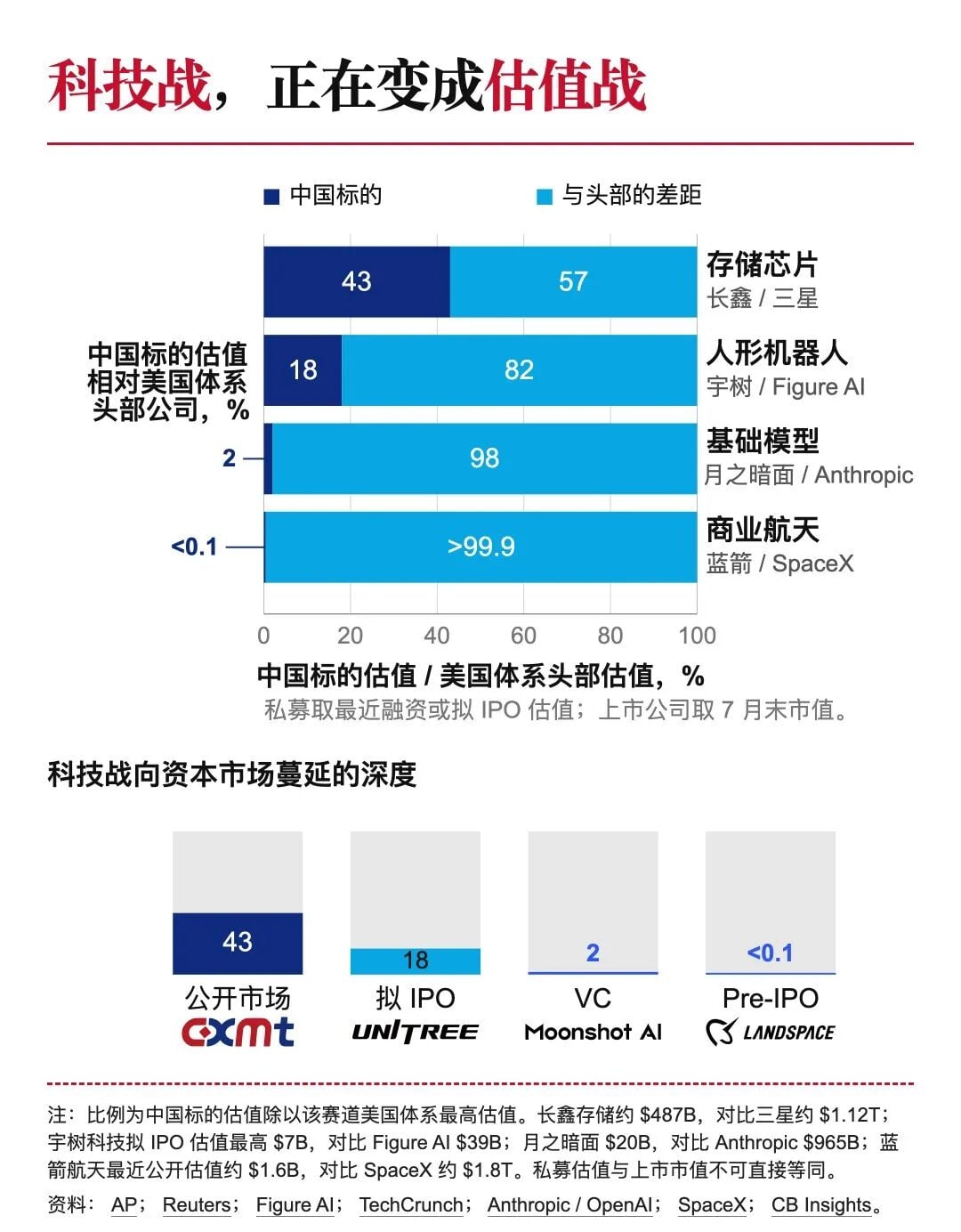 Caption: New Tactics in the Tech War
Image Source: @zuoyeweb3
The current standoff between Chinese and US stock market targets is marked by ChangXin Technology and Moonshot AI. ChangXin Technology caused a plunge in Korean semiconductor and US stocks, while Moonshot AI stirred a complex American attitude toward open source. Not to mention, the US FCC has already begun to ban robots, taking aim at the Chinese robotics industry represented by Unitree.
This tech war does not mean that US and Western tech industries are unable to lead China in scale or performance. Even to the same degree, China’s corresponding targets have achieved larger-scale R&D and production based on the 0-to-1 breakthroughs made in the US, with sales directions even targeting European and American markets. Essentially, they remain part of the US-Western system.
ChangXin, Hesai, DJI, and even BYD all hope to enter the US market and all wish to use the dollar — a momentum born of decades of inertia.
But the world is increasingly splitting into two world systems. If each side achieves a natural monopoly in its own domain, it can inflict heavy damage on the other — only, this heavy damage is anchored in the stock market rather than traditional trade share.
However, note that just because US stocks become the new sovereign-class assets and A-shares become the new restricted assets, it does not mean the two countries’ stock markets will rise forever. It is analogous to how the US Treasury yield is globally recognized as the risk-free rate and US debt is a massive headache for the US government — these two things are isomorphic and concurrent.
The real takeaway is that, over the past 30 years, the consumer monopoly enterprises built globally on efficiency by Apple, Google, and others will give way to enterprises within their respective systems that can earn monopolistic profits in localized regions—and these will also become the new targets of competition.
This matters more than whether AI is a bubble or whether the semiconductor summer has ended. Everyone must make their own choice.
Conclusion
The wildest financial crises harbor the greatest alpha returns in human history.
From the bankrupt banker in 1672, persisting until the establishment of the Bank of England, it cost an entire generation’s youth. Whether it is the debate over banning robots or the ambiguity surrounding DUV, what is ultimately being served is not market demand, but the will of the state itself.
In a sense, Peter Thiel and others have seen this pivot: Silicon Valley + defense, like Anduril. Crypto VCs have also spotted new opportunities: America + manufacturing, like Paradigm investing in the custom manufacturing shop SendCutSend.
Fortunately, TradeXYZ still has Pre-IPO Perp to price CXMT in advance. At the very least, the arbitrage business, before the two great powers, remains the most expensive entry and exit passage.
The wilder the storm, the dearer the fish. Here’s to this great era of contest!