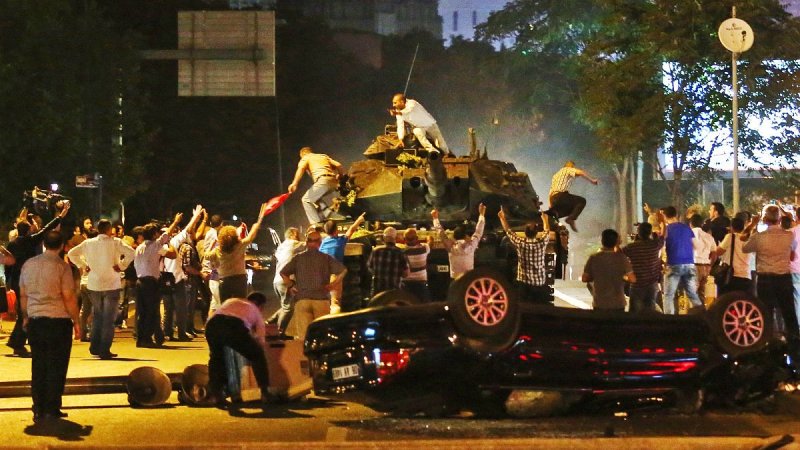
Turkish authorities have announced the arrest of a man accused of participating in the failed attempt to assassinate President Recep Tayyip Erdoğan during the 2016 coup attempt.
According to the Interior Ministry, the suspect, identified only by the initials B.K., was captured in a coordinated intelligence operation after being wanted under an Interpol Red Notice.
Officials say he was a former army captain and helicopter pilot linked to the Fetullah Terrorist Organization (FETO), which Türkiye holds responsible for orchestrating the failed coup. The arrest has once again drawn attention to the long-running investigations into the events of July 15, 2016, and Türkiye’s continued efforts to locate individuals accused of involvement in the attempted overthrow of the government.
Who is the suspect arrested by Turkish authorities?
According to Türkiye’s Interior Ministry, the arrested suspect has been identified only by the initials B.K.
Officials stated that he is a former army captain and helicopter pilot who was dismissed from military service following the failed coup attempt in July 2016.
The ministry alleges that B.K. was part of the group assigned to carry out an attempted assassination of President Recep Tayyip Erdoğan while he was staying in the coastal resort town of Marmaris during the coup attempt.
Authorities also said the suspect had been the subject of an Interpol Red Notice, indicating that Turkish law enforcement had sought international assistance in locating and arresting him.
The operation leading to his arrest was reportedly conducted jointly by intelligence units from the provinces of Afyonkarahisar and Eskişehir, working under the coordination of Türkiye’s Security Directorate Intelligence Department.
Counterterrorism police ultimately detained the suspect in Afyonkarahisar following intelligence-gathering and surveillance operations.
Turkish officials have not publicly disclosed additional operational details regarding where the suspect had been living or how long investigators had been tracking his movements before the arrest.
The detention represents another development in Türkiye’s continuing investigations into individuals accused of participating in the events surrounding the failed coup attempt.
What happened during the attempted assassination in Marmaris?
One of the most dramatic episodes of the failed coup unfolded in the early hours of July 16, 2016, in the resort town of Marmaris on Türkiye’s southwestern coast.
President Erdoğan had been staying at a hotel there while on holiday when military personnel allegedly assigned to capture or kill him launched an operation against the location.
According to Turkish authorities, Erdoğan departed the hotel shortly before the assault began, avoiding the attackers by a relatively short period.
Security personnel protecting the president engaged in armed clashes with the attackers after they reached the hotel.
The incident became one of the defining moments of the failed coup because it demonstrated that the operation allegedly targeted not only government institutions but also the country’s political leadership.
Subsequent criminal investigations resulted in numerous prosecutions involving military personnel accused of participating in the Marmaris operation.
Turkish courts later convicted many defendants for their alleged roles in the attempted assassination, while authorities continued searching for additional suspects believed to have escaped arrest.
The latest detention announced by the Interior Ministry is presented by Turkish authorities as part of those continuing efforts to identify and apprehend everyone allegedly connected to the operation.
What is FETO, according to Türkiye?
The Turkish government designates the Fetullah Terrorist Organization, commonly referred to by the acronym FETO, as a terrorist organization.
Turkish authorities accuse the movement, led by the late Fetullah Gülen, of infiltrating state institutions over many years before organizing the failed coup attempt in July 2016.
According to Ankara, members of the organization established networks within the military, police, judiciary, education system and other public institutions.
Following the coup attempt, Türkiye launched extensive investigations targeting individuals accused of links to the organization.
Thousands of military personnel, judges, prosecutors, civil servants, academics and police officers were dismissed, arrested or prosecuted under anti-terrorism legislation.
The Turkish government maintains that dismantling FETO’s organizational structure remains a national security priority.
However, the characterization of the movement has been the subject of international debate, with some governments and human rights organizations expressing concerns about the scope of post-coup investigations and legal proceedings.
Türkiye continues to insist that FETO remains an active security threat and regularly announces operations targeting individuals accused of belonging to or supporting the organization.
What is an Interpol Red Notice?
An Interpol Red Notice is an international request circulated through the International Criminal Police Organization to help locate and provisionally detain wanted individuals.
Contrary to common belief, a Red Notice is not itself an international arrest warrant.
Instead, it informs law enforcement agencies around the world that a member country is seeking a person’s arrest for extradition or legal proceedings under its domestic judicial system.
Each country decides independently whether and how to act upon a Red Notice according to its own national laws.
Red Notices are commonly used in cases involving terrorism, organized crime, homicide, financial crimes and other serious criminal allegations.
When a person subject to a Red Notice is located, authorities may detain the individual while legal procedures concerning extradition or prosecution are considered.
In this case, Turkish officials stated that the arrested suspect had been wanted under an Interpol Red Notice before being located inside Türkiye.
The use of international police cooperation demonstrates how governments coordinate investigations involving individuals believed to have crossed borders or remained at large for extended periods.
Why are investigations into the 2016 coup still continuing?
Although the failed coup occurred a decade ago, Turkish authorities continue investigating individuals alleged to have participated in its planning or execution.
Large-scale events involving thousands of participants often generate lengthy investigations requiring years to identify suspects, gather evidence and complete judicial proceedings.
Some individuals accused of involvement reportedly fled Türkiye following the coup attempt, leading authorities to pursue international cooperation through extradition requests and Interpol mechanisms.
Others have been arrested years after the events as new intelligence, witness testimony or investigative evidence became available.
Authorities also continue examining alleged organizational structures, financial networks and communication systems believed to have supported the coup plot.
The continuing investigations reflect the Turkish government’s position that accountability remains necessary for all individuals allegedly involved, regardless of the time elapsed since the attempted overthrow.
At the same time, legal proceedings connected to the coup continue attracting international attention because of their scale and long-term political significance.
The latest arrest demonstrates that Turkish security agencies remain actively engaged in pursuing unresolved cases connected to July 2016.
What impact did the failed coup have on Türkiye?
The events of July 15, 2016, remain one of the most consequential moments in modern Turkish political history.
According to official figures cited by Turkish authorities, the failed coup attempt resulted in the deaths of 253 people and injuries to 2,734 others.
Following the defeat of the coup, the government declared a nationwide state of emergency and initiated extensive security operations across the country.
Major institutional reforms followed, affecting the military, intelligence services, judiciary and public administration.
The government also introduced constitutional changes that transformed Türkiye’s political system, expanding presidential powers under a new executive presidency.
Beyond institutional reforms, the events significantly influenced Türkiye’s domestic politics, foreign relations and national security policies.
Annual commemorations continue to honor those killed during the coup attempt, while government officials frequently emphasize the importance of preventing similar threats in the future.
The latest arrest therefore represents more than an isolated law enforcement operation. It forms part of Türkiye’s continuing effort to address one of the country’s most significant political and security crises, an event whose legal, institutional and political consequences continue shaping Turkish public life nearly a decade later.