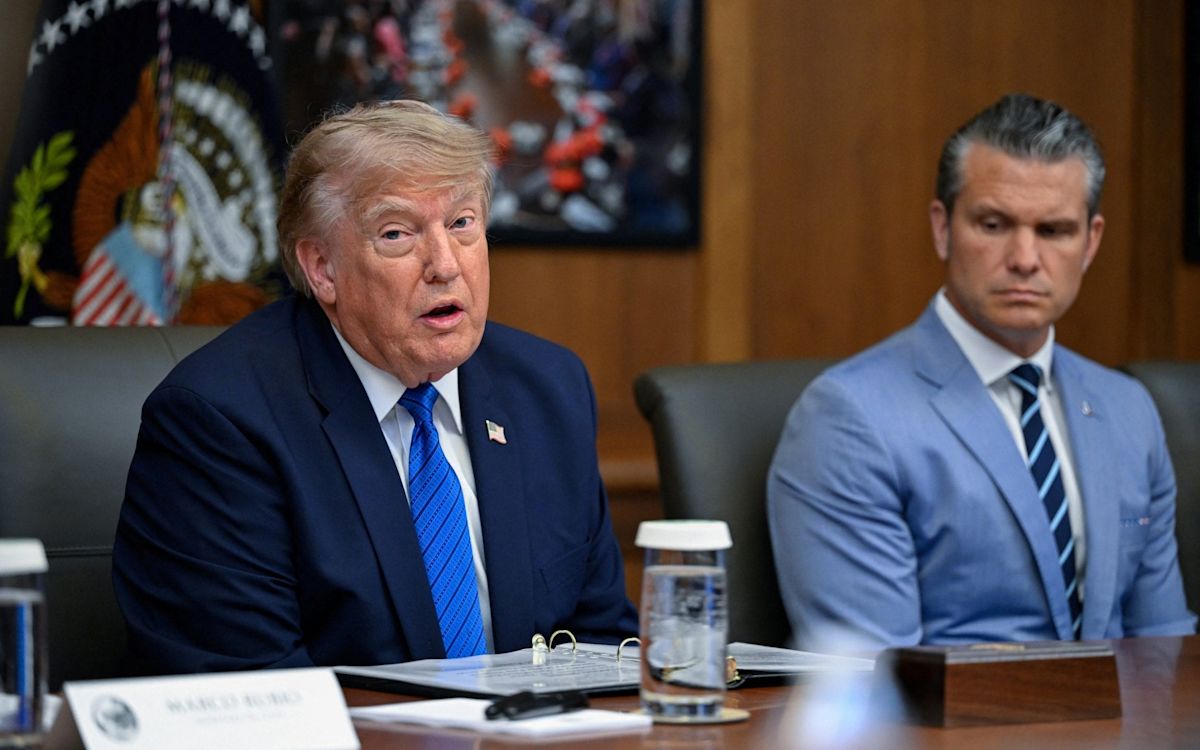
Donald Trump clashed with Pete Hegseth over a claim that a US munitions shortage could limit his options in the Iran war, according to reports.
The US president confronted his defence secretary at Camp David, his country retreat in Maryland, demanding to know why he had been misled about the missile shortage.
The clash occurred on the sidelines of Mr Trump’s cabinet meeting on Friday, at which he said that he thought the missile issue “had been fixed”, two people familiar with the matter told the Washington Post.
The White House dismissed the claims as “fake news”, denying that the encounter had taken place.
The US has reportedly used “virtually all” of its missile stockpiles as the Iran war drags into its sixth month. The shortages, understood to be of long-range guided missiles and air-defence interceptors, allegedly contributed to it pulling back from new strikes in recent days.
Mr Trump said on Monday that he had ordered, and then called off, “the biggest attack since World War Two”.
Mr Hegseth blamed Stephen Feinberg, his deputy, for the shortages and for not ensuring Mr Trump was aware of the issue, the sources said.
The defence department’s second-in-command later gathered top military and defence specialists for a meeting on Friday night to address the issue after receiving an angry phone call from the president.
Mr Trump expressed frustration that the Pentagon’s munitions shortfall was affecting whether he could expand his operation in Iran, four people with knowledge of the meeting told NBC.
he even suggested that Mr Feinberg should be fired, demanding to know how the Pentagon was fixing the problem.
The meeting convened by Mr Feinberg after the call was described as “a crisis meeting”. He has taken a leading role in attempting to replenish the munitions stockpile.

Stephen Feinberg, Pete Hegseth’s deputy, has been blamed for the munitions shortages – Win McNamee/Getty Images
The scarcity of US munitions also affects areas beyond the war in Iran, with Ukraine also running out of air defences.
However, writing on Truth Social, Mr Trump claimed that the US had “massive” amounts of missiles.
“Defence companies are building the largest number of plants and factories in our country’s history. The ‘leakers’ of these treasonous statements are being hunted down. Long-term jail sentences will be sought,” he said.
Karoline Leavitt, the president’s press secretary, wrote on X: “I was at Camp David with President Trump and Secretary Hegseth. This literally never happened, and we told the Washington Post that repeatedly.
“This B.S. story was shopped to many outlets by someone clearly out to disparage the Secretary, for whatever reason. Unfortunately for them, the President loves the Secretary and thinks he’s doing a tremendous job. FAKE NEWS!”

Karoline Leavitt, the president’s press secretary, denied there had been a clash between Mr Trump and Mr Hegseth – Chip Somodevilla/Getty Images
The affected weapons in the shortage are understood to be the army’s highly accurate surface-to-surface munitions, known as army tactical missile systems (Atacms) and precision strike missiles (PrSM).
Testifying before the Senate in July, Mr Hegseth clashed with Democrats over whether he provided Mr Trump with an honest assessment of the war in Iran.
The defence secretary declined to discuss his advice to the president during the hearing and instead blamed the munitions shortage on the Biden administration.
Mr Hegseth asked legislators to approve $67bn (£50bn) of extra defence spending as he claimed that the conflict had already cost a total of $37.5bn.
The true cost of the war, however, is understood to be higher, with a Telegraph analysis placing the total figure closer to $151.3bn.
