
Eirik Hystad Solberg / photo: Norges Skiforbund
Norwegian technical skier Eirik Hystad Solberg made one of the World Cup’s biggest jumps last season. He earned four top-10 slalom finishes, placed seventh at his first Olympics, and moved into the top 15 on the World Cup slalom start list.
His rise is especially notable because he grew up far from Norway’s major ski centers. Solberg trained skiing primarily on weekends, played soccer, and did not follow a regular weight-training program before entering a ski academy at 16.
This July, he recorded the second-highest score in the Norwegian Alpine Team’s annual Ironman physical test. He also holds the overall Ironman record.
In exclusive interviews with Ski Racing Media, Solberg and longtime Norwegian Sports Science Director Robert Reid discussed the training, curiosity and work ethic behind Solberg’s unlikely climb.
Solberg’s World Cup Breakthrough
Solberg made significant progress during the 2025-26 season. He finished seventh in slalom at his first Olympics, and his World Cup season was equally impressive.
He started the season with bib No. 49 in slalom and No. 35 in giant slalom. Thanks to solid results, he now ranks 15th on the World Cup slalom start list and 28th on the World Cup giant slalom start list after only 25 career World Cup slalom starts and 14 in giant slalom.
He earned four top-10 finishes, all in slalom, led by fifth place in the Madonna di Campiglio night slalom.
What did he consider the greatest highlights during last season?
“Tough question. I think Madonna was cool. It was a pretty tight race and ending up fifth. I’d say Schladming was maybe my best race, execution-wise. I could say the Olympics, because that was also cool.”
He concluded: “I’d say Schladming and Madonna were the highlights.”
What worked so well in Schladming?
“It was icy and the second run course was a difficult set, or slow-speed turns, which I’m usually good at.”
Click on the images to enlarge
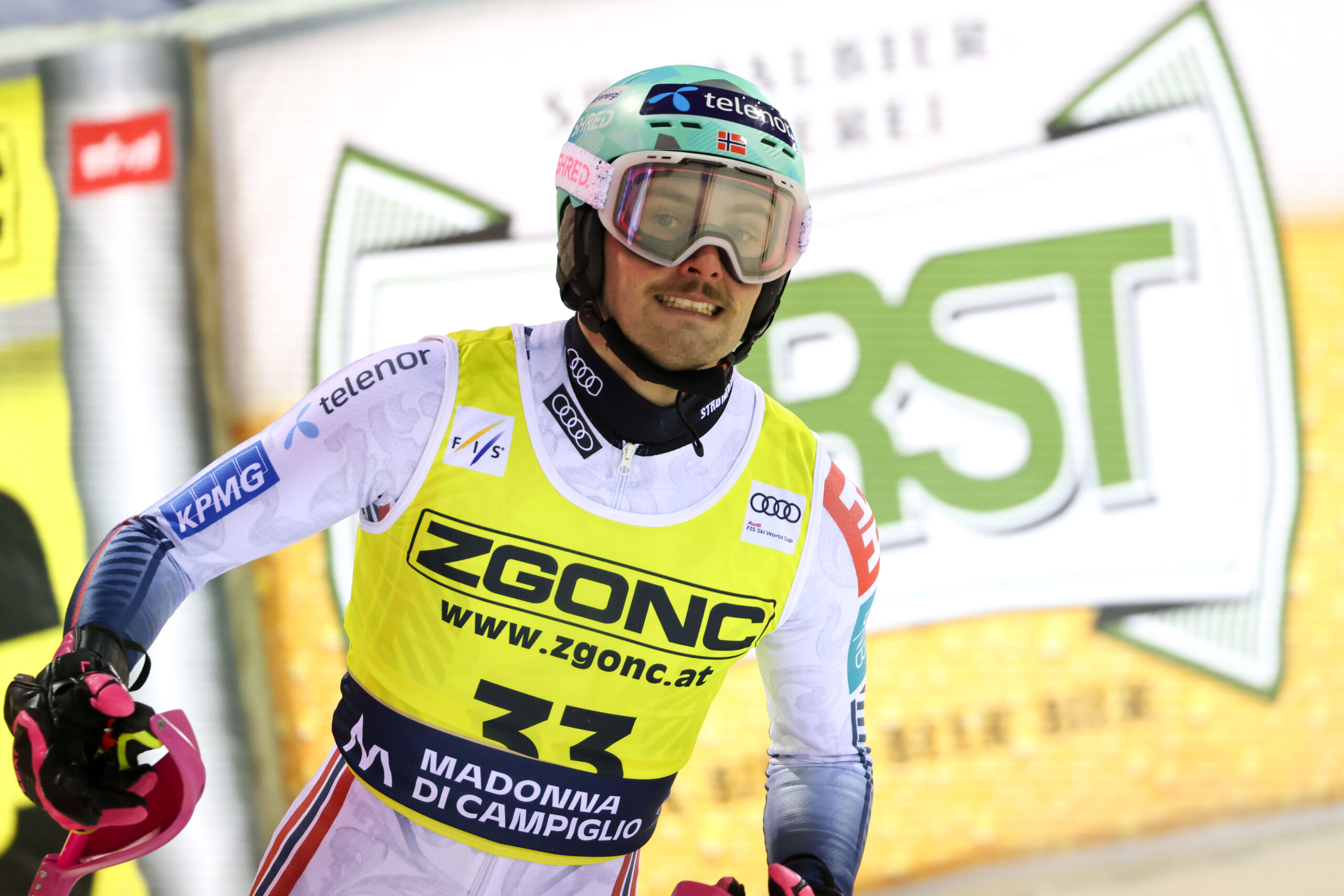 MADONNA DI CAMPIGLIO, ITALY, 07.JAN.26 – Eirik Hystad Solberg (NOR). Photo: GEPA pictures/ Mathias Mandl
The Realization That Changed His Racing
What was the most important development for him overall last season?
“I think when you realize that it’s not that difficult. The previous season, or in the 2024 season, I felt like I was doing my best and always missing it. This season, I’ve just skied normally and realized that I’m not that far off.
“Also, when you get to know the other guys that you are competing with and realize they are not special, they’re not different than you.”

A Memorable World Cup Debut
Solberg started his first FIS race in November 2018 and made his Europa Cup debut three seasons later, in January 2022. After missing the 2022-23 season due to injury, he made his World Cup debut at the legendary Hahnenkamm slalom in Kitzbühel in January 2024, finishing 18th.
A week earlier, he captured his first Europa Cup victory in Berchtesgaden, Germany. Conditions in Berchtesgaden and Kitzbühel were icy, which Solberg prefers.
“I had some confidence coming in. But I never expected to make the top 30,” Solberg said about his World Cup debut.
“I struggled to sleep the night before.”
Still, the competition was not the most nerve-racking part. The night before a Norwegian team member makes a World Cup debut, the athlete must deliver a “rookie speech” at the team meeting.
“So, I would say most of the guys are more nervous for the speech than the actual race,” Solberg said, smiling. Yet Solberg’s route to the World Cup was far from predictable
An Unusual Ski Racing Background
Solberg grew up in Stavanger on Norway’s southwestern coast, an oceanfront city with a mild climate, rainy winters and little snow.
Young Eirik started skiing when he was four or five. His parents bought a small apartment at the nearest ski area in Sirdal, about 90 minutes inland from Stavanger.
Solberg, his younger sister, Oda, and their parents traveled to Sirdal on weekends, where he skied all day. Oda, now 18, also competes in FIS races.
“Up until I was 14 or 15, I only skied on the weekends and played football and did other stuff — like a normal kid growing up in Stavanger,” Solberg told Ski Racing Media.
In addition to weekend skiing and weekend races, Solberg attended summer ski camps at Folgefonna and occasionally trained in Hintertux, Austria, during the fall as he grew older.
His path differed from those of many national team teammates from the Oslo area and from larger ski areas.
“During the winter, I never trained skiing after school like the guys from Oslo do.”
Community, Friendship and Time to Play
“It’s special to think about that I ended up here, and it feels coincidental,” Solberg said. “My parents didn’t ski when they were young, so we just found our community up there and it was pretty fun.”
There were four skiers his age in his home club, Skiforeningen Stavanger, and several young athletes from other regional ski clubs who also trained in Sirdal.
“All three clubs trained together on the weekends. We were five guys skiing together; we all kept pretty close to one another from an early age.
“Eventually, some of the guys quit, but I think that’s a big part of it; having friends or looking forward to meeting your friends up there at the resorts,” Solberg said.
These friendships gave him a reason to return each weekend before elite competition became a realistic goal.
What made Solberg choose skiing over other sports?
“I figured I had a talent for it, and it was pretty fun, not just the racing stuff but just skiing itself was fun. I never really chose it, but I never stopped.
“We didn’t have coaches in the clubs. It was all parents organizing, so not super organized gate training. A typical Saturday would be one to two hours with drills, exercises with some of the parents that skied themselves.”
After lunch, there would be an hour or two of gate skiing.
“And then we were always like, ‘Ah, how many more runs do we have to do before we can go and play?’ So that was the fun part of it.”
The schedule combined drills and gate training with the free skiing Solberg enjoyed most. He still knows how to play while skiing, occasionally mixing slalom turns and backflips into the same run.
The Move to Oppdal Ski Academy
Solberg won the under-16 boys’ slalom at the 2018 Pokal Loka international children’s competition in Slovenia.
He played soccer at a relatively high level, but by age 16, he decided to attend the respected ski academy in Oppdal and focus fully on skiing.
Until then, he had stayed active through outdoor play, swimming and soccer, while skiing remained secondary to soccer. Weight training had not been part of his routine.
“I had strong endurance and mobility, stability, agility from football — obviously, a good base that I took with me when I started doing weightlifting. But coming into Oppdal, I weighed 55 kilos and barely squatted 70 kilos.
“I think I had a lot of body control from a young age. A lot of kids set goals when they are eight to 10 years old to be the best at something. I was kind of drifting along, just playing, having fun,” he said.
How Did Oppdal Transform Solberg’s Approach to Training?
Attending Oppdal changed his training. During his first week, students completed a demanding block of dryland training and other sports known as “Hell Week.”
“That first week was a brutal hit for me, and my first realization was, ‘Wow, this is what they’re doing up here.’ I became interested in how to get stronger and become more fit, and that interest really grew in me. So, I’ve been pretty consistent from that week on.
“At Oppdal, I was not the strongest or fastest or biggest or whatever. So, I remember fearing, ‘What if the day I come into the national team, I’m the smallest guy, lifting the least, running the slowest?’”
Solberg found motivation in the strength gap between himself and his peers.
“When you come into a group and all the other guys are stronger than you, you kind of follow. I found it motivating, but it took a couple of years before I fully caught up.”
Other benefits of training at Oppdal included working with coach Niklas Kjelsli, now a Norwegian men’s World Cup technical team coach, and training with older athletes, including Alexander Steen Olsen and Fredrik Møller.
Living in Oppdal also gave Solberg regular access to snow at the ski area in town. Instead of skiing only on weekends, he could train with the academy five days a week.
Curiosity as a Competitive Strength
Solberg comes across as a focused athlete, intentional in his mindset, evaluation and choices.
How would he describe himself as a person?
“I’d say I’m a curious guy. I like seeing improvement. I know I may come across as a cold, distant type, but I feel like I’m focused on details, so the surface stuff goes past my head.
“When I come across a new exercise, I always try to figure out why and how it works and where it could work and when.”
He points to his mindset, agility and skiing skills as his strengths.
That curiosity has also shaped his approach to physical training. He wanted to understand each exercise rather than simply complete it.
What Is Norway’s Ironman Test?
The Norwegian Ski Federation’s Ironman test consists of eight exercises conducted according to set guidelines to ensure comparability:
3,000-meter run — aerobic endurance
Hexagonal obstacle test — alpine-specific speed and coordination
One-repetition maximum squat — maximum leg strength
Sub-maximum squats — repeated leg strength
One-repetition maximum bench press — upper-body strength
Chin-ups — upper-body strength
Brutal bench — abdominal strength
90-second box jump — alpine-specific endurance
“Our analysis of the physical characteristics of alpine skiers that we’re working towards — we call it ‘Jack of all trades, master of none.’ The concept is that we want to be quite good at everything, not necessarily extreme on anything,” Sports Science Director Reid said.
The Ironman takes around four hours to complete. Results are converted into points using a standardized table. The test provides athletes and teams with a tool for evaluating physical condition and yearly progress.
The senior Ironman is used from approximately age 17, depending on an athlete’s physical maturity and strength level. When appropriate, younger athletes continue with the Ironman Junior test after turning 17.
In recent years, athletes have been required to meet a minimum Ironman score to be considered for the Norwegian national team. The federation also considers their skiing results and abilities.
The 2026 Ironman Results
In late July, the Norwegian Alpine Team conducted its annual Ironman test at Olympiatoppen, Norway’s Olympic training center in Oslo.
For the third year in a row, Solberg delivered one of the highest total scores.
Hans Grahl-Madsen recorded this year’s highest men’s score with a personal-best of 1,083 points. Solberg followed in second with 1,029, while Atle Lie McGrath exceeded 1,000 points for the first time, totaling 1,006.
Marte Monsen led the women with a personal-best of 846 points, followed by Madeleine Sylvester-Davik with 805.
In total, 10 athletes set overall-score personal records, and the team recorded 66 personal bests across the individual exercises.
A new calculation system implemented this year made the sub-maximum squat test more neutral in relation to body weight and adjusted how individual exercises contribute to the total score. The changes reward athletes who perform well throughout the test rather than excelling in fewer areas.
With previous scores converted to match the new system, Solberg holds the all-time men’s record with 1,273 points from 2025. Aleksander Aamodt Kilde ranks second with 1,150 points from 2018.
Thea Stjernesund holds the women’s record with 1,157 points from 2023, followed by Kajsa Vickhoff Lie with 1,123 points from 2024.
Solberg also set a team record in the 3,000-meter run this year, completing the distance in 10 minutes, 8 seconds.
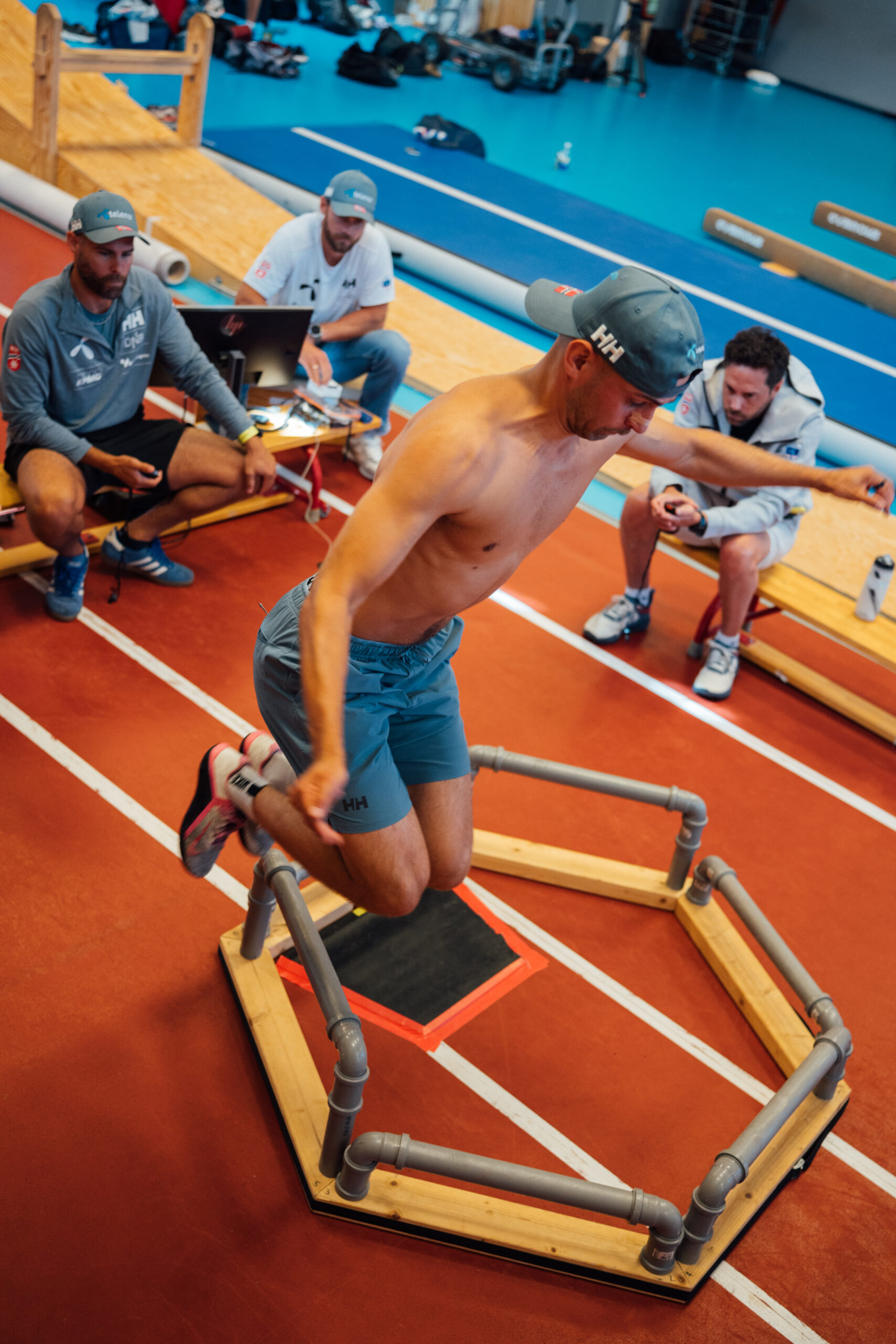 Eirik Hystad Solberg Hex Jump Test, Photo: Norges Skiforbund
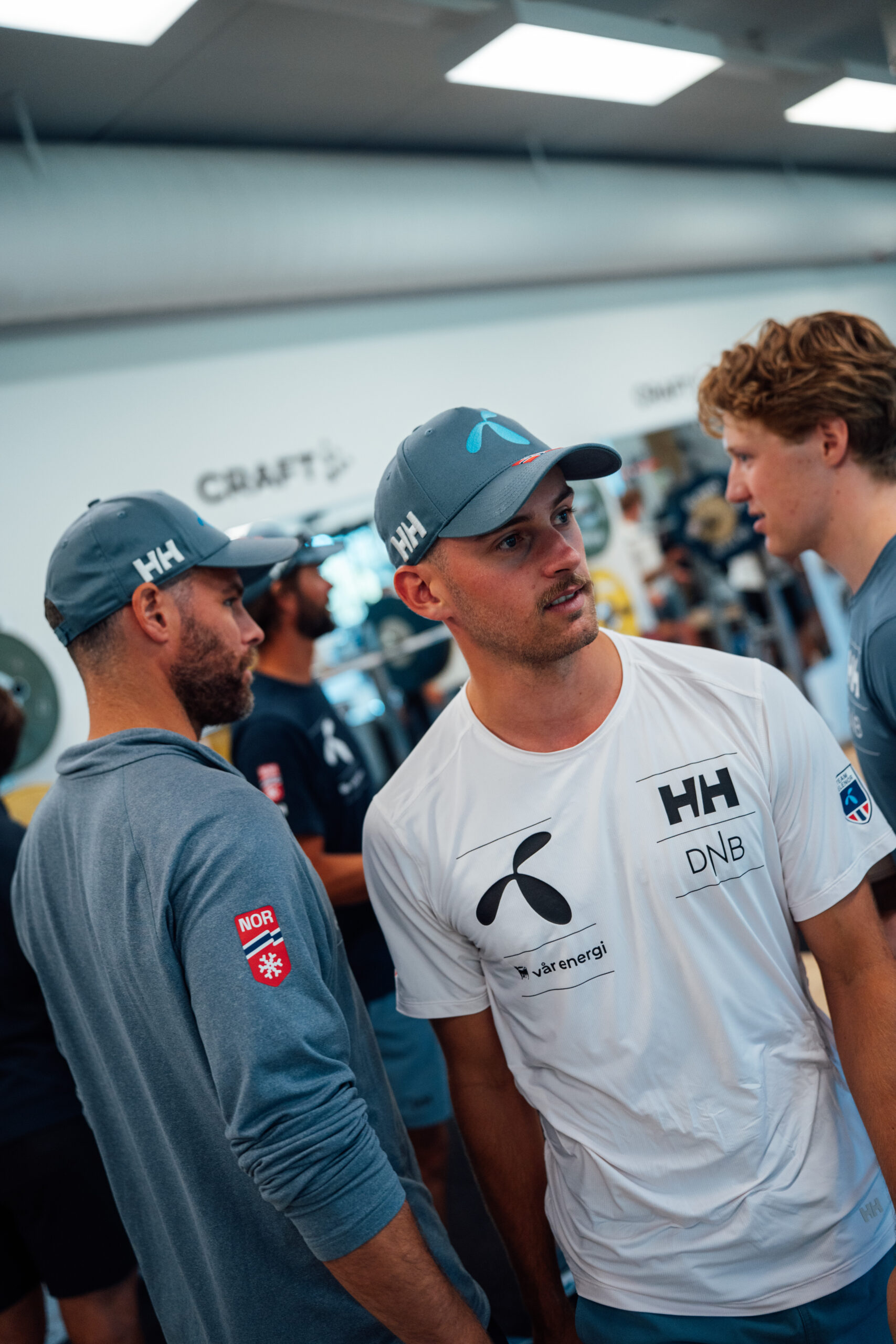 Eirik Hystad Solberg Ironman test, Photo: Norges Skiforbund
How the Ironman Became Part of Norway’s Culture
In the early 2000s, Reid, originally from the United States, worked as a conditioning coach for the Norwegian Alpine Team. In 2002, Reid and coaches Pella Refsnes and Jan Wojtaszek wanted to change the existing testing system and created the team’s Ironman test. Coach Mike Pilarski later joined the process.
“Originally, it was partially based on what was the old Medals Test in the U.S. when I grew up racing,” Reid told Ski Racing Media. “I did that both as an athlete and then, later, when I was working in the Ski Federation in the U.S., I traveled around to help conduct this test in the different regions.”
When creating the Ironman, the Norwegian staff moved away from laboratory-based testing and adopted more basic field tests.
They also wanted athletes to view the day as a competition rather than a test evaluation.
“In a lack of creativity, we called it the Ironman. It was just for the World Cup men at that time, and we conducted it as a type of decathlon.”
Over time, interest spread to other Norwegian team groups and ski academies. Reid began traveling around Norway in 2011 to help academies conduct the test according to common standards.

How Did the Ironman Test Shape Norway’s Training Culture?
“The whole process was actually not about the test itself, but about the culture for training,” Reid said.
“We wanted to get back to where the cool thing was doing the gritty hard work — and to inspire the next generation of athletes to really take that work seriously.
“It’s about raising the physical level, but it’s not just that. It’s the culture of working hard, discipline, doing the basics and understanding that hard work gets results.”
Reid said the test is intended to encourage athletes rather than eliminate them based on scores.
“It’s not trying to push people out; it’s trying to bring people in,” he said. “The goal is to identify effort and praise people for effort.
“If they can go in and do those eight tests and do their absolute best on each and every test, without thinking about the numbers, just do your best, then I think you should go away from that day, no matter what the numbers are, and say, ‘That was a good day!’”
Learning Before Loading
Ironman Junior is designed for athletes ages 12 to 16. The standing long jump replaces the one-repetition maximum squat, while push-ups replace the one-repetition maximum bench press.
Learning correct lifting technique for future back squats is an important focus. Athletes typically practice squat technique using body weight and an unloaded bar, such as a broomstick. They do not complete the senior sub-maximum squat test with added weight.
“The weight doesn’t get added until 17, depending on the athlete,” Reid said.
No total score is awarded. Instead, the focus is on learning to perform the exercises correctly, giving a full effort and gradually building a broad foundation of physical skills.
How Did Solberg Build His Physical Foundation?
Solberg offers a strong example of an athlete making consistent, gradual progress over time.
During his first Ironman Junior test at Oppdal in the fall when he turned 16, Solberg earned points in only two exercises.
“I scored 200 points — a hundred on the 3K and a hundred on the hexagonal obstacle. And that was it,” Solberg said with a chuckle.
The ski academy conducted testing twice a year, typically in May and September. Solberg enjoyed seeing his progress from one test to the next.
Reid used Solberg’s development to explain why young skiers do not need to begin heavy lifting early.
“I think that shows you don’t need to start squats too early. You can be smart about that progression through childhood and the youth years.
“When we look at alpine skiing, the demands of skiing are so broad. We want to build that foundation. We can train many different things, and everything transfers as important. Being generally active, doing lots of stuff and having fun doing it is the bottom line.
“You don’t need to start doing squats until after a while. Start to work on technique. Then, as you get into the ski academy type of age, start doing squats and progress in a healthy way into lifting when your maturity is there.”
The Risks of Early Specialization
Reid voiced concerns about early specialization in alpine skiing.
“I think a lot of our challenge is that we focus too much on short-term results and not enough on long-term development,” he said. “I often use a pyramid when talking about that. Our philosophy is to build out the base of the pyramid so that we can build the top of it higher.”
A young skier might progress quickly through large volumes of on-snow training. However, Reid believes problems can arise when technical ability develops faster than physical capacity.
“Maybe at younger ages, you’ll have rapid progress, but in the long term your foundation is not there,” he said.
“It leads to high skill-level development, but you don’t have the physical capabilities to match that skill level. That’s when, in my mind, skiing can be directly dangerous. They can ski fast with high forces, but they don’t have the physical side to back it up.”
Reid said the mismatch can place athletes in dangerous situations and contribute to long-term injuries.
“That’s why I think it’s so important that the physical side needs to go hand in hand with the technical side, and short-cuts are almost always a problem in the long term.”
He also emphasized the value of varied training.
“Overspecialization undermines that. It’s too one-sided, so you’re not off exploring and having fun with different kinds of activities. We use secondary sports at the Norwegian national team level a lot. From hockey to tennis to wrestling and jujitsu, we’re using these sports as training arenas.”
What Do World Cup Winners Have in Common?
Reid has analyzed data collected through more than two decades of Ironman testing.
“Now we have enough athletes where we can start looking at, ‘What do World Cup winners do? What does their profile look like?’” Reid said. “For repeated World Cup winners and other Olympic and World Championship athletes, there are two things that consistently shine through: The overall score, which is not surprising, and the other one is actually the 3,000-meters.”
Reid pointed out that some might question why the 3,000-meter run is part of a test battery for alpine skiers. To him, the reasons are clear.
“It is a measure of aerobic capacity,” Reid said. “It is nice in its simplicity and it’s every bit as much of a mental test as it is a physical test. It is a test of being willing to push yourself and to be uncomfortable for a period of time.
“They start to understand they can push themselves, it’s not dangerous and that’s a natural part of training. They learn how to do that and how to be robust.”
Reid also pointed to the training volume required to become a top skier.
“Looking at, ‘What are the demands to do the volumes of on-snow training and physical conditioning over time that are required to become a top alpine skier?’ We’re looking at that level, and then I think the 3,000-meter is a more appropriate test.”
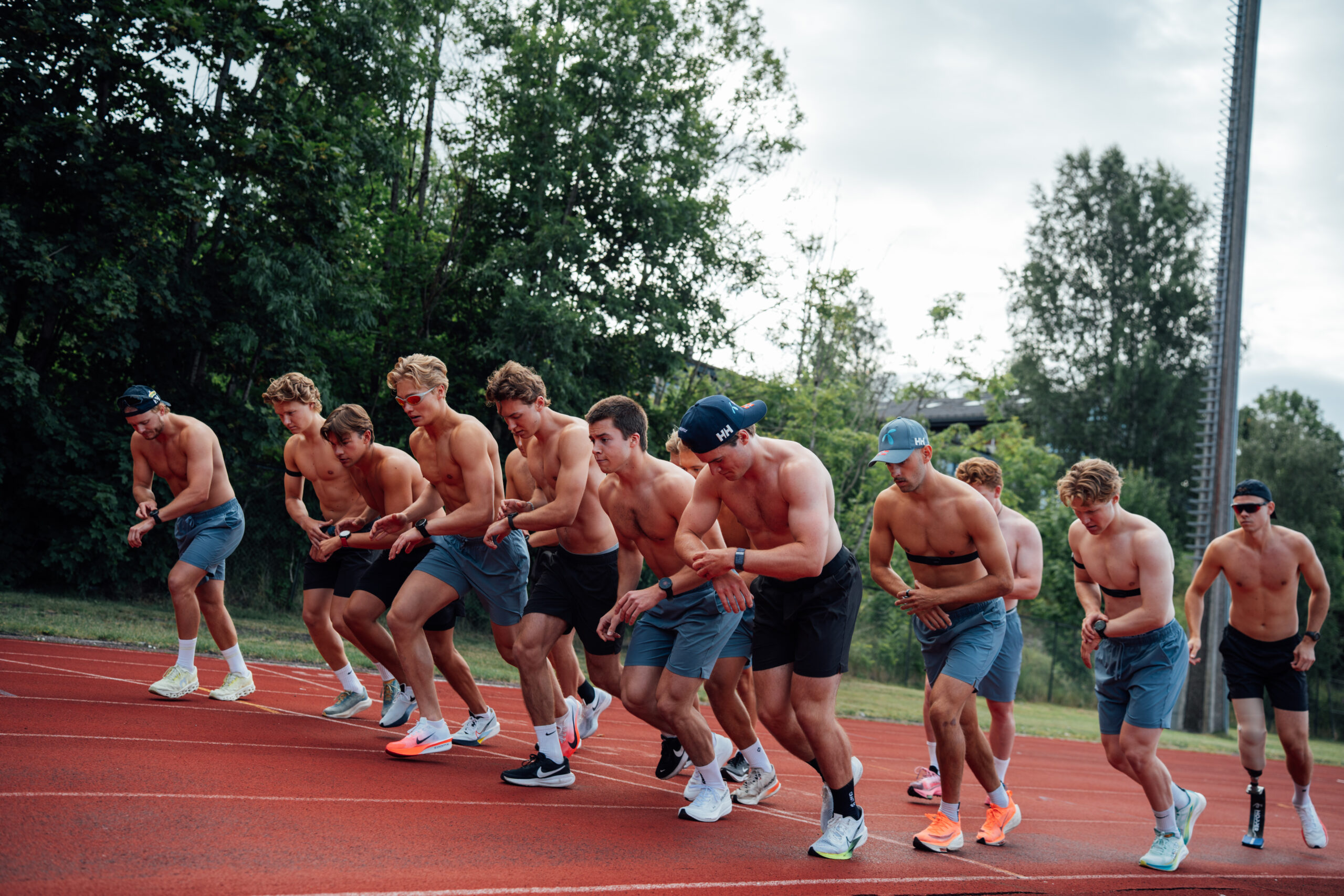 Norwegian Ironman 3000-meter run, photo: Norges Skiforbund
How Fitness Supports Solberg’s Skiing
Reid praised Solberg’s work.
“Eirik is just phenomenal. His dedication, work ethic and the culture for doing the work that’s needed to get there is at the very highest level. I think that is why you see him coming from a non-traditional background to the level he has achieved in racing. It is just so impressive, and the physical side is at a really high level.
“The physical aspect of it is obviously key, but that’s not the only part of it. The other part is his work ethic to get to that level. That’s really the point; it’s getting back to the culture and the grit to do the work that needs to get done every single day. Eirik has that.”
How Does Solberg’s Fitness Protect His Technique Under Fatigue?
Solberg sees the greatest benefits of his physical preparation when fatigue begins to affect his skiing.
He used the November 2025 World Cup giant slalom at Copper Mountain, Colorado, as an example.
“The season’s toughest race for the body was Copper, the GS,” he said.
Each run lasted around 1 minute and 15 seconds at an elevation above 3,000 meters. In the second run, Norwegian coach Kjelsli set the course.
“The speed was pretty slow during the middle section, so the legs started burning. Just seeing that I can ski technically well in the last sectors is good.
“Coaches tend to say, ‘If you feel tired, just think about how tired the other guys are feeling,’” Solberg added.
His physical condition also helps during training and equipment testing.
“Seeing that you can do more quality runs and still perform well technically on the fourth or fifth run of the day is valuable. You can do a lot more with equipment setups and do different things tactically if the technical stuff is the same every run. And with good physical preparation, you can ski technically clean every run.”
From Making the Second Run to Chasing Podiums
For the 2026-27 season, Solberg sees the benefits of his improved World Cup starting position and the confidence created by last season’s results.
“Having the goal of putting yourself in the position to defend good results or chase podiums, rather than the goal of getting to a second run.”
Preparations for the new season include mental focus and learning to manage his physical effort more efficiently.
This spring, the Norwegian Alpine Team spent one week at Haakonsvern, the Norwegian Navy’s main base.
“That was really tough. That was more mental focus, rather than physical training, and also switching off. Because everyone is pretty good at switching on when we need to, getting into the zone and the rhythm like on a race day. But most of us struggle after hard training sessions and then switching off and relaxing, getting ready for a new one.
“We mixed groups also. Everyone has their own voice, and everyone has been through different stuff. That was nice, combining all the groups and sharing — not just between us on World Cup men, but also Europa Cup and the women’s team.”
During his season preparations, Solberg wants to continue learning how to distribute his physical capacity efficiently by not using more power than necessary.
“That’s a point I’m getting a lot better at these past couple of years; not using all your force every turn, seeing how little you can engage your muscles.”
He also wants to increase his awareness of when and how he uses the smaller muscles involved in stabilizing and executing a ski turn.
Overall, he feels like he is on a good track.
“I think, never change a winning recipe. So, staying consistent with what I’ve been doing and being curious about how to improve.”
Eirik Hystad Solberg NOR, Box Jump Ironman test, Video: Norges Skiforbund