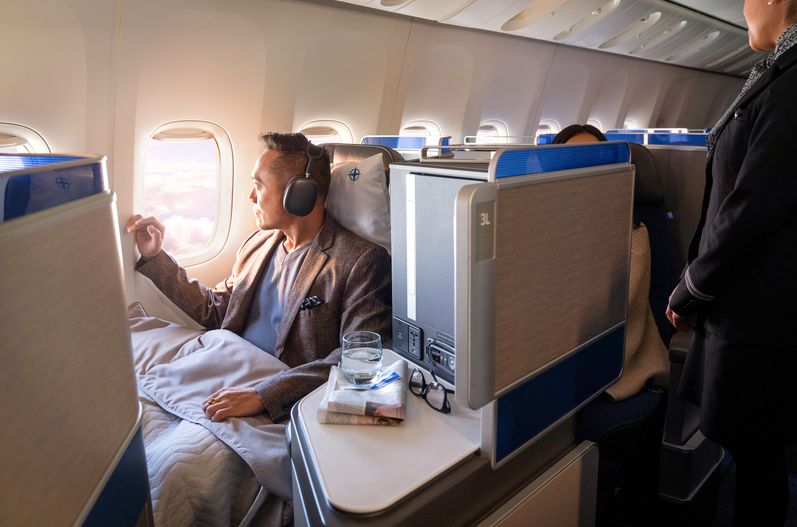
United Airlines recently announced that it is lowering some long-haul business-class fares in its Polaris cabin — the one with lie-flat seats — making them cheaper. I was intrigued but also a little skeptical.
As a longtime United loyalist with 1K status, I was concerned about how this new tiered fare structure would affect clearing PlusPoints upgrades. At the same time, the prospect of possibly affording a business-class fare without waiting for an upgrade was appealing. So I did some research to learn more about these new “base” fares for premium cabins.
United’s new business-class fares, explained
United is rolling out three business-class fare types — Base, Standard, and Flexible — across long-haul international flights, transcontinental routes, and select longer flights to Hawaii.
The new Base fare is where the shift happens.
It’s the lowest price point for business class, but also the most restrictive. Travelers may have to pay to select a seat ahead of check-in. Checked baggage allowance is lower than on traditional premium fares. Tickets can’t be changed or refunded. And Polaris lounge access — one of the defining perks of flying business class — isn’t included.
On certain longer Hawaii routes — including flights from hubs like Newark and Chicago — United is also expanding Polaris-style service, meaning these same fare rules will apply on some domestic flights as well.
Instead, base-fare passengers will have access to the standard United Club, which offers a noticeably different experience from the quieter, more premium Polaris lounges designed specifically for long-haul travelers.
Standard and Flexible fares largely preserve the traditional business-class experience, bundling in perks and flexibility at a higher price.
If this structure feels familiar, it should.
United has essentially created a version of basic economy for the front of the plane — something travelers have been bracing for since airlines began aggressively unbundling fares more than a decade ago.
This isn’t new — it’s just new in the U.S.

United is following international carriers in rolling out tiered business-class fares, a model already common outside the U.S.
While this is a first for a major U.S. airline, the concept has already taken hold internationally.
Carriers like British Airways, Air France, and Lufthansa have spent years experimenting with tiered business-class fares, offering lower entry prices while charging extra for things like seat assignments or added flexibility.
The logic is straightforward. Strip out perks, lower the headline fare, and let travelers decide what matters enough to pay for.
In reality, those add-ons have a way of creeping back into the final price — especially on long-haul flights where seat selection and lounge access aren’t exactly optional for many travelers.
United is simply bringing that playbook stateside.
And if the basic economy rollout is any indication, competitors won’t be far behind.
What this means for upgrades and PlusPoints
This is where things get more complicated — and where frequent flyers are paying the closest attention.
United has confirmed that these Base fares won’t be eligible for upgrades. That alone removes one of the more common strategies travelers use: booking Premium Plus and using PlusPoints to move into Polaris.
But the bigger impact isn’t about eligibility. It’s about availability.
If more travelers start buying cheaper business-class seats outright, even with fewer perks, it means more seats are filled earlier. And when Polaris cabins fill up sooner, there are simply fewer seats left to upgrade into.
For Premier 1K members, who already compete for a limited pool of upgrade inventory on long-haul routes, that shift could make PlusPoints even harder to use successfully.
There’s also a behavioral change at play.
Travelers who might have booked Premium Plus with the intention of upgrading could now skip that step and buy a base business-class fare instead. Even if it’s stripped down, it still guarantees the lie-flat seat — which is ultimately what many travelers care about most.
That shifts demand forward into the business-class cabin itself.
And when demand shifts, upgrade dynamics follow.
United is segmenting the flying experience — from Polaris to economy
This move isn’t happening in isolation.
Over the past few weeks, United Airlines has rolled out a series of changes that point to a broader strategy: segment the experience, and price every piece of it.
The airline recently updated its MileagePlus program, adjusting how miles are earned and placing greater emphasis on credit card engagement. At the same time, it’s continuing a major push to upgrade its onboard product — particularly in premium cabins — as it competes more directly with airlines like Delta for high-spending travelers.
Even economy is getting a rethink.
United’s new “Relax Row” turns economy seats into couch-style beds

United Airlines is planning to introduce something called the “Relax Row” starting in 2027 — a new seating option on long-haul flights that turns a standard row of three economy seats into a lie-flat, couch-style bed.
The concept is simple but surprisingly practical. Leg rests fold up to meet the seat in front, creating a flat surface measuring roughly 57 inches long and 30 inches wide. The setup includes a fitted mattress pad, extra pillows, and a blanket, essentially turning the row into a compact bed designed for overnight flights.
It’s expected to roll out on Boeing 787 and 777 aircraft, with between nine and 12 of these rows available per flight. United plans to expand it across more than 200 long-haul routes by 2030.
The target is clear: travelers who want more space than economy, but aren’t willing to pay for business class.
Airlines in other parts of the world have experimented with similar “sky couch” concepts, but this would make United the first North American carrier to bring it to scale.
And like the new business-class fares, it fits into the same broader strategy — break the cabin into more tiers, create more pricing options, and give travelers just enough flexibility to spend a little more for comfort.
Why airlines keep moving in this direction
From an airline’s perspective, this all makes sense.
Unbundling allows carriers to advertise lower starting prices while still capturing revenue from travelers willing to pay for more comfort or flexibility. It also gives them more control over pricing as demand shifts.
For travelers, the experience is more complicated.
On one hand, there is more choice. If you don’t care about lounge access or booking flexibility, a lower-priced business-class ticket could be appealing.
On the other hand, the definition of what’s “included” keeps shrinking.
What used to be standard — picking your seat, checking bags, accessing premium lounges — is increasingly something you have to pay extra for, even at the highest price points.
And once those perks are separated out, they rarely get bundled back in.
The bigger question: what happens next?
United may be the first U.S. airline to roll out basic business-class fares, but it likely won’t be the last.
Delta has hinted at similar ideas in the past, and the broader industry trend is already well established internationally.
The real test will be how travelers respond.
If enough people opt for the lower-priced fares, even with fewer perks, it reinforces the model — and gives airlines even more incentive to continue breaking apart what used to be all-inclusive experiences.
For frequent flyers, the shift is already clear.
Upgrades are becoming less predictable. Loyalty programs are more complex. And the gap between what you pay and what you actually get continues to widen.
As someone who has spent years navigating that system — chasing upgrades, watching inventory, and figuring out when to use PlusPoints — this feels less like added choice and more like a recalibration.
Not of the seat itself.
But of everything that used to come with it