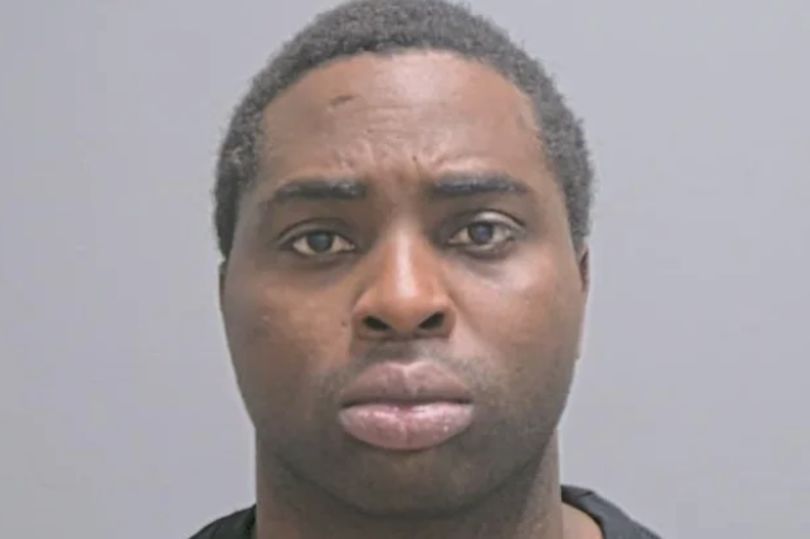
A former child refugee from war-ravaged Congo has been handed a life sentence for a “wicked act of violence” after fatally stabbing a former UEA student during a dispute over money.
Benjamin Katabana, 28, plunged a knife into Uchenna Okirie, 33, in the corridor of student accommodation block Somerleyton House, in Norwich’s Golden Triangle, Norfolk, where both men resided.
The attack was carried out after Katabana lured his victim out of his flat through a series of provocative WhatsApp messages.
The fatal assault was recorded on CCTV within the accommodation block, with the footage showing Katabana delivering an initial stab to his victim.
He then proceeded to launch a sustained assault on Mr Okirie — a former postgraduate student at UEA’s School of International Development, who completed his studies in 2022 — before kicking him in the head.
While Katabana offered a guilty plea to manslaughter, he denied murder outright, yet jurors took fewer than six hours to return a guilty verdict following a trial at Norwich Crown Court.
On Friday, 7 August, Judge Anthony Bate handed down a life sentence with a minimum term of 20 years, stating that Mr Okirie’s life had been “cut short by a wicked act of violence”.
Judge Bate said: “You drew a knife and stabbed him in the back so deep as to penetrate his aorta.
“You kicked and stamped on his head after he collapsed on the floor mortally wounded.”
The judge further noted that while it remained unclear whether Katabana, whom he described as an “angry young man”, had brought the knife to the scene, he maintained it was “plain” that he had “intended to kill”. The judge described Mr Okirie as “a much loved and talented brother and son” who was “entitled to feel safe” within the accommodation block he had called home.
He added that the victim was “taken by surprise and quickly overwhelmed in this brutal attack”.
Katabana, formerly residing at Somerleyton Street, Norwich, appeared via videolink from Norwich Prison when he was sentenced by the judge during a resumption of the hearing, which had originally commenced last Friday.
Regarding the murder, Mr Rose stated that Katabana had, on numerous occasions to his legal representatives, “expressed remorse” for the events that unfolded.
He noted that Katabana had “handed himself in” and “taken responsibility for what he had done”.
Esther Okirie, the victim’s sister, joined the hearing remotely from Nigeria, as she had done the previous week alongside another of the victim’s siblings, Tina.
A victim impact statement read aloud on behalf of the sisters portrayed Mr Okirie as a “remarkable young man” and “extraordinary human being” who was “deeply loved and cherished” by all those around him.
Born in Nigeria, Uche was affectionately known as ‘Common Man’, a nickname his family attributed to his remarkable ability to connect with people from all backgrounds and walks of life.
From a young age, the statement revealed, he displayed outstanding academic aptitude, graduating with a degree in Economics before embarking on a career as an auditor, later relocating to the United Kingdom to further his studies. He secured a place at the University of East Anglia (UEA), where he went on to complete an MSc in Development Economics.
His relatives described him as someone who embraced life with warmth, patience and an infectious sense of optimism.
He had a passion for living joyfully, cherishing music and dancing.
The statement continued, expressing that his passing had created an unimaginable void, adding: “Uche’s death is not merely the loss of a family member; it is the loss of a compassionate soul, a peaceful young man full of dreams, purpose, love, and hope for humanity.”
The trial was told Mr Okirie suffered fatal stab wounds at Somerleyton House following a dispute concerning money.
The fatal incident, which occurred shortly after 5am on 22 November last year, was recorded on CCTV within the accommodation block.
The assault proved “rapidly fatal” despite an air ambulance doctor responding after emergency services were summoned by fellow residents who discovered the victim in the hallway at 5.31am.
The court heard that “life-saving efforts were futile” and Mr Okirie was pronounced dead at the scene.
Katabana, dressed in a yellow hoodie which had blood stains on it, departed the flats, located near Unthank Road, and made his way towards the city centre.
Jurors heard that at some stage Katabana disposed of the weapon and placed the blood-stained hoodie in a marketplace bin.
However, Mr Jackson stated Katabana “no doubt realising he had nowhere to go” contacted police shortly before 6am declaring: “I’ve killed someone, I think”.
Katabana informed police of Mr Okirie’s location and the defendant was apprehended, though he subsequently gave no comment responses during questioning. He opted not to testify during the trial, though jurors heard testimony on his behalf from his step-brother, Fabrice Katabana.
He informed the court that the defendant arrived in the UK as a child refugee after his family fled the conflict-torn Goma region in eastern DRC.
Goma’s modern history has been characterised by violence, placing it at the epicentre of one of the globe’s most severe humanitarian crises.
Katabana came to Norwich via the Gateway Protection Programme, the then government initiative that provided a legal pathway for up to 750 refugees to resettle in the UK annually.
He was an accomplished basketball player who completed an apprenticeship following his education in Norwich.
A GoFundMe page was established to collect funds to assist Mr Okirie’s family with repatriating his body to Nigeria.
The fundraiser generated more than £1,864 towards the repatriation expenses.
The page, created in loving memory of Uchenna “Common Man” Okirie, described “he was a remarkable soul, steady, genuine, and deeply compassionate.”
His family expressed that his passing “has left us devastated” with them “working together to honour him with dignity.”
Senior Investigating Officer Det Insp Alix Wright stated: “Uche was a graduate of the University of East Anglia who came to the UK seeking a better life. He did not deserve to lose his life in such a violent and unprovoked attack.
“While nothing can ever make up for his death, we hope today’s sentence provides some measure of justice for his family and loved ones.
“Our thoughts remain with them as they continue to come to terms with their loss.”
That hearing also revealed he had allegedly attacked officers at the Knox Road jail and had been escorted the previous week by prison staff in riot gear when he appeared via video link.
This followed Andrew Jackson, prosecuting, informing the court of a recent incident at the Knox Road jail where a “prison officer came to be injured” on July 21.
The prosecutor stated the incident highlighted Katabana’s tendency towards anger and his habit of “resolving matters through violence.”
Stephen Rose KC, representing Katabana, argued the court ought not to consider those matters — which had yet to be formally charged — when passing sentence for the murder conviction.
Prior to Katabana being sentenced on Friday, Mr Rose stated that his client had raised “numerous” grievances and complaints regarding his treatment while in custody between his murder conviction and the sentencing hearing.
Mr Rose confirmed that Katabana “will want to pursue” a formal complaint regarding these issues following the conclusion of the sentencing hearing.