
In June 2026, the Phelan US Centre hosted the event, “The foreign policy of Donald Trump in historical perspective” with a panel of experts as part of 2026 LSE Festival, “How to save the planet”. Iman Shaikh gives an overview of the event.

On 19 June, as part of the LSE Festival 2026, the Phelan US Centre hosted the event, “Saving the planet in an age of geopolitical rivalry”. The event featured Professor Robert Falkner of LSE’s Department of International Relations, Professor Tang Xiaoyang and Professor Zhao Kejin of Tsinghua University, Professor Stephanie Rickard of LSE’s Department of Government, Professor Catherine Boone of LSE’s Department of Government and Department of International Development, and was chaired by Peter Trubowitz, Professor of International Relations and Director of the Phelan US Centre.
Is the traditional era of geopolitics over?
Professor Kejin opened the discussion with an assessment of the world at large: traditional geopolitics forefronts national security and issues of strategic competition within a firm world order that has since fragmented. The resultant shift towards multipolarity has allowed China to continue to consolidate its focus on the Global South, which makes up 40 percent of global GDP. Similarly, the EU has also begun to prioritise its strategic autonomy. Professor Kejin outlined the new frontiers of geopolitics: for example, the race towards accessing minerals like cobalt and nickel in resource-rich Africa, where China’s relative progress has put significant pressure on the US. Other such frontiers include deep-sea technology, cyber, and AI, which have spurred a focus on human security as another element of geopolitics.
Professor Boone then argued that whilst allowing foreign access to precious minerals may be a “good opportunity” for an African country in the initial five to ten years, the lack of political capital renders these states vulnerable to any negative externalities that may occur because of the “resource curse”. Referencing Mark Carney’s January 2026 comment at Davos, that if a country was “not on the table, [they’re] on the menu”, Professor Boone highlighted that the Chinese government has been more successful in its pursuit of African minerals due to a more accommodative attitude than the US and EU, and the EU’s prioritisation of regional security and economic issues over building a presence in Africa. The resulting situation is one where the onus for African development is on the African nations themselves through regional competition and collective action, via organisations like the African Union, which can increase capacity for collective bargaining and decrease the propensity for ‘intensified exploitation’.
How has trade and green policy changed in recent years?
Shifting the discussion towards trade, Professor Rickard observed that international trade has become increasingly fractionalised, with bilateral or regional trade agreements being favoured over multilateral agreements. The lack of consensus and overall low-trust environment in global politics have normalised the violation of existing agreements and regulations, whilst hindering new agreements on trade, or indeed, on climate. Much of this, Professor Rickard noted, is rooted in domestic politics, as the “losers” of globalisation have successfully politicised the issue — the results of which are visible in elections across the West. Mitigating this low-trust environment is a systemic issue going beyond a single administration, requiring more transparency on the logic underpinning economic policy decisions, and more regular contact between global powers.
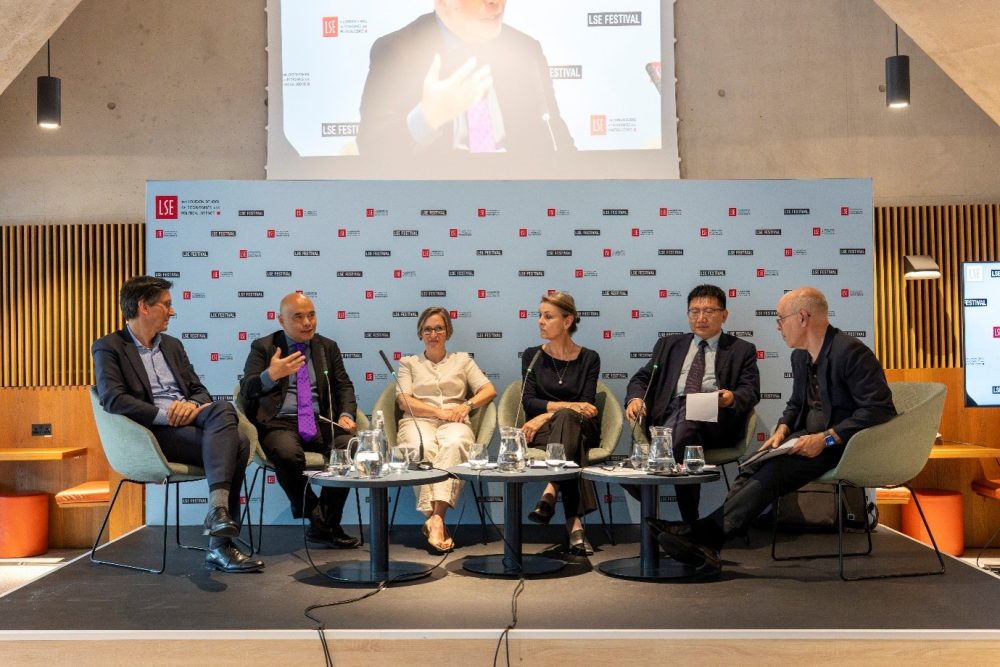 Left to right: Robert Falkner (LSE Department of International Relations), Tang Xiaoyang (Tsinghua University), Stephanie Rickard (LSE Department of Government), Catherine Boone (LSE Department of Government and Department of International Development), Zhao Kejin (Tsinghua University), and Peter Trubowitz, chair (Phelan US Centre).
On green policy, Professor Xiaoyang considered China’s relatively successful green transition. His overarching argument was that green policy in China is not part of a politicised discourse where mass consensus is required — rather it is a developmental necessity, where mass consensus already exists. China has thus maintained several long-term investments and commitments on green energy. Professor Xiaoyang reflected on how in the West, politics often contain ample ‘talk’ around sustainability, but seldom much tangible action: in China, 50 percent of cars are electric vehicles, whereas rates across Europe remain significantly lower.
In response, Professor Falkner outlined the obstacles that European states have faced in the energy transition. Overall energy price increases resulted from the 2022 Russian invasion of Ukraine, and the recent US-Israeli attacks on Iran (which Professor Falkner added were more befitting of the name ‘Operation Strategic Blunder’ than ‘Epic Fury’). These shocks encapsulated the reliance of European economies on foreign, particularly Russian, energy imports, and the importance of decarbonisation in addressing this dependency. Highlighting Spain, Professor Falkner noted that the investment of the Spanish government into solar and wind energy has made Spain less sensitive to energy price shocks. Likewise, the domestic production of oil and gas in the US has reduced its need for imports. Professor Falkner concluded by observing that energy independence is a spectrum, where “electrostates” like China still maintain coal-fired power plants, and petrostates like the US also utilise natural resources.
Moving forward…
Questions from the audience covered the possibility of a tripolar world order, possibly including India or other Global South players. Professor Kejin considered that we must remember that geopolitics is not inherently bad but comes down to each country doing what it deems is the best for its domestic interests, and India alongside other Global South nations are independent middle-powers with their own political inclinations and alliances. Professor Xiaoyang added that the resource-richness of the Global South can provide opportunities for growth, if the competition between the US and China to exploit these resources is utilised strategically.
On trade and green policy, Professor Rickard noted that WTO rules should be updated to account for developments in the AI and service economies. Professor Falkner concurred that great powers continue to maintain spheres of influence, and to maintain healthy competition, the multilateral trading framework must be ‘kept alive’. Finally, Professor Kejin stated that going forward, it is important to shift from a policy of regionalism to a more pragmatic, multi-stakeholder model of regionalisation, focussing on working together collaboratively, rather than regional and institutional power play.
Watch the event recording – Saving the planet in an age of geopolitical rivalry – 19 June 2026