
E-scooter riders face a significantly higher risk of traumatic brain and internal injuries than motorcyclists or bicyclists, according to a new report that sounds the alarm in scooter-dense cities such as Tel Aviv.
As Israeli municipalities push to promote micromobility and curb urban traffic, the British study, recently published in Scientific Reports, shows that riders of electric scooters are three times more likely to sustain a traumatic brain injury compared to motorcyclists, and have an increased risk of organ trauma and damage to major blood vessels.
While the study shows that e-scooter riders experienced a 20 percent lower risk of bone fractures than motorcyclists and a 10% lower risk than cyclists, the physical momentum of an e-scooter collision impacts the rider’s soft tissues, internal organs, and the skull.
The research also revealed that in 23,000 self-reported collisions and near-misses, female riders were more than twice as likely to have severe injuries following a crash than male riders, despite men recording higher overall risk-taking behaviors.
“This was one of the most surprising findings of this study,” said Dr. Raquel C. Gardner, a clinical director in neurology research at Sheba Medical Center.
Get The Times of Israel’s Daily Edition
by email and never miss our top stories
By signing up, you agree to the terms
She said the finding is “doubly concerning.”
Women not only appear to be at higher risk of traumatic brain injuries when riding e-scooters, she said, but there is also growing published evidence that women “may have a greater burden of persistent post-concussive symptoms following mild traumatic brain injuries as compared to men, and overall worse functional outcomes following traumatic brain injuries as compared to men.”
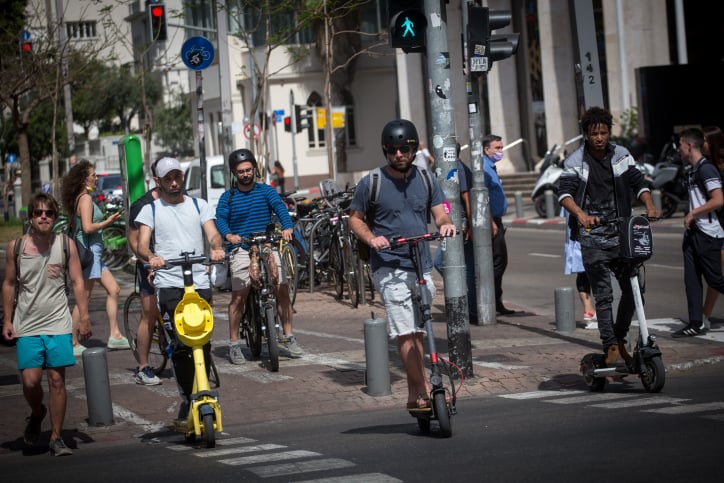
Israelis ride their electric scooters on Rothschild Boulevard in Tel Aviv, on May 5, 2021. (Miriam Alster/Flash 90)
According to a 2022 Tel Aviv Sourasky Medical Center study, there are between 100,000 and 150,000 electric scooters in Israel. Between 2014 and 2019, accidents involving e-bikes and e-scooters were responsible for more than 10% of the hospital’s admissions for dental and maxillofacial injuries — a figure mirrored nationwide.
In 2019 and 2020, the hospital treated 320 e-bike and e-scooter riders for facial or oral injuries. Of these, just under 75%, or 238 patients, were found to have been injured as a result of riding an e-scooter.
Falling over the handlebars
“I began my orthopedic and trauma training in Liverpool, home of the Beatles,” the study’s lead author, London-based Dr. David Bodansky, told The Times of Israel. “I was doing night shifts at a hospital there, and over the course of one weekend, I started seeing all these patients with broken thigh bones, broken arm bones, and head injuries. They were all on e-scooters.”

Dr. David Bodansky, London-based lead author on a new study on e-scooter injury. (Courtesy)
Bodansky said he had seen the results of accidents for bicycle and motorbike riders before, but he wanted to know if the accidents were “more or less the same for e-scooters.”
Unlike bicycle or motorcycle riders, who sit behind a wheel, a rider on an e-scooter stands behind the handlebar on a narrow board attached to small wheels.
When the small front wheel encounters an obstacle such as a pothole, a stone, or someone opening a car door, the e-scooter stops instantly. However, the rider continues moving forward and can catapult over the handlebars. Without anything to break the fall, the rider’s head and chest strike the pavement first.
For women, this is particularly dangerous, said Gardner.
“Women, on average, have lower muscle mass, particularly of the neck and upper body,” she said. “So, they are less equipped to brace, roll, and perhaps better distribute or deflect the head or face from being the single site of greatest initial impact.”
Bodansky said his study showed that the risk profile of an e-scooter is different from that of a motorbike or bicycle because the center of gravity is lower.

Dr. Raquel C. Gardner, associate professor at the Tel Aviv University Faculty of Medicine and clinical research director at Sheba Medical Neuroscience Research Center. (Courtesy)
“This means that it’s easy for the front wheel to get caught in something, and then you’re flipped head over heels,” he said. “And for women in particular who are shorter, the riding handlebar is not adjustable, meaning that it catches you just where the top of the belly is, causing damage.”
Concern about scooter riders putting themselves at risk resounds internationally, and has prompted Israeli lawmakers to increase fines and regulations. Currently, Israeli law mandates that e-scooter operators be at least 16 years old and wear helmets. However, enforcement remains lax.
“Brains are soft, helmets are hard. Use both,” Gardner said, citing the motto of a clinic where she’d worked as a medical student.
In 2024, the Transportation Ministry introduced a nationwide mandatory registration system requiring all e-scooters to carry visible yellow license plates.
The registration system enables municipal inspectors and automated traffic cameras to issue tickets directly to the e-scooter’s owner.
The fine for not wearing a helmet has been raised to NIS 1,000 ($300). Helmets have been proven to lower the risk of injury, Bodansky said.
However, he said, studies still need to be done to compare “the two years before the law was introduced to the two years after, to see what the change was in terms of head injuries.”
“Personally, I believe that there is sufficient published evidence to outlaw e-scooters in Israel,” Gardner said.
Meanwhile, she said, “we need higher fines and more aggressive enforcement by our police force. This approach has been proven over and over again to work to change [people’s] behavior and reduce injuries.”
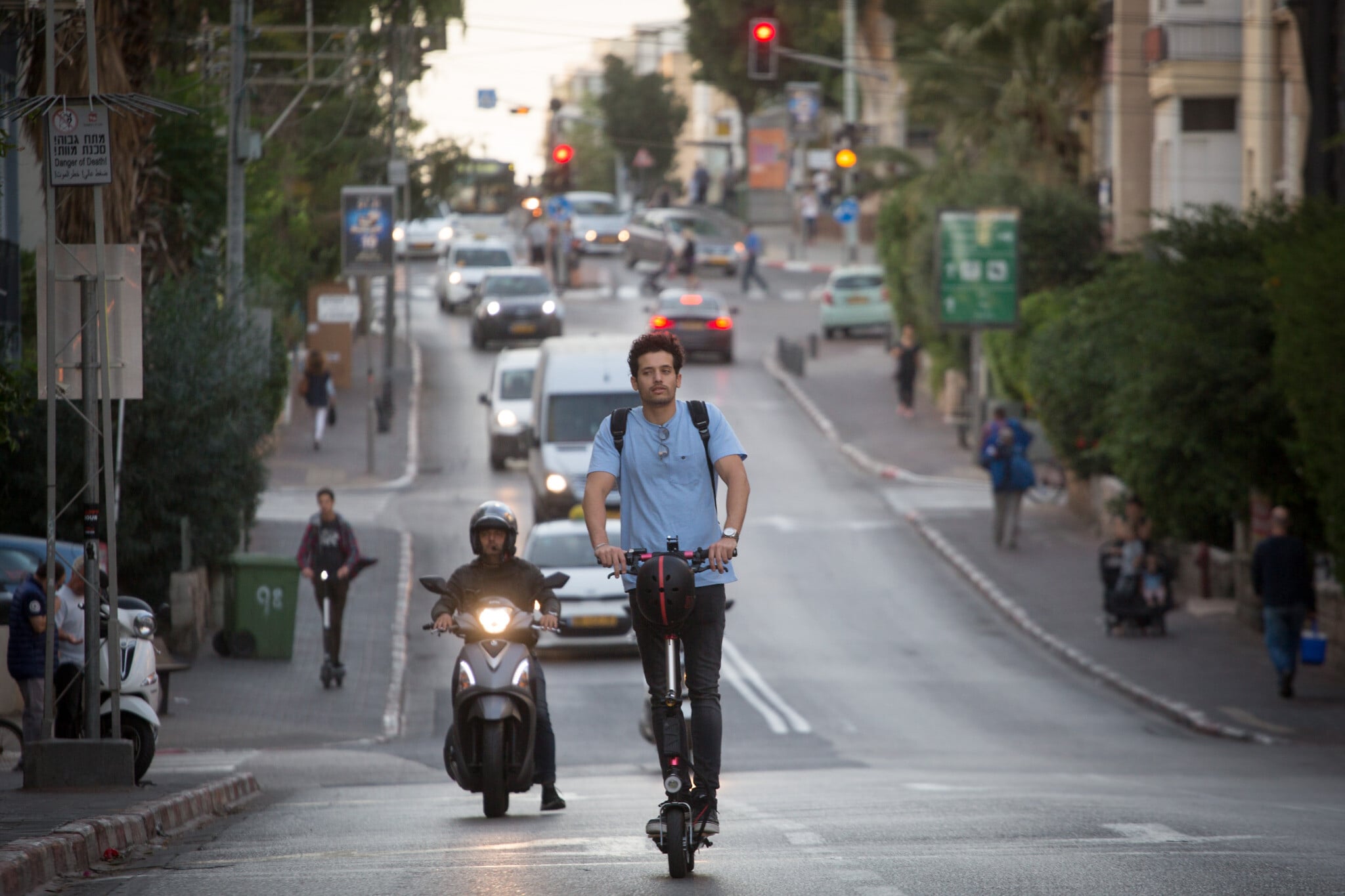
An illustrative photo of a person riding an electric scooter in Tel Aviv, November 27, 2019. (Miriam Alster/FLASH90)
In London, Bodansky said he hopes to do a biomechanical study for e-scooters the way people do crash-testing for cars to get more insights into how crashes impact riders.
Bodansky, who has two children, aged 3 years old and 14 months old, said that the toddler already has a scooter, “a push one for Shabbat.”
“But she’s wearing a helmet, as she would with any scooter, and I can see her,” he said. “Once she’s older and out of my view, I don’t think I’ll sleep easy.”