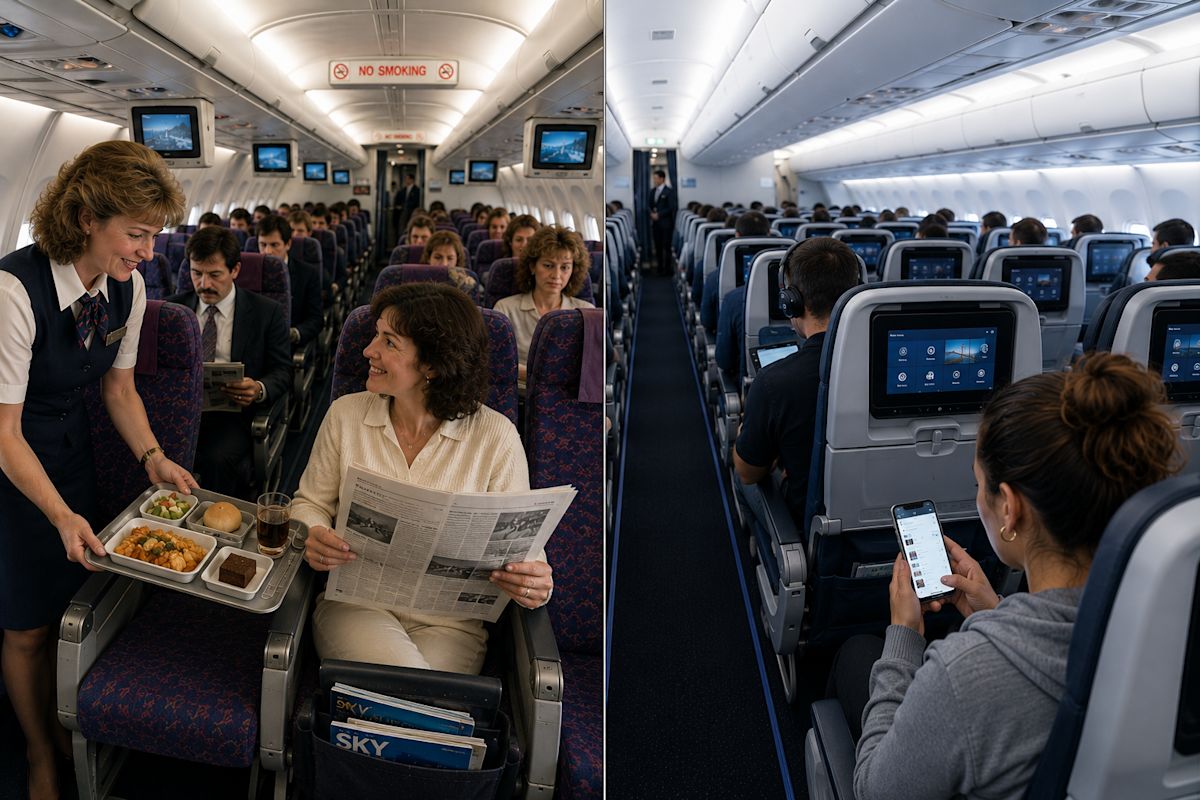
30 years ago, your ride didn’t just drop you off at the airport – they walked you all the way to the gate. Flight attendants served real meals, magazines were tucked into every seatback pocket, and if someone lit a cigarette a few rows behind you…well, that was just part of flying.
A lot has changed since then.
Some of those changes have made flying safer. Others have made it more convenient. And a few have left behind some of the best parts of the travel experience.
Here are ten things that were once completely normal on commercial flights but all but disappeared.
You could smoke on the plane

You used to be able to smoke on board
(Image generated with AI)
If you’re under 30, this one probably sounds completely unbelievable.
For decades, smoking wasn’t just allowed on airplanes – the public embraced it. Airliners had designated smoking sections, ashtrays built into the armrests, and later, ashtrays inside the lavatories. In fact, modern airplanes are still required to have lavatory ashtrays, not because you’re allowed to smoke, but because regulators want passengers who break the rules to have a safe place to extinguish a cigarette.
The rules didn’t change overnight.
In 1988, the U.S. banned smoking on domestic flights lasting two hours or less. Two years later, the ban expanded to nearly all domestic flights. By 2000, smoking had been prohibited on virtually all scheduled flights operated by U.S. airlines, including international routes.
It’s amazing how quickly people adapted. Today, even the thought of someone lighting a cigarette in Row 22 sounds absurd. But it wasn’t that long ago.
Your family could walk you all the way to the gate

There was a time when your family could meet you at the gate
(South_agency via Getty Images)
It used to be normal to step off the plane to see greeting committees waiting in the boarding area when you stepped off the plane. Back then, there were no Ubers, so your ride was usually a friend or relative who walked you all the way to the gate.
There was something comforting about watching your loved ones wave goodbye from the boarding area instead of hugging them outside the TSA checkpoint. Parents walked nervous college students to their flights. Grandparents greeted grandchildren the moment they stepped off the plane. Nobody needed a boarding pass to enter the secure area.
That changed almost overnight after the Sept. 11 terrorist attacks in 2001.
As airports overhauled security, access beyond the checkpoint became limited almost exclusively to ticketed passengers. The newly created Transportation Security Administration introduced much stricter screening procedures, and the familiar sight of dozens of people waiting at arrival gates largely disappeared.
A few airports now offer visitor passes that let non-travelers access secure areas after passing security, but they’re the exception rather than the rule.
If you’ve ever watched a romantic movie from the 1990s where someone races through the airport to meet a loved one at the gate, that wasn’t Hollywood fantasy. That’s how airports used to work.
Checked bags used to be included

Airline tickets used to come with checked bags
(Chirayu via Getty Images)
Today, paying $40 or $50 to check a suitcase feels like a normal part of flying.
It wasn’t always this way.
For years, a checked bag was included in the price of your ticket on nearly every major U.S. airline. Nobody stood at the check-in counter trying to decide whether to squeeze three days’ worth of clothes into a carry-on just to avoid another fee.
That changed during the financial crisis of 2008.
Facing soaring fuel prices, airlines began searching for new ways to generate revenue. In July 2008, American Airlines became the first major legacy carrier to charge economy passengers for their first checked bag on most domestic flights. United, Delta, US Airways and others quickly followed.
Southwest famously resisted the trend, building entire advertising campaigns around its “Bags Fly Free” policy while competitors added fee after fee. It was too good to last. Now Southwest charges for checked bags, too.
The strategy worked so well that baggage fees became one of the airline industry’s biggest sources of ancillary revenue.
Now, many travelers automatically compare baggage fees before booking a flight, something almost nobody had to think about 20 years ago.
Hot meals in economy weren’t considered a luxury

Free meals used to be standard, even in economy class
(mtreasure via Getty Images)
Not too long ago, flight attendants rolled a meal cart down the aisle, and nobody reached for a credit card.
On many domestic flights, especially longer ones, passengers received a complimentary hot meal. Breakfast might include eggs and potatoes. Lunch or dinner could be pasta, chicken, or a Salisbury steak served on an actual tray with real silverware. It wasn’t gourmet dining, but it made flying feel like a luxury experience instead of a bus ride in the sky.
That gradually changed after airline deregulation increased competition, but the decline accelerated following the Sept. 11 attacks and the airline industry’s financial struggles in the early 2000s. Carriers looked for every possible way to cut costs, and complimentary meals were one of the first things to go on domestic routes.
Today, you’ll still find free meals on many international flights and in premium cabins, but on most domestic economy flights, you’re more likely to be offered a snack mix or pretzels than a hot entrée.
Cockpit visits were part of the adventure

A pilot in the cockpit
(O2O Creative via Getty Images)
Generations of children grew up visiting the cockpit.
Before takeoff or after landing, kids were often invited to meet the pilots, sit in the captain’s seat, and look at what seemed like thousands of glowing buttons and switches. Flight attendants handed out plastic pilot wings, and for a few magical minutes, every child felt like they might grow up to be a pilot.
That tradition largely disappeared after Sept. 11, when cockpit doors were reinforced, and access became heavily restricted as part of broader aviation security reforms. Today, the cockpit remains locked during flight except under very limited circumstances.
Every once in a while, a pilot will still invite children to peek inside while the aircraft is parked at the gate, but those moments are much rarer than they used to be.
Paper tickets were something you had to guard with your life

A man hands over his paper boarding pass
(Jacob Wackerhausen via Getty Images)
Long before boarding passes were stashed on our phones, flying involved carrying a paper ticket that was almost as important as your passport.
These weren’t the flimsy receipts you sometimes get at the airport today. Airline tickets were printed in booklets with multiple carbon-copy coupons. Each flight segment had its own coupon, and airline employees tore one out every time you boarded another plane. Lose the ticket, and replacing it could be expensive and time-consuming. Chances are, it meant missing your flight.
That began to change in the late 1990s as airlines embraced electronic ticketing. In 1994, United Airlines became the first U.S. airline to test e-tickets on a large scale, and other carriers quickly followed. By the early 2000s, paper tickets were becoming the exception rather than the rule. In 2008, the International Air Transport Association completed its industry-wide transition to 100% electronic ticketing, marking the end of an era.
Today, passengers can book a flight while standing in line for coffee and board with nothing more than a phone.
Every passenger watched the same movie

Today’s travelers have countless streaming options
(urbazon via Getty Images)
Streaming entertainment has spoiled us.
Today, travelers can watch exactly what they want, when they want, and pause it whenever the beverage cart rolls by. Thirty years ago, passengers didn’t have nearly as much choice.
If your flight had entertainment at all, everyone watched the same movie together. A handful of bulky CRT monitors folded down from the ceiling every few rows, and passengers craned their necks to see the screen. The image was grainy, the headphones were usually an additional charge, and if you were sitting near the back of the plane, you spent half the movie trying to figure out what was happening.
As seatback entertainment systems became more common in the late 1990s and early 2000s, passengers gained more control. Then airlines began replacing those heavy systems with streaming entertainment delivered over onboard Wi-Fi. Today, many airlines encourage travelers to use their own phones or tablets instead of installing expensive seatback screens.
The picture quality is undeniably better now, but there was something fun about an entire airplane laughing at the same joke or gasping at the same scene.
Airplane phones seemed like the future

Seatback phones were considered cutting-edge technology
(Image generated with AI assitance)
If you spotted a telephone mounted in the back of an airplane seat, it felt like the future had arrived.
Verizon Airfone debuted on commercial aircraft in the mid-1980s, allowing passengers to make phone calls while cruising at 35,000 feet. It wasn’t cheap. Calls often cost several dollars per minute, so using one usually meant you had something important to say.
The novelty eventually wore off. As cell phones became commonplace and airlines introduced onboard Wi-Fi, fewer passengers were willing to pay premium prices for seatback phones. Verizon shut down the Airfone service in 2006 after usage dropped dramatically.
Looking back, airplane phones feel like a stepping stone. For a brief period, they represented cutting-edge innovation. Today, they’re remembered mostly by travelers who smile when they see one in an old movie.
Choosing your seat used to be part of buying a ticket

Seat selection used to be included in every fare
(O2O Creative via Getty Images)
Buying an airline ticket used to mean buying…an airline ticket, seat and all.
You picked a seat, packed a suitcase and showed up at the airport. Over the past decade, airlines have broken those pieces apart and turned many of them into optional extras.
One of the biggest changes came in 2012 when Delta Air Lines introduced Basic Economy. American Airlines followed in 2017, and United Airlines rolled out its version the same year. These lower-priced fares often came with restrictions like no advance seat selection, limited boarding privileges, and fewer opportunities to make changes.
The model spread quickly because it gave airlines a way to advertise lower starting fares while charging extra for features that many travelers considered standard.
Now savvy travelers read the fine print before clicking “purchase.” A ticket that looks like a bargain can quickly become much more expensive once you add a carry-on bag, choose a seat, or decide you’d rather not board last.
Wi-Fi has completely changed the flying experience

Wifi has changed how we spend time on planes
(urbazon via Getty Images)
There was a time when boarding a plane meant disappearing for several hours. Friends and family simply expected you to be unreachable until you landed. If your flight was delayed, they usually didn’t know until you called from baggage claim.
That started to change in the 2000s as airlines experimented with onboard internet service. JetBlue became the first major U.S. airline to offer free high-speed Wi-Fi across its fleet in 2017, raising the bar for the rest of the industry. Today, several major airlines either offer complimentary Wi-Fi or are in the process of rolling it out fleetwide.
Being able to answer emails, keep up with news stories, or send a quick text has changed the onboard experience, especially for business travelers. It’s made flying more productive, less stressful and, on long cross-country trips, a lot less boring.
Of course, there’s one downside. It’s much harder to use a flight as an excuse for not answering your messages.
Airline travel has become almost unrecognizable

A woman places her suitcase in the overhead bin
(CHARTCHAI KANTHATHAN via Getty Images)
Looking back on how flying has changed over the last 30 years, it’s easy to focus on what we’ve lost.
Meeting people at the gate, cockpit visits, and hot meals are sorely missed by many.
But few miss smoky cabins, paper tickets that could be misplaced, or wondering how many messages were waiting after hours without internet access.
Flying today is safer, faster, and far more connected than it was a generation ago.
Air travel will keep evolving. Today’s frustrations will eventually disappear, replaced by technology and policies we can’t yet imagine. Thirty years from now, travelers may be remembering the days when they had to line up to board, pay for Wi-Fi, or squeeze into economy seats.
But more importantly, airplanes will still be there to take us where we want to go, and that’s what matters in the first place.