
Back to Article List
The 2026 total solar eclipse reaches Iceland and Spain on August 12. Astronomy magazine’s Senior Editor Alison Klesman is on the ground in Iceland and Editor Emeritus Dave Eicher is in Spain — follow our live updates on totality, weather, and the science in real time.

Baily’s beads, like these seen during the 2017 total solar eclipse, appear just before and just after totality. Credit: NASA/Aubrey Gemignani
Today, the Moon’s shadow will fall across the North Atlantic, sending Greenland, Iceland, and Spain into darkness for a total solar eclipse. This will be the first Iceland has seen since 1954, and the first over Reykjavík in almost six hundred years. Totality will reach Iceland in the afternoon local time and Spain in the evening, just before sunset. Astronomy’s Senior Editor Alison Klesman is on the ground in Iceland and Editor Emeritus and former Editor-in-Chief Dave Eicher is in Spain with our travel partner, Eclipse Traveler. They’ll be filing live updates as the eclipse unfolds.
Refresh for updates
12:05 p.m. EDT: Who can see a partial eclipse?
Inside the path of totality, the Moon fully covers the Sun’s disk — the only moment it’s safe to look up without protective eyewear. Everywhere else, from most of Europe to parts of Canada and the northern U.S., observers are seeing a partial eclipse, where a sliver of the Sun stays uncovered.
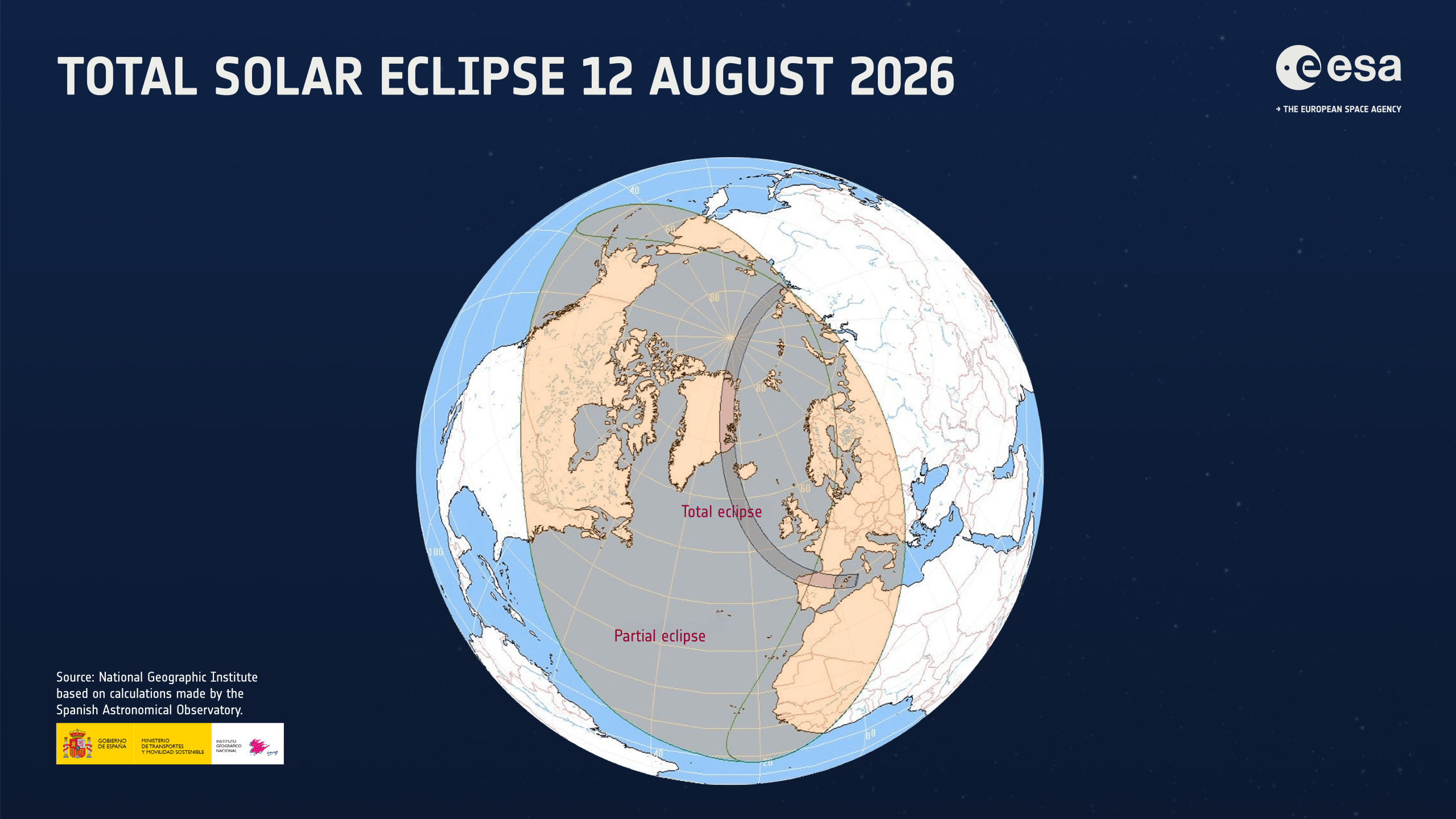 A narrow band traces the eclipse’s path of totality from the Arctic through Greenland, Iceland, and northern Spain in this global view. The much wider gray zone marks where observers across northern North America, Europe, and western Africa will see only a partial eclipse. Credit: European Space Agency (ESA)
11:55 a.m. EDT: Where today’s eclipse will — and won’t — be total
The path of totality is a narrow band roughly 183 miles (294 km) wide. Starting over a remote northeastern corner of Russia, it runs across eastern Greenland before curving south to the west coast of Iceland, arcing across Spain, and ending over the Mediterranean.
In Iceland, the Moon’s shadow reaches the shores of the Hornstrandir Nature Reserve at 1:43 p.m. EDT, before heading south across the Westfjords, the Snæfellsnes Peninsula, Reykjavík, and the Reykjanes Peninsula. The single longest totality along the entire path — 2 minutes and 18 seconds — occurs over the water of Breiðafjörður Bay on Iceland’s western coast. Totality lasts longest on land at Látrabjarg in the Westfjords, at 2 minutes and 13 seconds; in downtown Reykjavík, it’s a brief 1 minute.
From there, the shadow advances across the Atlantic, reaching northern Spain about 35 minutes later. As sunset closes in, the Sun will hang lower in the sky for totality in Spain. In some cities, the Sun will set fully before the partial eclipse ends. Totality runs about 1 minute 45 seconds in León and fading to just over a minute near Vitoria-Gasteiz which lies along the path’s northern most edge.
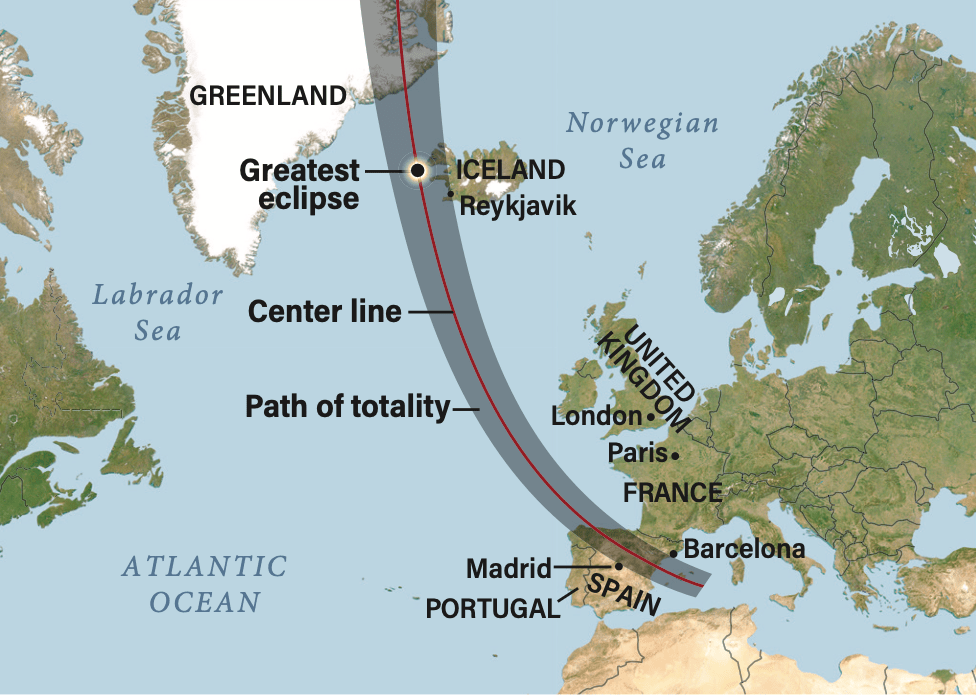 Eastern Greenland, western Iceland, and northern Spain are the places to be if you want to witness the Aug. 12 total solar eclipse. Credit: Astronomy: Roen Kelly