

London will see its most complete solar eclipse in over a quarter of a century today.
It is estimated that around 90% of the Sun will be covered by the Moon, triggering a rare and stunning natural phenomenon.
There won’t be a better eclipse in Britain until 2090, so you won’t want to miss this one.
But the phenomenon isn’t without its risks and Londoners should take care as they try to catch a glimpse.

The last total solar eclipse which could be seen from the UK was in 1999
PA Archive
Here is everything you need to know about the solar eclipse.
An eclipse occurs when the Moon moves directly between the Sun and Earth. This blocks the light of the Sun to part of Earth, totally or partially.
The type of solar eclipse you experience depends on the relative positions of the Sun, Earth and Moon, as well as where exactly on Earth you’re watching from.
There will be a partial eclipse on Wednesday. It is a rare event because of how much of the Sun will be blocked.
When is the solar eclipse and what is the best time to watch?
This week’s solar eclipse will begin at 6.17pm for those based in London, Bristol, and Cardiff.
The height of the eclipse is expected at 7.13pm for Londoners and it will last around 1 hour and 49 minutes until 8.06pm.
For those in Manchester and Liverpool, the eclipse will commence at 6.13pm, while for those in Scotland, the eclipse will begin closer to 6.08pm.
Some European countries, like Greenland and Iceland, are set to experience a total eclipse.
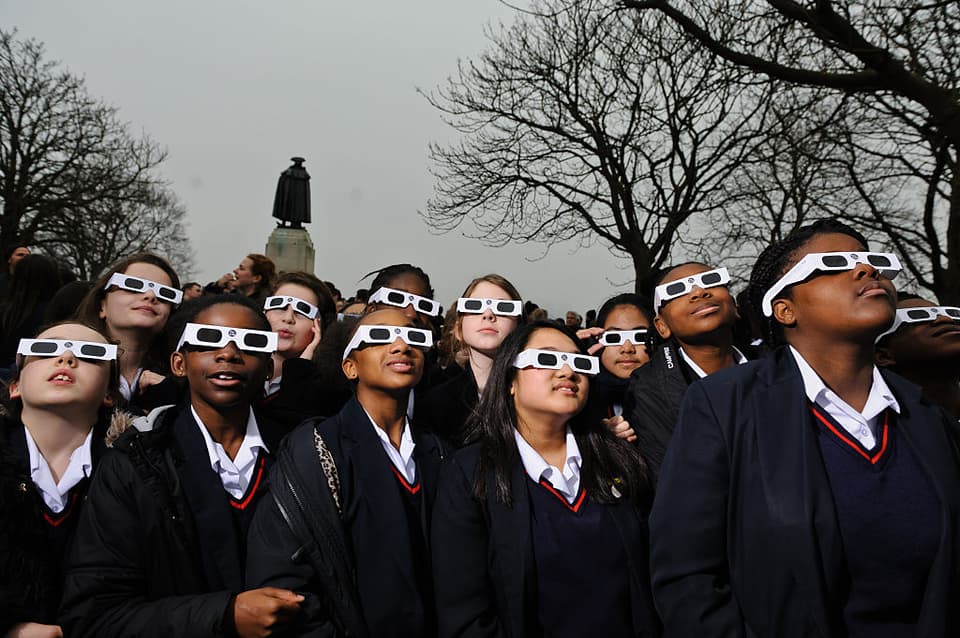
Local school kids wear protective glasses to watch a partial solar eclipse from Greenwich park in 2015
Getty Images
Best places to watch the solar eclipse in London
There are plenty of apps which will help you find the clearest possible view of the eclipse, including Eclipse Horizon Checker.