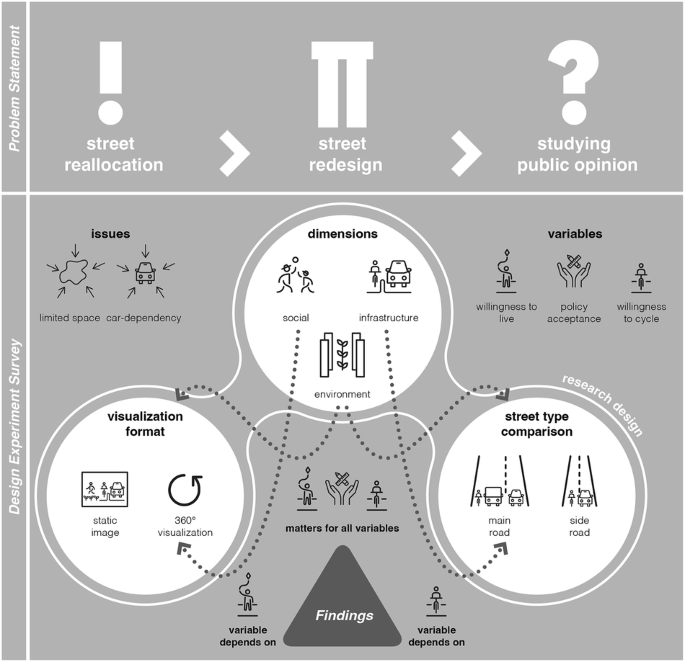
Urban street reallocations and redesigns are central to sustainable mobility transitions, yet public acceptance remains a major challenge. While previous research has examined general attitudes toward transport policy, little is known about how specific design features shape support across diverse user groups. We conducted a large-scale stated choice experiment (N = 5991) embedded in a nationally representative mobility panel in Switzerland. Respondents evaluated navigable 360° and static visualizations of redesigned fictional urban streets, varying in infrastructure, greenery, and social space. We examine effects on three outcome dimensions: acceptance, willingness to live nearby, and willingness to cycle. Greenery consistently increases support across both formats. How the redesigns are visualized shapes which features become salient: the 360° condition increases sensitivity to social features, while the static condition increases sensitivity to environmental and infrastructural features. Subgroup analyses reveal substantial cleavages by gender, age, transport behavior, and political ideology. The results show that design-sensitive, visually supported planning strategies can build broader public coalitions for urban street transformations. Our findings inform participatory planning and policy design for more inclusive and context-sensitive urban transitions.