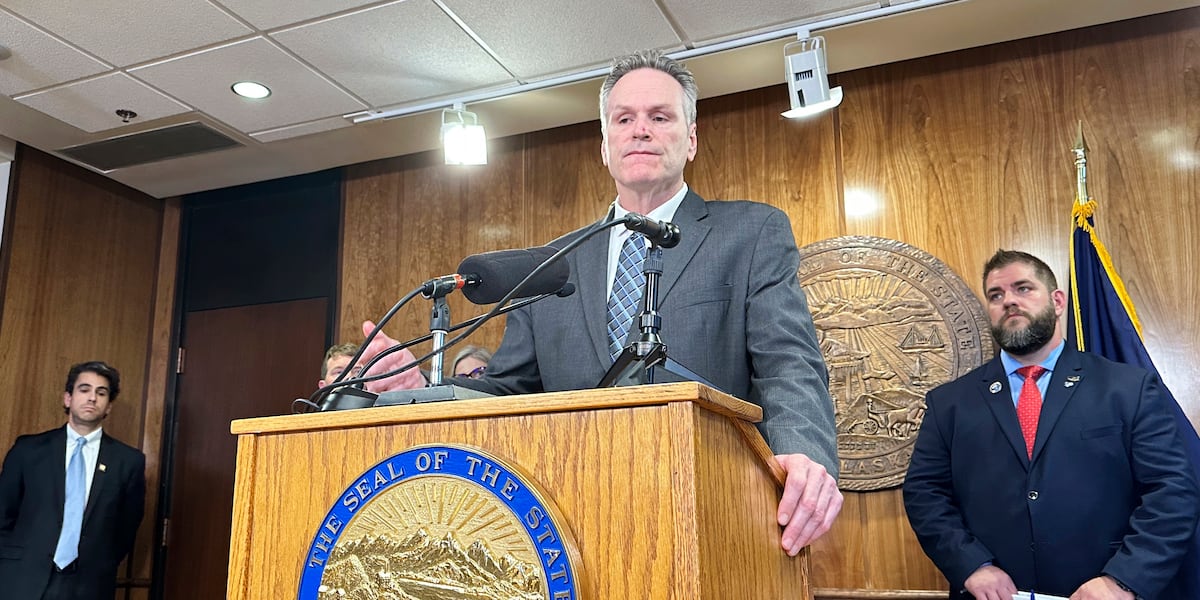
ANCHORAGE, Alaska (KTUU) – “There’s little reason to keep the session going,” Alaska’s Governor Mike Dunleavy, R, said on social media Thursday evening.
It’s the tail end of a third special session to pass property tax exemptions for a private company in the hopes it creates an LNG pipeline. The political football has been tossed back and forth, changed and edited, critiqued and praised for months recently — for decades, not-so recently — but lawmakers, who are trying to get re-elected, say this bill doesn’t have the time or votes.
As the special session wanes, and so, too, does Dunleavy’s administration, who is term-limited, the question looms over the Juneau state house: is the gas line dead for good or delayed once again?
Will there be a fourth session on the gas line?
After Dunleavy’s public message, it seems unlikely he will try for a fourth special session.
Since the regular session ended months ago, lawmakers have been thrust into special session after special session, ultimately resulting in a bill which upset the minority and the governor. By one vote, the bill failed when Rep. Chuck Kopp, R-Anchorage, defected from his caucus. Even if it did pass, it would not have enough to survive a vote from the governor, which he promised he would deliver.
“I shared with the majority caucus that under no circumstances was I going to support [the bill],” he said Friday. “[That was] no surprise to my caucus there and they knew that there wasn’t going to be the votes on the floor.”
When Dunleavy called the third, current special session, Alaska’s News Source asked if he thought it would yield a different outcome.
“We know where people are standing on the S-Corp now,” he answered. “We have more information as to what’s in the oil [and] the gas side of the bill.”
The S-corp tax provision is one minority lawmakers and the governor have characterized as a ‘poison pill’ for the project. Alaska’s corporate income tax only applies to publicly traded companies and the S-corp provision would extend that tax to privately held oil and gas companies — like Glenfarne, the gas line’s major developer, and Hilcorp — that don’t pay it.
That, Kopp and Dunleavy agreed, was one of the major issues to the mostly-majority-approved plan.
But in the other chamber, Senate Majority Leader Cathy Giessel said earlier this week that there were bigger issues than just that provision.
“I realize that perhaps the governor and others may feel that the S-corp piece was the deciding factor,” Giessel said after calling an attempt at compromise introduced by Dunleavy earlier this week a “low-fat milk version of a corporate income tax.”
“There were other deciding factors in this bill,” she added.
There are two ways to call a special session: the governor calls it or two-thirds of the 60-member legislature call it.
But lawmakers have repeatedly said the will to work on the issue is waning.
“Unfortunately, intractable differences have emerged on the Governor’s bill relating to property tax relief for the gas line,” a statement from House leadership reads. “The proposed [bill from the governor] does not appear to have the support needed to pass the Alaska House, with opposition being expressed by both Majority and Minority members.”
The minority caucus disagreed with the assessment.
“That was a statement from a caucus,” a letter signed by most of the House Minority read. “It was not the vote of this body. Forty members were elected to decide questions of this magnitude on the record, and not one of us has been given that chance.”
Three members did not sign the letter: Rep. Jamie Allard, R-Eagle River, Rep. Will Stapp, R-Fairbanks, and Rep. Mia Costello, R-Anchorage.
Construction this year?
Going into January’s regular session, Glenfarne set high expectations: beginning construction, or laying down pipe, by December 2026. The announcement stopped short of declaring FID, or a final investment decision.
“Even if we are three weeks behind on our forecast date, we’re a year ahead of where other entities would be,” Glenfarne CEO and Founder Brendan Duval told Alaska’s News Source during an online press conference in January.
But out the get-go, lawmakers had concerns — over transparency, over the price of exemptions and over state readiness with labor and road conditions.
Without property tax exemptions, it’s unclear if the company will be able to meet it’s construction goals.
Alaska’s News Source reached out to Glenfarne for comment, which has not been returned.
Up to a new governor
“I think we’re slowly reaching the point where it might be best for a new Governor and a new legislature to delve into this,” Senate President Gary Stevens, R-Kodiak and a retiring legislator, said in July.
If a bill is not taken up, his vote to pass the tax exemption bill will have been his last as a lawmaker. The senate president is far from the last lawmaker who feels the governor has used up his good will.
“I feel like the circumstances only get more difficult from here and unless the governor and Hilcorp are willing to reconsider the package, I think there’s very little appetite to deal with this this year,” Rep. Calvin Schrage, NA-Anchorage and chair of the final committee to draft a compromise plan, said in July as well. “This will have to be something to come back and deal with it in January.”
On the eve of the third gas line session, Senate Minority Leader Mike Cronk, R-Tok/Northway, said he was optimistic but wasn’t hedging his bets.
“At this point, I would say [passing the project to the next administration and legislature is] the real expectation,” he said. “I mean, I’m frustrated with it. I don’t like it. But I got to be a realist.”
House Speaker Bryce Edgmon said anything was possible in the legislature, but the window for the body to act may have closed.
“In terms of just setting it aside for the next governor, I’ve heard that,” Edgmon said. “I think there will be an attempt this session to try to make all the ends meet and to get the support needed in the legislature again, but it’s going to be hard.
“At this point, I couldn’t put my finger on where all this is going to go.”
In a crowded field of 17 vying to succeed Dunleavy, many are listing the gas line as a major item for their campaigns. Alaska’s News Source interviewed 14 of the 17 candidates running for office. Meda DeWitt, who has not been interviewed, has committed to an interview.
See a spelling or grammar error? Report it to web@ktuu.com
Copyright 2026 KTUU. All rights reserved.