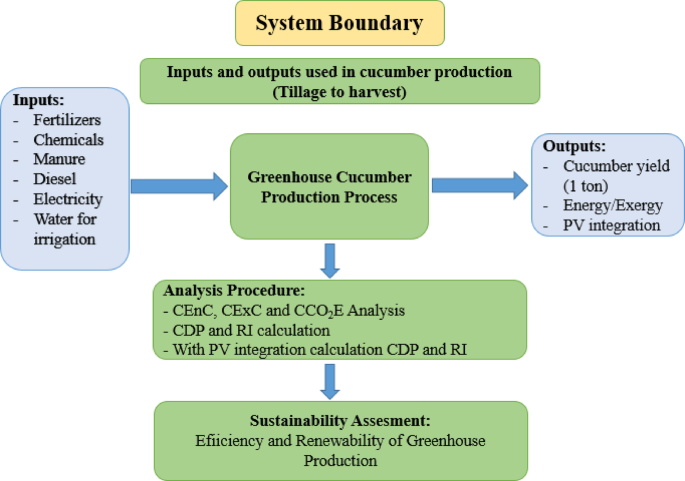
This study provides an in depth examination of the intensive resource utilization and environmental impacts of modern greenhouse farming by employing thermodynamic and exergy based analyses. The focal point of this work is to assess the greenhouse cucumber production process in Türkiye through a holistic approach, by analyzing energy consumption, exergy consumption, and carbon dioxide emissions via key metrics such as CDP and RI. The analyses consider one ton of greenhouse cucumber production as the functional unit. The data obtained provides a holistic evaluation of where greenhouse cucumber production is positioned in the context of energy efficiency and environmental performance, through comparison with an extensive body of literature on other agricultural production processes.
Cumulative energy consumption (CEnC) analysis
This section details the per ton cumulative energy consumption for greenhouse cucumber production in Kırklareli and Konya, two distinct agricultural regions in Türkiye. CEnC analysis provides a critical thermodynamic metric for assessing the energy intensity and sustainability performance of agricultural production processes. As illustrated in the comparative distribution in Fig. 2, the distribution of energy consumption reveals that primary energy drivers shift significantly depending on the regional context.
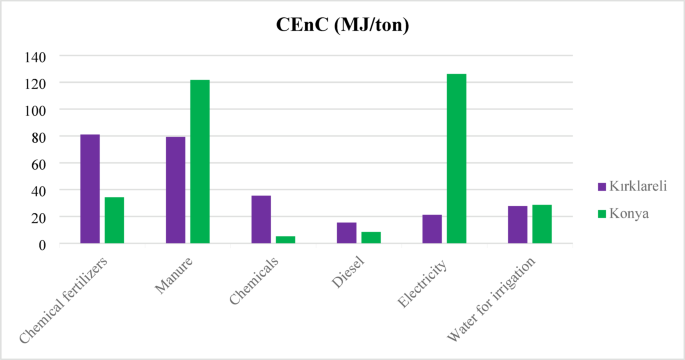
Cumulative energy consumption according to inputs of one ton cucumber production.
According to the data obtained, the total energy consumption in Konya is significantly higher compared to Kırklareli, primarily driven by differences in manure, electricity, and irrigation water inputs. As shown in Table 1, the higher manure consumption in Konya suggests a need for more intensive nutrient supplementation. This trend of high fertilizer impact is a common bottleneck in agricultural energy budgets; for instance, in onion production in Iran, nitrogen fertilizers were found to be the largest contributor to CEnC, accounting for up to 44.64% of total energy use35. Furthermore, findings by Degerli et al. (2015) and Öztürk et al. (2025) recent assessments of agricultural production confirm that nitrogen fertilizers, due to their energy-intensive production processes, remain a dominant factor in energy consumption across different crop types36,37.
One of the most notable differences is observed in electricity and irrigation water consumption. In Konya, 126.13 MJ/ton is spent on electricity and 28.60 MJ/ton on irrigation, while in Kırklareli, these values are 21.21 MJ/ton and 27.72 MJ/ton, respectively. The high electricity demand in Konya is consistent with its semi-arid continental climate and reliance on deep groundwater extraction. This parallels findings in apple cultivation in Niğde, where water scarcity and deep-well pumping resulted in an irrigation energy demand (111.43 MJ/ton) nearly 20 times greater than in more humid regions like Antalya (5.87 MJ/ton)37. Hesampour et al. (2022) stated that in regions where diesel or electric pumps are used for water extraction, these activities constitute the primary source of total energy consumption38. Similarly, a study on maize production found that irrigated systems have much higher energy consumption than rain fed systems16.Regarding the CEnC profile, chemical fertilizers in this study (Konya: 34.32 MJ/ton, Kırklareli: 81.03 MJ/ton) show lower total consumption compared to manure. In a similar thermodynamic assessment of greenhouse cucumber production, Taki and Yıldızhan (2018) reported a significantly higher total CEnC of 4412.39 MJ/ton, with 48.5% attributed to diesel fuel39.
While the diesel consumption in the current study (Konya: 15.45 MJ/ton, Kırklareli: 8.40 MJ/ton) is lower, it aligns with the broader observation that fossil fuel based inputs are decisive factors in energy intensity. The integration of renewable energy scenarios, such as the use of liquid hydrogen in onion cultivation35 or agricultural photovoltaic systems in apple cultivation37, has been shown to significantly reduce such energy consumption; highlighting that this is a critical way to improve the sustainability of these input-intensive agricultural ecosystems.
The data obtained reveal distinct structures of energy consumption in greenhouse cucumber production across the studied regions of Kırklareli and Konya. The higher CEnC values observed in Konya are primarily associated with significant electricity demand and more intensive fertilization practices. These findings suggest that for similar semi-arid climatic contexts, sustainability strategies could prioritize enhancing electricity use efficiency and exploring the integration of renewable energy sources, such as solar-powered pumping, specifically for operational energy substitution. Conversely, the lower CEnC values in Kırklareli reflect regional climatic conditions that necessitate lower irrigation and energy intensity. For both provincial prototypes, the adoption of precision farming techniques and optimized fertilizer management shows significant potential for reducing energy consumption and mitigating environmental impacts within the defined production boundaries.
Cumulative exergy consumption (CExC) analysis
Exergy analysis is an advanced method that evaluates a system’s true thermodynamic efficiency by considering not only the quantity of energy but also its potential to perform useful work. Figure 3 reveals that different inputs show significant differences in exergy consumption between Kırklareli and Konya provinces.
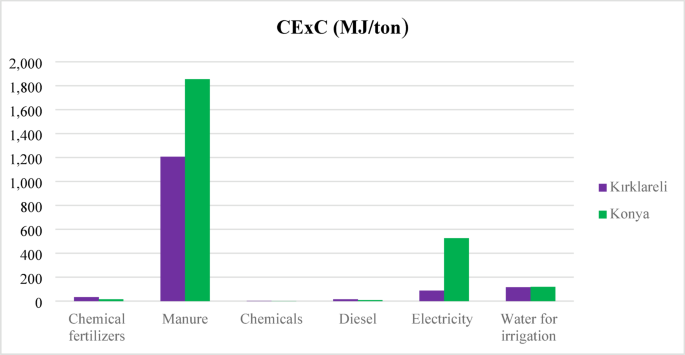
Input based cumulative exergy consumption in the production of one ton of cucumber.
The results indicate that Konya has a significantly higher total CExC value in greenhouse cucumber production compared to Kırklareli. This difference becomes evident particularly in key input items such as manure, electricity, and irrigation water. The largest exergy consumption in both provinces stems from manure. However, this value was calculated at 1853.91 MJ/ton in Konya, while it was 1207.20 MJ/ton in Kırklareli.
The difference in manure application rates stems from regional soil and climate variations. Semi-arid Konya requires high manure input to compensate for low organic matter and increase water retention capacity. In contrast, Kırklareli’s humid climate and superior soil profile necessitate more moderate organic fertilization. These agricultural adaptations significantly alter cumulative energy and exergy inputs due to the high exergy density of the manure.
The dominant role of manure in exergy consumption is consistent with analyses by Özilgen and Sorgüven (2011), who emphasize the high potential of the chemical structure of organic inputs32. This result demonstrates that biological inputs like fertilizer have a high thermodynamic potential that can be overlooked in a simple energy balance analysis but is revealed through exergy analysis.
Electricity consumption also shows a significant difference between the two provinces. The exergy consumption for electricity, at 525.94 MJ/ton in Konya, is approximately six times higher than the 88.44 MJ/ton value in Kırklareli. Similarly, the exergy spent on irrigation water is also slightly higher in Konya (119.18 MJ/ton) than in Kırklareli (115.51 MJ/ton). This situation is due to the vital importance of irrigation in Konya’s arid climate and the high energy cost of extracting water from deep wells.
A similar regional disparity was observed in apple production, where Niğde exhibited significantly higher exergy consumption (2975 MJ/ton) compared to Antalya (1183 MJ/ton), primarily due to diesel-powered irrigation and deep-well pumping in more arid zones37. Furthermore, a study on date production by Hesampour et al. (2022) stated that in regions where diesel pumps are used for water extraction and irrigation, these activities constitute the largest source of the total CExC38. In contrast, in more modern irrigation infrastructures, such as those analyzed for onion production, the transition to renewable energy sources like liquid hydrogen can reduce exergy consumption significantly35.
The share of chemical fertilizers in total exergy consumption is considerably lower than that of manure. In their study on vegetable oil production from sunflower and soybeans, Özilgen and Sorgüven (2011) stated that the highest CExC resulted from fertilizer use, but this was due to excessive and inefficient application32. The relatively low chemical fertilizer exergy consumption in greenhouse cucumber production indicates that these inputs are used more efficiently.
According to the findings from the analyses, the exergy profiles in greenhouse cucumber production in Kırklareli and Konya differ due to regional climate and farming practices. The higher CExC observed in Konya is primarily associated with energy-intensive activities, particularly electricity consumption for deep-well pumping and manure utilization. These results indicate that exergy analysis, by accounting for the quality and efficiency of resources, offers a more detailed thermodynamic perspective than traditional energy analyses for assessing the sustainability of regional greenhouse cucumber production. Consequently, sustainability efforts in semi-arid regions similar to Konya could prioritize the optimization of irrigation systems and the exploration of renewable energy integration, specifically for operational energy substitution within the defined production boundaries.
Cumulative carbon dioxide emissions (CCO2E) analysis
Figure 4 shows the impact of inputs used for producing one ton of greenhouse cucumber in Kırklareli and Konya, Türkiye’s different climate regions, on carbon dioxide emissions. CCO2E is a key metric for determining a product’s environmental sustainability and carbon footprint.
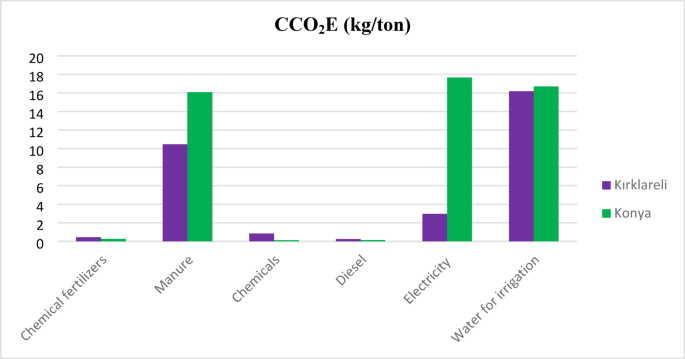
Cumulative CO2 emissions associated with 1 ton of greenhouse cucumber production.
While the inputs that contribute the most to total emissions differ in each province, some common trends are observed. Emission values in Konya’s production process are notably higher than in Kırklareli for many inputs. For example, manure use in Konya generates 16.07 kg CO2/ton of emissions, while this value is at 10.46 kg CO2/ton in Kırklareli. Similarly, electricity consumption is significantly higher in Konya at 17.66 kg CO2/ton compared to 2.97 kg CO2/ton in Kırklareli. This situation indicates that electricity intensive activities in Konya substantially increase the environmental footprint of greenhouse cucumber production. This finding is consistent with a study on maize production in Mexico, which revealed that irrigated systems have a larger environmental footprint due to high input use16.
According to the analysis, inputs such as irrigation water, manure, and electricity contribute the most to total emissions in both provinces. In Konya, electricity (17.66 kg CO2/ton) and irrigation water (16.69 kg CO2/ton) are the highest emission sources, whereas in Kırklareli, the highest emissions come from farm manure (10.46 kg CO2/ton) and irrigation water (16.17 kg CO2/ton). These data suggest that within the studied regional contexts, strategies to enhance environmental sustainability in greenhouse cucumber production could effectively prioritize the efficiency of manure, water, and electricity use. Within the defined tillage-to-harvest assessment boundaries, optimizing these specific inputs appears to be a critical factor for mitigating the carbon footprint of the production phase in both semi-arid and humid climatic prototypes.
This regional emission profile is consistent with findings in apple production in Niğde and Isparta, where irrigation water and diesel-powered pumping were identified as the primary drivers of carbon intensity, reaching values up to 65.49 kg CO2/ton37. Furthermore, a study by Taki and Yildizhan (2018) reported that the total CCO2E value for greenhouse cucumber production in Iran was approximately 175 kg CO2/ton, with 64% of it originating from natural gas used for heating37. While this is higher than the emission values calculated in this study, the decisive role of key greenhouse farming inputs on emissions emerges as a common finding in both analyses.
The emission contribution of other inputs like chemical fertilizers and chemicals is quite low in both provinces. For example, the share of chemical fertilizers in total emissions is 0.26 kg CO2/ton in Konya, while it is 0.43 kg CO2/ton in Kırklareli. This indicates that the environmental impacts in cucumber production are largely linked to fossil fuel based energy consumption and that the use of chemical inputs results in a relatively lower environmental burden. However, a study by Özilgen and Sorgüven (2011) stated that the largest carbon emission contribution in vegetable oil production from sunflower and soybeans resulted from excessive fertilizer use32. Similar variations depending on crop type are observed in wheat production in Türkiye and Germany, where fertilization, irrigation, and diesel use were identified as the main emission sources, with Türkiye exhibiting higher values due to greater dependency on these inputs36,37. This comparison highlights that environmental impact profiles can vary significantly depending on the product type and agricultural practices used.
In conclusion, the findings indicate that the carbon emission profiles in greenhouse cucumber production in Kırklareli and Konya vary according to regional agricultural practices and climatic conditions. The higher emissions observed in Konya are primarily associated with the energy-intensive utilization of resources, specifically electricity for water extraction. Within the defined tillage-to-harvest assessment boundaries, these results suggest that strategies aimed at enhancing irrigation efficiency and exploring the integration of renewable energy particularly for operational electricity substitution could play a significant role in improving the environmental sustainability of regional greenhouse farming prototypes.
CDP and RI analysis
The findings of this study are based on specific greenhouse conditions in the Kırklareli and Konya regions. Although these two regions represent different climatic zones, broader and long-term datasets are required to generalize the results on a global scale. Therefore, the presented sustainability improvements should be evaluated as a potential within the framework of the energy profiles of the studied regions.
CDP and RI are critical thermodynamic metrics that evaluate a production process’s sustainability by considering not only the quantity of energy inputs but also their quality and renewability level40. These metrics provide a powerful framework for comparing the environmental footprint and thermodynamic efficiency of production systems. In this study, the chemical exergy value was taken from the literature as 1.07 MJ/kg39.
As a result of the analysis, the CDP value for greenhouse cucumber production in Kırklareli province was calculated as 0.73, and the RI value as −0.36. In contrast, the CDP and RI values for Konya were determined to be 0.42 and − 1.36, respectively. Based on the calculated RI values, the greenhouse cucumber production process was found to be completely non-renewable for both Kırklareli and Konya provinces.
Kırklareli’s higher CDP value compared to Konya indicates that it uses input resources more efficiently. The main reason for this difference is that inputs like electricity and manure play a dominant role in cumulative energy and exergy consumption in Konya.
A study by Özilgen and Sorgüven (2011) stated that CDP values in high energy intensive processes like vegetable oil production ranged from 0.92 (soybean oil), 0.98 (olive oil), and 2.36 (sunflower oil)32. The inherently low chemical exergy of a product with high water content like cucumber (approximately 1.07 MJ/kg) generally limits CDP values. Taki and Yildizhan (2018) noted that the CDP for greenhouse cucumber production under Iranian climatic conditions was 0.23 but suggested that this value could increase to 0.47 with the use of renewable energy sources39. In this context, Kırklareli’s CDP value of 0.73 shows that it has reached a better level of thermodynamic efficiency than Konya, but still holds potential for improvement.
The calculated value of −0.36 for Kırklareli indicates that production is dependent on non-renewable resources and that the restoration work is higher than the useful work produced. However, Konya’s value of −1.36 reveals that this non-renewable dependency is much deeper. This difference is due to Konya’s agricultural production process consuming far more fossil fuels and electricity than Kırklareli.
A study on rice production by Nikkhah et al. (2021) stated that the most efficient rice variety had a positive RI value of 0.88, indicating that the process was partially renewable41. In contrast, Taki and Yildizhan (2018) calculated an RI value of −3.32 for greenhouse cucumber production in Iran, but stated that this value could increase to-1.09 with the use of renewable energy sources39. While these values show that greenhouse cucumber production in Türkiye is carried out with a more efficient agricultural process, the negative RI values in both provinces signal that serious steps need to be taken to increase the renewability of greenhouse cucumber production systems. Especially in Konya, high energy-intensive irrigation and fertilization practices are seen to negatively affect the RI value.
In conclusion, a comparative analysis of CDP and RI values shows that greenhouse cucumber production in Kırklareli is thermodynamically more efficient and less dependent on non-renewable resources environmentally than in Konya. However, the negative renewability indicators in both provinces clearly show that fundamental steps such as reducing fossil fuel consumption and integrating renewable energy sources must be taken to increase sustainability.
Based on the analyses and comparative evaluations, developing various strategies to increase the sustainability of the greenhouse cucumber production system will make the production process more efficient;
Renewable Energy Integration: Replacing natural gas used for greenhouse heating and diesel and electricity used in irrigation pumps with renewable energy sources will significantly reduce the environmental footprint. Türkiye’s high geothermal energy potential in some regions offers an alternative for heating. Solar energy, on the other hand, stands out as an effective solution for both electricity generation and water pumping. For example, a study examining date production recommends using solar energy instead of diesel fuel40. In models developed for rapeseed production, it has been shown that CExC and CCO2E values decrease significantly with the use of biofuels and solar energy14.
Efficient Resource Management: Reducing irrigation water, and consequently the energy spent on pumping, is of critical importance. Using efficient systems like drip irrigation instead of traditional methods such as surface irrigation will decrease water consumption and related energy costs. In fertilizer management, precision farming practices based on soil analysis can prevent excessive fertilizer use, thereby reducing both costs and environmental emissions.
System Optimization: Modeling techniques like the Multi-Objective Genetic Algorithm (MOGA) used in rapeseed production14 can also be applied to greenhouse cucumber production. Such an approach can help determine the most sustainable production conditions by striking a balance between maximum yield and minimum energy consumption and environmental impact. This way, an optimal point can be found to ensure that increases in input use are proportional to yield increases.
Sensitivity analysis
In this study, a sensitivity analysis was performed to evaluate the stability and robustness of the sustainability indicators (CDP and RI) against a 20% variation in primary input parameters and product yield. The results, illustrated in Figs. 5 and 6, highlight which variables exert the most significant influence on the thermodynamic and environmental performance of the system in Kırklareli and Konya regions. The analysis reveals that product yield is the most critical parameter affecting system efficiency. A 20% increase in yield led to a linear 20.06% improvement in CDP for Kırklareli and a 20.17% improvement for Konya (Fig. 5). More remarkably, the same yield increase resulted in a 61.57% improvement in the RI for Kırklareli and 29.21% for Konya, emphasizing that operational productivity is the primary driver of renewability (Fig. 6).
Among the input categories, farmyard manure usage demonstrated the highest sensitivity, particularly impacting the CDP in both regions due to its significant exergy intensity. Conversely, the system showed minimal sensitivity to changes in chemical and diesel inputs, suggesting that the study’s conclusions remain robust despite potential minor uncertainties in these data coefficients. Although Konya’s RI exhibited a higher sensitivity to electricity variations (7.25%) compared to Kırklareli (4.54%), the overall regional performance hierarchy remained unchanged across all tested scenarios.
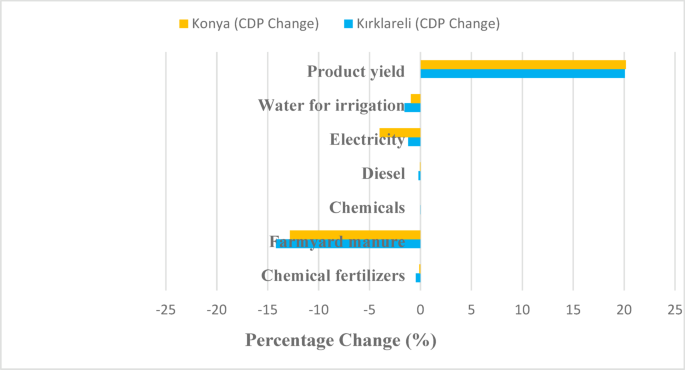
Sensitivity of the CDP to variation in input parameters and product yield for Kırklareli and Konya.
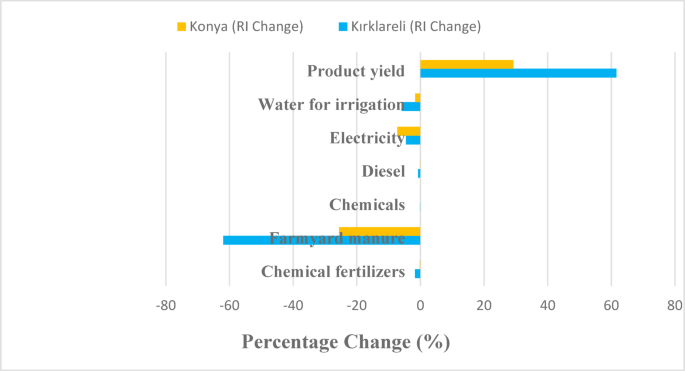
Sensitivity of the RI to variation in input parameters and product yield for Kırklareli and Konya.
The effect of PV panel use in greenhouses on CDP and RI indicators: a new scenario analysis
The PV integration scenario presented in this study focuses specifically on an operational electricity substitution model rather than a full life-cycle assessment. Consequently, the embodied energy of PV components, energy inputs for installation, detailed lifetime degradation rates, and the comprehensive carbon footprint of the PV infrastructure itself are considered beyond the scope of this work. This approach has been adopted to evaluate the thermodynamic impact of using renewable energy specifically for the energy-intensive stages of the greenhouse production cycle, from tillage to harvest.
Based on the regional energy demands identified in the previous sections, the feasibility of PV integration is evaluated particularly in light of Konya’s high electricity consumption for deep-well pumping.
Figures 7 and 8 show the monthly solar radiation and sunshine values for Kırklareli and Konya provinces. Konya’s annual average sunshine duration is 7.94 h and its global radiation value is 1608 kWh/m2-year. Kırklareli’s sunshine potential is a daily average of 7.2 h and a radiation value of 1321 kWh/m2-year42. These data show that the high cost of electricity consumption in Konya constitutes a significant burden, but at the same time, the abundant solar resource makes PV systems an extremely suitable and effective solution for the region. This is a key finding that reveals the direct relationship between climate, agricultural practice, energy consumption, and solar potential.
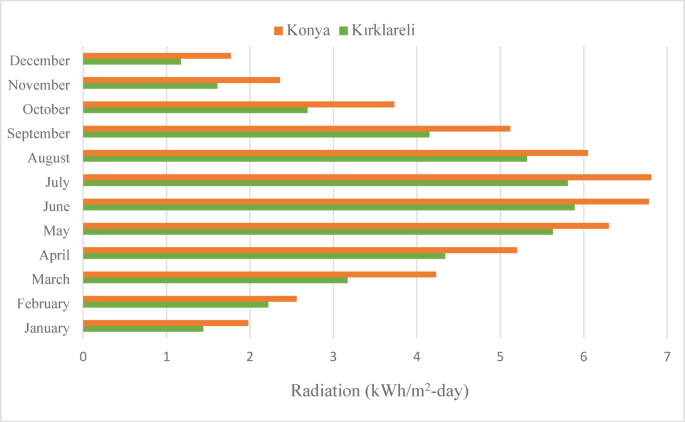
Solar radiation levels for Kırklareli and Konya provinces42.
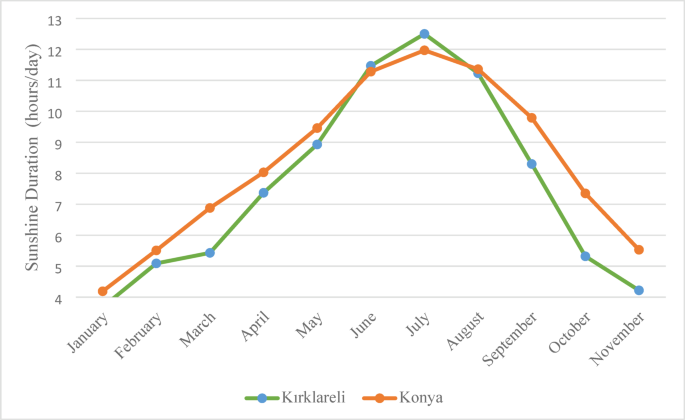
Sunshine duration values in Kırklareli and Konya provinces42.
The new indicators obtained in the scenario where PV panels supply electricity show remarkable changes in terms of both system efficiency and renewability. In solar energy integration, the exergy consumption per 1 MJ of electricity production was taken from the literature as 0.19 MJ30. New values were calculated for the PV scenario according to this exergy consumption. Compared to the previous situation (Kırklareli: CDP = 0.73, RI = −0.36; Konya: CDP = 0.42, RI = −1.36), with PV integration, CDP increased to 0.77 and RI to −0.30 in Kırklareli; while in Konya, CDP rose to 0.51 and RI to −0.96. The PV panels meeting the electricity supply reduce the system’s non-renewable energy consumption and have a positive effect on CDP and RI. This transformation shows a potentially significant effect on renewability in Konya, while in Kırklareli, it could be complemented with broader measures such as input optimization and energy efficiency. These findings suggest the importance of exploring PV integration specifically for operational electricity substitution within greenhouse farming, while emphasizing the need for planning additional strategies tailored to local operational conditions.