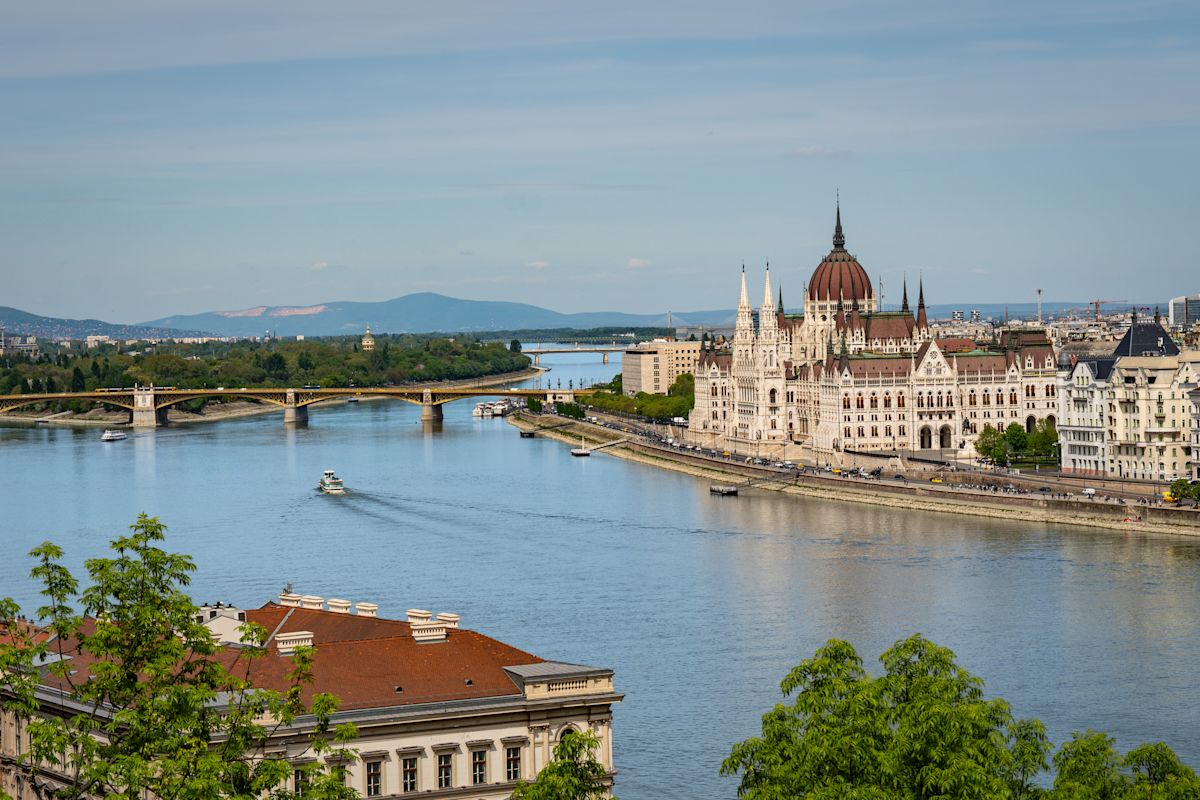
If you’ve been eyeing a Danube river cruise, I get it. I did one last October with my family, and it was pretty magical — strolling the streets of Vienna (and stuffing my belly with cappuccinos and pastries), diving into history (and sausages) in Regensburg, marveling at Budapest, the works. But you’ve probably also seen the kind-of-scary headlines: cruise ships stranded on sandbars thanks to drought, sunken Nazi-era warships resurfacing near the Serbian border, and cancellations rippling across some of the biggest names in river travel. It’s enough to make anyone with a nonrefundable deposit start sweating.
Here’s the short version: the Danube really is drying up, in ways that haven’t been seen in decades, and the Rhine is having similar issues. But “disrupted” and “dangerous” aren’t the same thing, and understanding the difference matters if you’ve got a sailing booked this year.

The river cruise ship Viking Hlin is moored on the banks of the Rhine in Deutz.
(Gerd Harder via Getty Images)
What’s actually happening with Europe’s rivers
In late July, Hungary’s water authority measured the Danube in Budapest at just 10 centimeters — that’s just less than 4 inches — obliterating the previous all-time low of 33 centimeters, set during the drought of 2018. Serbia and Croatia are reporting record lows of their own, and Serbia’s fuel imports, fishing industry, and river tourism are all taking hits as vessels there are forced to sail at roughly half their normal load capacity. The Rhine, Europe’s other great commercial river, is in similar trouble: the critical chokepoint gauge at Kaub, Germany, dipped below its previous 2018 record this summer too.
The cause is a brutal, monthslong combination of heat waves and drought that’s gripped the continent, on top of thinning Alpine snowpack that used to top off the rivers with meltwater through late summer. Climate researchers who study these events say the human fingerprint is no longer subtle — one recent attribution analysis found these conditions are now roughly 80 times more likely than they’d be without human-caused warming.
One more eerie side effect: the receding water has exposed dozens of scuttled German warships from World War II near Prahovo, Serbia, along with expanses of pale, cracked riverbed that are normally well underwater.

River cruises on the Rhine River through Basel Stadt at sunset.
(SiyueSteuber via Getty Images)
So what does that mean for river cruises?
In late July, the Viking-operated Viking Ullur ran aground overnight in a stretch of the Danube between Serbia and Romania, after drifting outside the navigable channel in the dark. With 186 passengers and 52 crew aboard, and the ship’s drinking water running low, authorities carried out a daylight evacuation the next morning — passengers were ferried to a second ship by small boat, then bused roughly five hours to Bucharest. No injuries were reported, and officials said the vessel was never in danger of sinking (hard to sink in four inches of water, eh?). A cargo ship also ran aground nearby, near Calafat, Romania, stuck on a sandbar the falling river had exposed.
Elsewhere, the disruption has looked less dramatic and more logistical. Avalon Waterways and Uniworld have canceled select Danube departures outright this summer. AmaWaterways, Viking, Scenic, and Riviera Travel are largely keeping cruises running by lightening ship loads, swapping passengers onto sister vessels past shallow stretches, or bridging gaps with bus transfers — annoying, but not unsafe.

Viking cruise ships docked along the Danube River in Budapest, Hungary.
(titoslack via Getty Images)
Should you still go? Let’s hear from the experts.
“Is it still smart to book? Yes, but book with your eyes open,” says Duncan Greenfield-Turk, CEO and Chief Travel Designer of Global Travel Moments. He points to three key things: choosing an operator with a genuine contingency plan, leaning toward the spring’s shoulder months rather than the peak of late summer when levels are at their lowest (late July through September carries the highest risk), and traveling with the flexibility and protection of a good advisor.
As for how likely you are to end up on a bus? “It does happen, and any operator who tells you it never does is not being straight with you,” he continues. “When levels drop too low, lines will usually swap you to a sister ship beyond the shallow stretch and coach you between the two, or reshape the itinerary. The best companies do this so smoothly you barely notice, and the experience stays intact; it’s at the budget end that a low-water day can quietly become a bus tour.”
Emma Guse, a River Cruise Specialist and Travel Advisor with Travelmation, recently had clients on the Danube River who were unable to embark on their cruise in Budapest as planned — instead, they had to board the ship at a different port approximately 60 miles away, and bus transportation was then required the following day for excursions in the city. “Sailing into and docking in the heart of these grand cities is an important part of the experience,” says Guse. Ship crews do their best, but “it’s naturally disappointing for travelers looking forward to the ease and luxury of stepping off their ships into world-class cities to now be faced with one-to-two-hour bus commutes or total itinerary changes and overhauls.”
From her perspective, larger cruise lines like AmaWaterways and Viking are ideally positioned to navigate these challenges well, “especially due to their large ship fleets that allow for sister ship swapping when needed.” They also offer additional resources when it comes to local connections and transportation options.
Kristin Freeman, Founder and CEO of FlyOver Travel, offers some honest feedback. “The more disappointing situation is when several days of sailing are replaced by long bus rides and hotel stays. We’ve seen [that] this summer, along with changed ports, missed stops, and some canceled departures. Two people taking the same itinerary a week apart may have completely different experiences. I don’t think anyone can honestly give travelers a percentage chance that their cruise will be disrupted, [but] we watch these updates regularly for clients who are still sailing this year.”
Lastly, Brian Rooney, Founder & Travel Advisor at GetCruiseInfo.com, puts it succinctly: For travelers, I think the most important question [of whether or not to book] is this: “Would you still be happy with this vacation if part of your river cruise became a motorcoach trip?”

Mainz Viking river cruise ship at dock on Rhine River during the day.
(Claudia Nass via Getty Images)
What you can do if you’re considering booking a river cruise — or have already booked
To sum up, here are a few things worth doing before you go:
Call your cruise line directly before final payment to ask how they’re currently handling low-water contingencies on your specific route and dates, especially if you’re sailing the Rhine or Danube.
Buy travel insurance that explicitly covers itinerary changes — standard trip insurance doesn’t always cover disruptions caused by low water, and this is exactly the kind of gap that catches travelers off guard.
Watch the season. Late summer and early fall carry the highest low-water risk on the Danube and Rhine; spring sailings benefit from snowmelt keeping levels topped up.
Set expectations for flexibility. If the idea of a bus swap instead of a scenic sail past a castle would ruin your trip, this may not be the year for it.
Consider an advisor. River cruise specialists know the ins and outs of all of this and have day-to-day updates on the situation at hand. They can greatly help you navigate your situation.
The Danube and Rhine aren’t disappearing (that we know of), and river cruising isn’t becoming unsafe. But it is becoming less predictable — and in the age of climate-driven drought, “check the water levels” now belongs on the pre-trip checklist right next to “check the weather.”
If you love nature and travel as much as I do, I’d love if you could follow me on Yahoo Creators for more articles on our wild world. This shows the Yahoo team what their readers want — and the more brands that support the planet, the better.