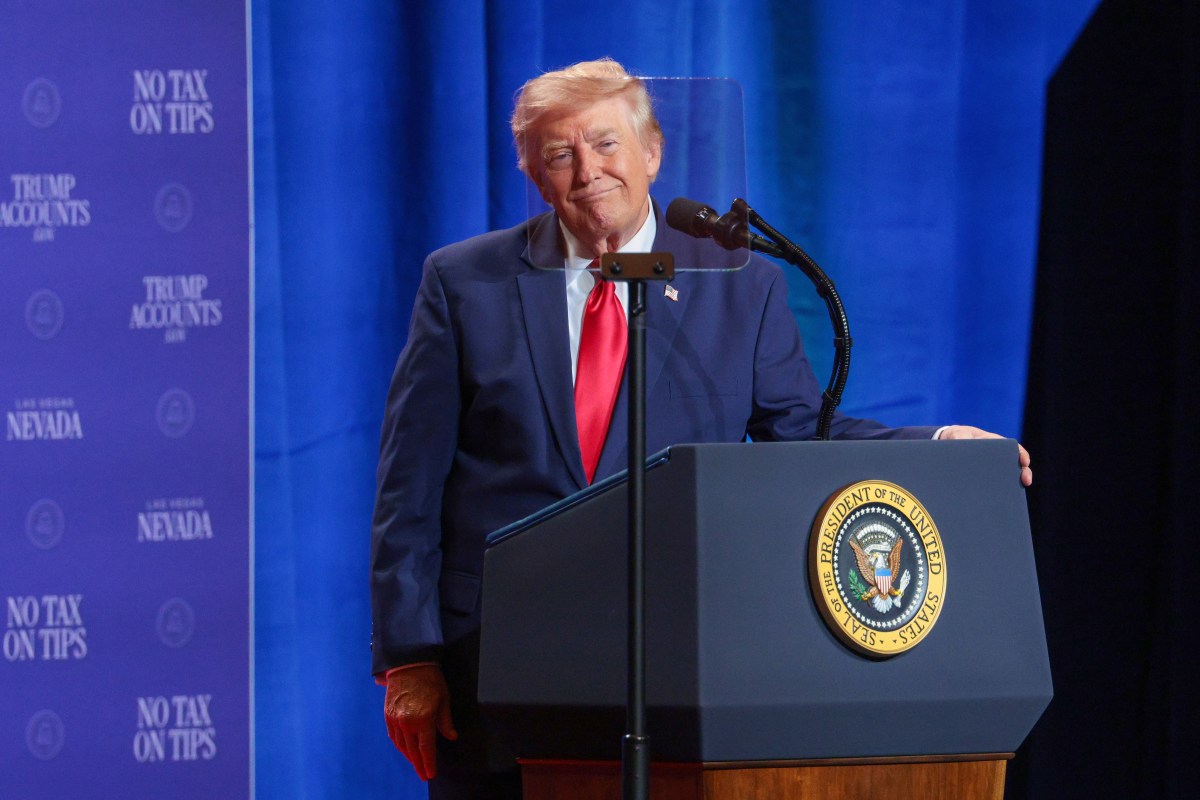
President Donald Trump‘s net approval rating among Republicans has fallen by 8 percentage points over the past month, according to a new Financial Times/Focaldata poll, adding to signs that some GOP voters are growing frustrated with the economy and the rising cost of living.
The survey found that more than 53 percent of registered voters say they are financially worse off since Trump returned to the White House in January 2025. That includes nearly 57 percent of independents and almost one-quarter of Republicans.
The findings come less than three months before the midterm elections, as Republicans seek to defend congressional majorities and the White House continues to promote Trump’s economic record.
Read More on News
Trump Approval Among Republicans
The survey, conducted August 7-10 among 1,913 registered voters, found that 55 percent disapprove of Trump’s performance as president. It also found that Trump’s net approval rating among Republicans, a measure of the gap between approval and disapproval, fell 8 percentage points from the previous month.
More than half of registered voters said they are worse off financially since Trump’s return to office.
The survey also found that voters were more likely to trust Democrats than Republicans on inflation, the cost of living, jobs and the economy, issues traditionally viewed as Republican strengths.
The poll had a margin of error of plus or minus 2.9 percentage points.
Economic Concerns Persist
Economic issues remain among the most important concerns for voters heading into November’s elections, and Republicans have increasingly faced polling showing dissatisfaction with inflation, household costs and the broader economy.
The latest survey is not the first sign of growing economic unease among Republican voters.
A Pew Research Center poll reported by Newsweek in July found that 28 percent of Republicans said Trump’s policies had made economic conditions worse, up from 18 percent in January. The same survey found 19 percent of Republicans expected the economy to worsen over the next year. Even so, 69 percent of Republicans said they approved of Trump’s job performance, compared with 29 percent who disapproved.
Other recent polling has similarly pointed to voter frustration over prices and inflation. A YouGov/Economist survey conducted from July 31 to August 3 found only 30 percent approved of Trump’s handling of the economy while 65 percent disapproved. On inflation specifically, just 25 percent said he was handling rising prices well, while 69 percent disapproved.
The Financial Times/Focaldata poll found similar concerns. Among registered voters, 64 percent disapproved of Trump’s handling of inflation and the cost of living, including nearly seven in 10 independents and about one-third of Republicans.
Nearly two-thirds of respondents said the economy was moving in the wrong direction, while only about one-quarter said it was heading in the right direction.
Republican Faults Trump Economic Message
Speaking on CBS News’ Face the Nation on Sunday, Representative Don Bacon, a Nebraska Republican, said Trump has not effectively communicated that he understands voters’ economic struggles.
“He doesn’t communicate it well,” Bacon said when asked whether the president understands Americans’ financial pain.
Bacon added that Trump “makes light of the affordability question” despite what he described as a continuing affordability problem.
“I think most Americans are feeling the pain at the grocery store and the gas,” the congressman said. “So, I think it’s better just to acknowledge, hey, this is a problem, and we got to work towards getting wages climbing faster than inflation.”
The Republican also criticized the president’s tariff policies, arguing they have contributed to higher prices for consumers.
“Tariffs have hurt inflation,” Bacon said. “Global tariffs, it ends up being a tax on consumers, and we’re paying more because of it.”
Bacon’s critique comes as Trump has increasingly asked voters to tolerate higher fuel costs tied to the Iran war. Speaking at a rally on Friday, the president said Americans paying $4 for gasoline should remember they were doing so to prevent Iran from obtaining a nuclear weapon and said he would “never apologize” for the decision.
Political consultant Matt Klink previously told Newsweek that “voters experience the economy not through GDP charts or stock market gains, but at the grocery store, the gas pump, and the kitchen table.”
White House Defends Record
White House spokesman Kush Desai pushed back on the bleak assessment offered by the poll.
“The Trump administration continues to deliver on the President’s affordability agenda by lowering drug prices, reshoring American jobs, and cutting taxes while simultaneously touting a historic drop in violent crime nationwide and the most secure border in history,” Desai told the Financial Times.
The administration has repeatedly argued that many economic problems were inherited from former President Joe Biden and has highlighted tax cuts, manufacturing investment and decreases in some consumer prices as evidence that Trump’s policies are working.
Midterms Draw Closer
The Financial Times/Focaldata survey also found Democrats holding a 44 percent to 39 percent lead when voters were asked which party they were more likely to support in November.
Recent government data showed inflation running at 3.4 percent in July, while consumer sentiment fell sharply and real wages declined last month.
With inflation and the economy consistently ranking among voters’ most important issues, the latest poll suggests Republicans may face a difficult balancing act: defending Trump’s record while addressing voters’ continuing concerns about affordability just weeks before Americans head to the polls.
Contact Newsweek editor for this story: Anthony Murray.