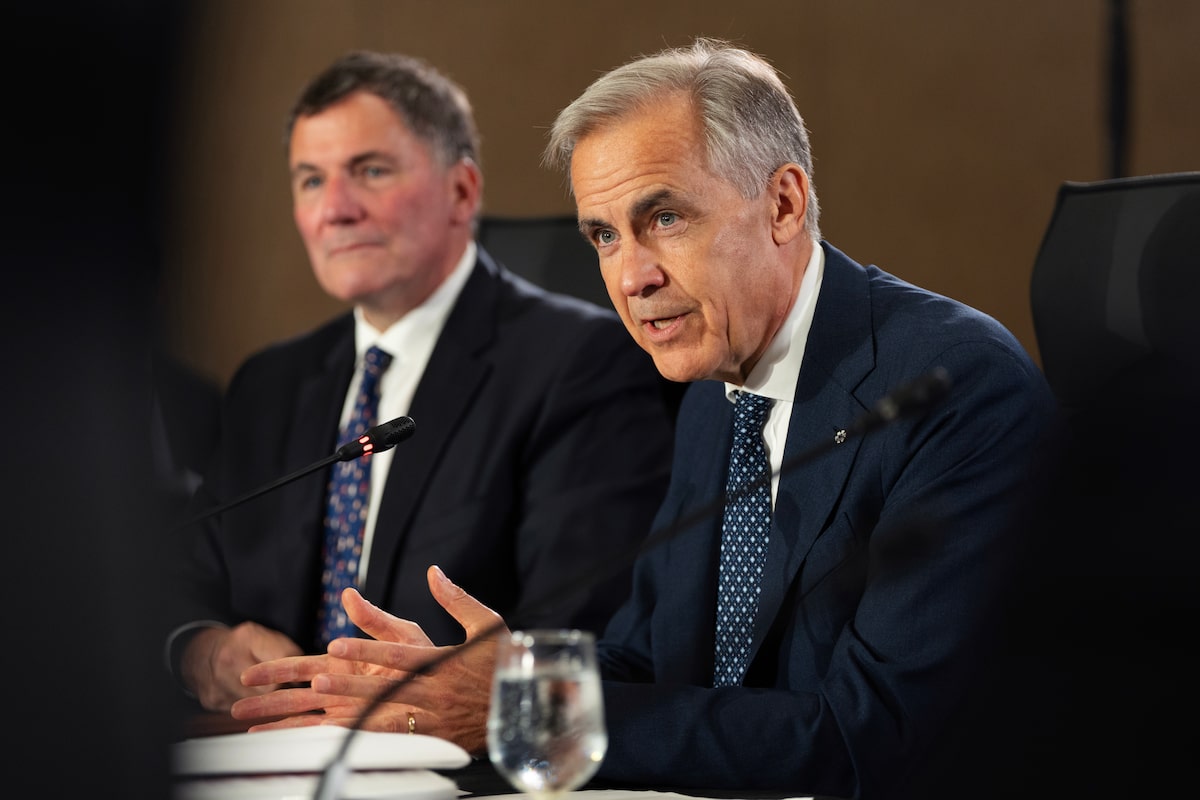
Mr. Carney’s election victory in April, 2025, confirmed that Canada had embraced the politics of deference. And in the year since, that dynamic has only deepened.Darren Calabrese/The Canadian Press
Scott Reid is a principal at Feschuk-Reid and was the director of communications to former prime minister Paul Martin.
In the roughly 17 months since Mark Carney strode onto the political scene with his banker-steady promise of competence, order and calm, the defining attribute of his relationship with the Canadian public has been deference. In large numbers, people have surrendered their trust to the Prime Minister. Not just their vote, not just their hopes – their trust.
This has been a jaw-cracking development.
For decades, the one unmistakable pattern apparent across western democracies was a decline in deference. In 1974, Richard Nixon proved that our governments were lying to us – and maybe always had been. Regard for political leaders, along with confidence in experts, authorities and institutions, eroded steadily for decades until social media and the broken bargain of globalization accelerated that decline into anger and activism. About a half-century after Mr. Nixon’s resignation, our politics have morphed into Brexit, MAGA, convoy Conservatism and growing interest in strongman solutions. It was a trend that seemed certain, a couple years ago, to deliver a majority government to the populist agitant Pierre Poilievre.
But in 2025, Donald Trump’s assault on Canada’s economy and even our country’s right to exist shifted that trajectory. The unpopular Justin Trudeau had left the scene. A damaging trade war had arrived. Anger was diluting into anxiety. Suddenly, the idea of meeting MAGA’s anti-everything hostility with a shadow populism of our own seemed a lot less sensible to many voters.
Five things you need to know about the Canada-U.S. trade talks
In that moment Mr. Carney appeared as a living champion of the “un.” He was the un-Trump. The un-Trudeau. The un-Poilievre. And as an un-politician, he brought a resume that seemed ideally composed to manage Mr. Trump, trade and an unravelling world order. Even his balanced demeanour provided a reassuring contrast to the President’s erratic antagonism.
Mr. Carney’s election victory in April, 2025, confirmed that Canada had embraced the politics of deference. And in the year since, that dynamic has only deepened. The Prime Minister has racked up sky-high approval ratings, coaxed away Opposition MPs and transformed his minority government into a majority without recourse to the electorate.
Now, with trade talks intensifying and new tariffs looming, the durability of that deference will face its toughest test.
Will Canadians continue to grant Mr. Carney their trust if he comes peddling a package of concessions and compromises? Can he convince the public that what’s won at the bargaining table is sufficient to drop countertariffs and put American whisky back on store shelves? If talks collapse and tariffs soar, will confidence in Mr. Carney dissipate?
The answer may lie in a closer examination of what voters were thinking when they turned their fates over to the new Prime Minister last spring.
Canadians did not, as many Conservatives and some commentators assert, hire Mr. Carney to simply reach a deal with Mr. Trump. The contract was far more subtle and much less conditional than that.
Mr. Carney was chosen to decide for us – to employ his particular experience, intelligence and judgment to determine what to do on our behalf. Whether to reach a deal or not. Whether to strike out or stand down. With their votes, Canadians were making a de facto admission of confoundment: They could not imagine how to deal with a creature such as Mr. Trump, a vain, lying and spiteful President who treats us as an enemy. And so, they turned to the newcomer to figure it all out.
Opinion: In the trade war showdown, it’s strong-hand Carney vs. weak-hand Trump
This logic explains how Mr. Carney has been able to pursue policies that conventional wisdom had deemed politically impossible in Canada, such as exalting pipeline construction, expanding budget deficits and shifting tens of billions of dollars toward defence. It explains why Canadians cheer when he goes elbows up, but also accept when he goes elbows down, granting him an astonishing benefit of the doubt premised on the assumption that he must know best how to calibrate against Mr. Trump’s belligerence.
And this is why Mr. Carney now faces the toughest moment of his premiership. If he miscalculates the public mood – if assurances are provided only to be trampled upon, if too much is taken for granted – deference could spoil into disappointment. And disappointment could curdle into disaffection.
But that seems unlikely. This new era didn’t arrive by accident; Canadians chose it. They knowingly placed themselves in the hands of this former central bank governor and asked him to do their deciding. Notwithstanding deep distrust of the White House – or perhaps because of it – Canadians will continue to defer to Mr. Carney, for at least the foreseeable future.