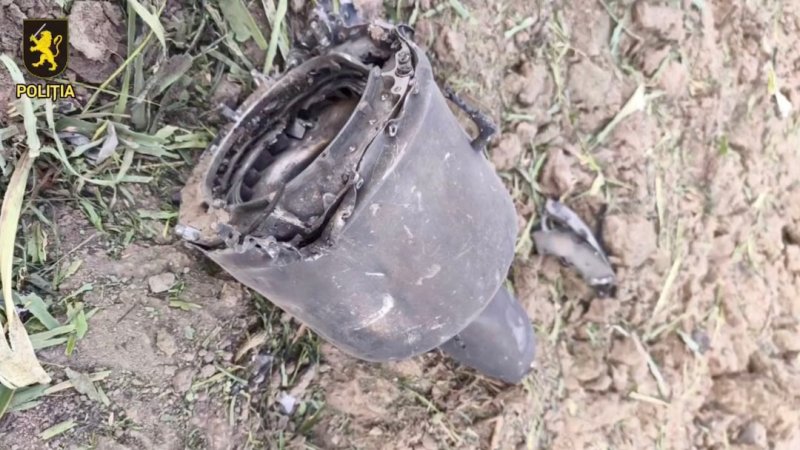
Moldovan authorities say the country’s airspace has been violated nearly 60 times since Russia launched its full-scale war against Ukraine in February 2022. Defence Minister Anatolie Nosatii presented the figure while warning that the conflict is creating security risks beyond Ukraine’s borders.
“Almost 60 cases of violations of Moldova’s airspace are proof” that the conflict is affecting neighboring countries, Nosatii told reporters in Chisinau.
The minister linked the repeated incidents to Russia’s military operations in Ukraine and said they endangered Moldova’s population and challenged the country’s neutrality. Moldovan authorities have previously reported incursions involving drones or other aerial objects, although the specific circumstances may differ from one case to another.
The figure of nearly 60 covers a period of more than four years. However, the government has not provided a detailed public breakdown identifying the date, location, duration and type of aerial object involved in every incident. It is therefore unclear how many cases concerned complete drones, missile fragments, unidentified aircraft or objects that briefly crossed Moldovan territory.
An airspace violation does not necessarily mean Moldova was deliberately targeted. Weapons or debris may cross borders because of navigation failures, interceptions, electronic interference or military operations taking place near the frontier. Nevertheless, every incursion creates risks for people and property.
The repeated nature of the incidents is central to Moldova’s concern. Even when individual violations cause no casualties, their cumulative effect places pressure on emergency services, airspace monitoring and the country’s wider security policy.
What happened near the village of Talmaza?
The latest reported incident occurred near Talmaza, a village in Moldova’s Stefan Voda district. Moldovan authorities said a drone exploded near the community one day before Nosatii made his comments about the wider pattern of airspace violations.
No injuries were reported, but the explosion started a fire at the site. Authorities have not provided a complete assessment of the damage or explained whether the fire affected farmland, buildings or other property.
Moldova’s Foreign Ministry condemned the episode as “a serious violation of the country’s sovereignty.” The statement reflected the government’s view that the presence and explosion of a military-type aerial object on Moldovan territory represented a significant security incident.
However, the precise origin and cause of the drone have not been independently established. Investigators will need to examine fragments, electronic components, explosive residue and flight information before reaching a definitive conclusion about where the aircraft came from and who operated it.
Authorities may also consider whether the drone entered Moldova intact, had been damaged before crossing the border or was affected by electronic warfare. Its intended target is another unanswered question. The drone may have been directed toward a location in Ukraine and deviated from its route, or it could have entered Moldovan airspace under different circumstances.
The absence of casualties does not reduce the seriousness of the incident. An explosion near an inhabited area could have caused deaths or injuries depending on where the drone landed. The Talmaza episode therefore illustrates why Moldova considers repeated aerial incursions a growing threat to civilian safety.
Why is Moldova vulnerable to spillover from the Ukraine war?
Moldova shares a border with Ukraine, placing it close to areas affected by missile and drone operations. When aerial attacks occur near the frontier, weapons, fragments or unmanned aircraft can enter Moldovan airspace intentionally or accidentally.
Modern drones can travel considerable distances and may follow routes affected by navigation errors, technical failures or electronic interference. Air-defence interceptions can also alter a weapon’s trajectory or cause debris to fall outside the territory where it was originally targeted.
Moldova does not need to be a direct participant in the conflict to experience its consequences. Border closures, refugee movements, damaged infrastructure and aerial incidents can affect neighbouring states even when fighting remains concentrated inside Ukraine.
The danger is particularly serious when an unidentified object approaches a populated area. Authorities may have limited time to determine whether it is armed, where it is heading and whether an interception would create additional risks on the ground. Falling debris can be dangerous even when a drone or missile has already been disabled.
Repeated incidents also create uncertainty among residents. Warning systems, emergency responses and temporary restrictions may disrupt daily life, while each new report can raise fears that the war is moving closer to Moldovan communities.
The nearly 60 reported violations indicate that Moldova’s exposure is persistent rather than theoretical. Although the circumstances of individual incidents may vary, their frequency demonstrates the difficulty of insulating a neighbouring country from an intensive aerial war. Geography therefore remains one of the most important factors shaping Moldova’s security concerns and its calls for greater protection of civilian airspace.
How do the incidents affect Moldova’s policy of neutrality?
Moldova has sought to maintain its neutrality while responding to the security consequences of the war in neighbouring Ukraine. Defence Minister Anatolie Nosatii argued that Russia’s military actions were threatening both the country’s neutrality and the safety of its population.
Neutrality means that Moldova does not consider itself a party to the conflict. It does not, however, require the country to accept violations of its territory or prevent it from strengthening its ability to protect civilians and monitor its airspace.
The government’s challenge is to distinguish defensive measures from direct participation in the war. Improving radar coverage, emergency-warning systems, border monitoring and the ability to identify aerial objects can be presented as necessary steps to preserve neutrality rather than abandon it.
Repeated incursions complicate this position because they force Moldova to respond to military activity originating beyond its borders. If the country lacks the capacity to detect and investigate those incidents, its sovereignty may appear vulnerable. If it expands defence cooperation with foreign partners, critics may argue that its neutral status is being weakened.
The Talmaza explosion adds urgency to this debate. A drone that reaches Moldovan territory and detonates near a village creates a direct civilian threat regardless of its intended target.
Neutrality also depends on other states respecting Moldova’s borders. From Chisinau’s perspective, repeated unauthorised entries into its airspace undermine that principle even when Moldova is not intentionally targeted.
The government is therefore likely to frame greater defensive preparedness as a means of protecting neutrality. The political debate will focus on how Moldova can strengthen security without becoming directly involved in the military confrontation.
What risks do drones pose to Moldovan civilians?
Drones can pose several dangers even when they are not intended to strike targets inside Moldova. An armed aircraft may explode after losing navigation, suffering mechanical failure or being affected by electronic countermeasures. Debris from an intercepted drone can also fall onto homes, roads, farmland or energy infrastructure.
The Talmaza incident demonstrates the potential consequences. The drone reportedly exploded near the village and caused a fire, although no one was injured. A different impact location could have produced a much more serious outcome.
Uncertainty creates an additional challenge. When authorities detect an unidentified aerial object, they must quickly determine its direction, altitude and possible payload. An interception may prevent it from reaching a populated area, but destroying it in the air can scatter fragments over a wider zone.
Civil protection therefore involves more than military interception. Moldova may need reliable public-warning procedures, emergency-service coordination and clear instructions for residents who discover drone debris. Unexploded components should not be touched because they may contain hazardous materials or remain capable of detonating.
Repeated alerts can also have psychological consequences. People living near the Ukrainian border may experience anxiety when they hear explosions or receive warnings about aerial objects. Farmers and other residents may be concerned about entering areas where fragments have landed.
The nearly 60 reported violations show that the risk cannot be treated as an isolated problem. Even if most incursions do not result in casualties, every incident creates a possibility of accidental harm. Strengthening detection, public communication and rapid emergency response is therefore essential for reducing the danger to Moldovan civilians.
Has Russia’s responsibility for every incident been established?
Moldovan officials have attributed recent drone activity and the wider security threat to Russia’s military operations in Ukraine. However, the origin and cause of the drone that exploded near Talmaza have not been independently established.
This distinction is important. The broader conflict may create the conditions for an aerial incursion, but investigators must still determine the origin of each drone or fragment. Technical evidence can include serial numbers, engine components, guidance systems, explosive materials and construction characteristics.
Flight paths and radar records may help establish where an object entered Moldovan airspace and the direction from which it travelled. Authorities may also compare fragments with known drone models used by the parties to the war.
Even when a drone is identified as a particular model, responsibility may not be immediately clear. Similar systems can be operated by different forces, and electronic warfare may divert an aircraft from its intended route. Investigators must therefore separate technical identification from conclusions about who launched it and what target was intended.
Moldova’s description of nearly 60 airspace violations is an official cumulative figure. A complete assessment would require detailed evidence for each incident rather than treating them as identical.
The absence of independent confirmation in the Talmaza case does not disprove the Moldovan government’s concerns. It means that attribution should remain provisional until the forensic investigation is completed.
Clear evidence is especially important because attribution may lead to diplomatic protests, requests for international assistance or changes in national security policy. Publishing technical findings where possible could strengthen public confidence and reduce the spread of unsupported claims.
What could Moldova do to reduce the threat?
Moldova’s response is likely to focus on improving early detection, public protection and diplomatic pressure. Better radar coverage could give authorities more time to identify drones or missiles approaching the border and determine whether populated areas are at risk.
Detection alone may not be sufficient. Moldova would also need procedures for deciding when to issue warnings, restrict airspace or deploy emergency teams. Local authorities in border districts should know how to respond when aerial debris or unexploded objects are discovered.
Public communication is another important element. Residents need clear instructions not to approach fragments and to report suspicious objects immediately. Authorities should also provide timely information after incidents to prevent rumours and reduce unnecessary alarm.
Moldova may seek technical assistance from international partners while presenting such cooperation as defensive and consistent with its neutrality. Support could include radar equipment, training, forensic expertise and systems designed to counter small drones.
Diplomatically, Chisinau can continue documenting incidents and raising alleged violations with relevant governments and international institutions. A detailed record of locations, damage and technical findings would strengthen its position.
No defensive system can eliminate every risk, particularly when intensive military operations are taking place close to the border. The priority is therefore to reduce the likelihood that an unidentified object reaches a populated area without warning.
The Talmaza explosion and the nearly 60 reported violations demonstrate that the spillover threat is continuing. Moldova’s challenge is to improve protection without escalating tensions or abandoning its neutral status. Its ability to do so will depend on defensive capacity, transparent investigations and sustained international cooperation.