
We might all think of the “Big Five” leagues and say, “They’re going to dominate the world until the end of football,” but in reality, there are many leagues that don’t get much attention and have the potential to go far. One of these leagues is the Eliteserien, the top tier of Norwegian football.
A BRIEF HISTORY
This league began in 1937, but it turned professional in 1990, and it wasn’t until 2017 that it was named the Eliteserien. The most successful team in this competition, with 26 titles, is Rosenborg BK. The all-time leading scorer is Norwegian forward Sigurd Rushfeldt, who scored 171 goals in 299 matches.
 A PROMISING FUTURE FOR THIS LEAGUE
The Norwegian league starts much earlier than the five major European leagues, and yet no one talks about it. The league begins in March and ends in December of the same year. Sixteen teams compete in the Eliteserien, four of which have a chance to play in European competitions: two teams play in the UEFA Champions League qualifying rounds and two teams play in the UEFA Conference League qualifying rounds.
At the same time, two teams are directly relegated, and one team plays in the relegation playoffs. Everything is decided after 30 matchdays.
So far this season, 16 matchdays have been played, and there is a seven-point gap between first and third place; at the other end of the table, there is an eight-point gap between 13th and 16th place.
In the 16 matchdays played so far, there has been an average of 3.19 goals per game. Of the 136 matches played, only four have ended scoreless. Of all the matches played, only 54 have had fewer than three goals.
 A MATCH THAT SHOWS GROWTH
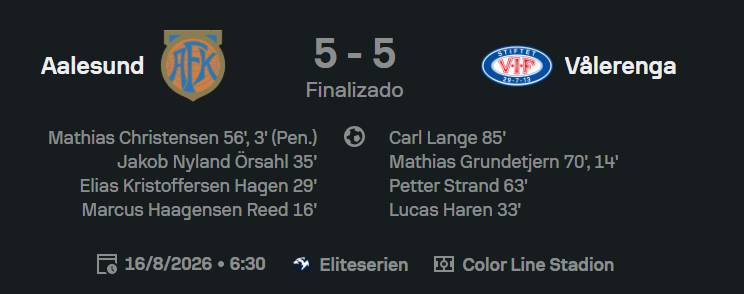
This season there are many talented teams, such as Bodo/Glimt, Molde and Rosenborg, among many others, but there was one match in particular that didn’t involve any of the top teams. This was a match between Aalesund FK and Valerenga IF on Matchday 18 that ended in a 5-5 draw.
Between these two teams, Valerenga IF has performed much better in recent years (in 2010, they finished in second place) and had remained in the top division ever since, until 2023, when they were relegated to the second division, only to be promoted back immediately afterwards.
On the other hand, Aalesund FK is a team that has not been very consistent in the Eliteserien; they have been relegated to the second division on several occasions and are currently in the relegation zone this season.
This match between Aalesund and Valerenga seemed like Valerenga would dominate, since in their previous encounter, the Oslo-based club won 6-1; however, Aalesund proved that despite being the underdog, they can hold their own against bigger teams.
 KEY STATISTICS
Aalesund didn’t mind not having possession, as they completed only 193 passes. They aim to create plays with few touches. Valerenga, on the other hand, does seek to keep the ball at their feet, having completed 530 passes. Both teams were successful with their respective styles of play.
In this match, it’s clear that Valerenga IF and Aalesund FK play very different styles of soccer; over the 90 minutes, there were a total of 46 shots by both teams, 18 of which were on goal, and ten of those resulted in goals. Another very important point to note is that both teams combined reached the final third of the field 146 times, which speaks volumes about the offensive play in this match.


 EUROPEAN COMPETITIONS
Obviously, these stats are playing against each other. Sadly, there has been almost no participation by Eliteserien teams in European competitions, as it is a league that is still growing. In total, seven teams have advanced to the group stage/league stage of the three competitions: the UEFA Champions League, Europa League and Conference League. Those teams are: Bodo/Glimt, Molde FK, Rosenborg BK, SK Brann, Sarpsborg 08, Tromso IL and Viking FK.
The best performance of all the teams came from Bodo/Glimt in 2024, when they reached the semifinals of the UEFA Europa League, eliminating opponents such as Lazio, Twente and Olympiacos, and defeating rivals like Porto and Braga in the league phase.
But a year later, Bodo/Glimt achieved a feat that will never be forgotten in football history. They qualified for the UEFA Champions League for the first time and achieved some excellent results, including a draw against Tottenham, a draw against Dortmund, and victories over Manchester City and Atlético Madrid. Thanks to those results, they advanced to the next round, in which they faced Inter de Milan. No one expected much against them, but they managed to beat them and advance to the round of 32, only to be eliminated by Sporting CP.

All of this shows that Norwegian football (both at the international and club levels) is on the rise, and it doesn’t look like it’s going to stop. Ever since Norwegian clubs began making their mark on European football, it’s become clear that they’ve reached a high level—not to mention the national teams. Starting with this World Cup, the Norwegian national team will begin pushing forward to continue making history.
For more content, check my page