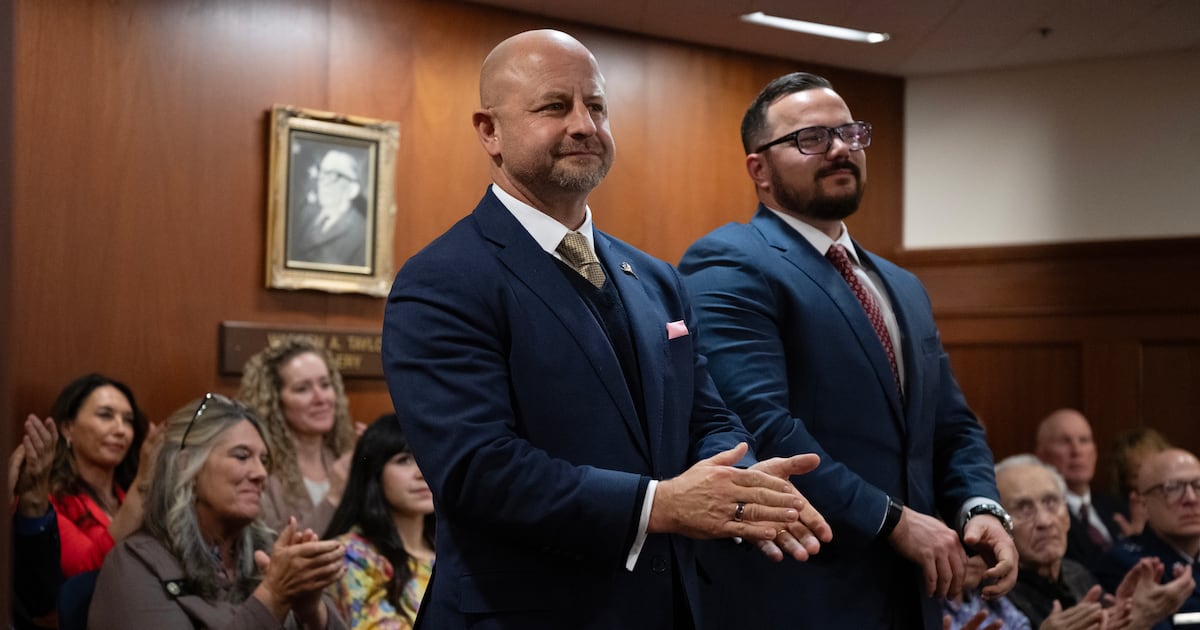
 Glenfarne Group’s CEO Brendan Duval and Glenfarne Alaska LNG president Adam Prestidge are recognized during Gov. Mike Dunleavy’s State of the State address in Juneau on Jan. 22. (Marc Lester / ADN archive)
The developer of the Alaska LNG megaproject said Wednesday that it’s “disappointed” the state Legislature is not reconvening to consider a multibillion-dollar property tax cut for the project.
The statement is the first from Glenfarne after Gov. Mike Dunleavy’s effort to provide the tax cut, to help the project win financing, blew up last week after the House and Senate had failed to come to agreement on a bill after months of effort.
“We are disappointed the Legislature has stated they will not take final action on property tax legislation to facilitate the development of the Alaska LNG pipeline,” Glenfarne, a private company based in New York and Texas, said in a statement provided by spokesperson Tim Fitzpatrick.
“This will cause schedule delay and cost increase on the gas line,” Glenfarne said. “This outcome hinders our efforts to deliver North Slope natural gas to Alaskans as quickly and affordably as possible and to offset declining production and rising costs from Cook Inlet. We are evaluating alternative paths forward while continuing to advance the commercial, engineering and financing work required to deliver the full Alaska LNG project, including the LNG export terminal.”
Last week, Senate and House leaders expressed deep skepticism they could quickly study and pass a bill this year after Dunleavy introduced compromise legislation deep into the third straight special session that provided a slimmed-down corporate income tax provision to apply to oil and gas companies that currently don’t pay the state’s income tax — such as Hilcorp, a major producer in Alaska.
The monthlong special session had been expected to end Aug. 25.
Hilcorp and major business groups have expressed opposition to the corporate income tax provision, which has been a major sticking point in the negotiations. They also opposed the governor’s version, though it would have created a maximum 2% tax, well below the maximum 9.4% that other companies face in state law and that the Senate majority has sought, while excluding the project itself.
Dunleavy, who is termed out and leaves office in December, issued a statement last week saying there was “little reason” to continue with the special session after the statements from legislative leaders.
 Gov. Mike Dunleavy holds a press conference after calling the Legislature into a third consecutive special session to continue working on a tax break bill for the proposed Alaska LNG project at the Alaska State Capitol building in Juneau on July 16, 2026. Behind him stood members of the House Republican minority caucus, Rep. Frank Tomaszewski of Fairbanks, Rep. Garret Nelson of Sutton, and Rep. Kevin McCabe of Big Lake. (Mari Kanagy / ADN)
The events raised questions about the future of the project, an up to $55 billion proposal to deliver long-stranded natural gas from the North Slope for delivery to Alaskans and Asian entities. It’s seen as critical to resolving a gas supply shortage in Cook Inlet that could lead to costly imports of liquefied natural gas for Alaskans to heat and power homes and offices.
It could also provide the state with billions of dollars in royalties, gas-production taxes and a newly proposed gas-volume tax over the coming decades, even with the huge property tax cut.
State legislative leaders have indicated that the next Legislature that reconvenes for a regular session in January could again take up legislation to support the project, under a new governor.
Glenfarne owns 75% of the project while the state’s Alaska Gasline Development Corp. owns the remaining 25%
Glenfarne said in its statement: “The fundamental case for Alaska LNG remains strong: Alaska needs a long-term solution to its energy supply challenge, the North Slope has one of the largest natural gas resources in the world, global customers continue to value secure Pacific LNG supply, and the project continues to have strong support from Alaskans and the federal government.“
“We appreciate Governor Dunleavy and the many legislators who worked constructively toward a solution,” Glenfarne said. “Alaska still needs a long-term solution to its energy supply challenge, and we will continue working with Alaska’s leaders and our global construction and LNG offtake partners to find the best path forward.”