
Economic resilience as strategic power
A multipolar system does not require bloc politics
Why this matters for European policy
Translating geography into economic value
Technology, skills, and strategic capability
Strategic autonomy begins at home
The pivotal issue is whether Islamabad can cultivate sufficient economic, technological, and diplomatic resilience to prevent any single foreign partnership from narrowing its sovereign strategic choices.
The resurgence of great power competition is transforming the very nature of national power. While conventional military capability remains indispensable, international influence increasingly hinges on technological capabilities, finance, energy resources, supply chains, market access, and critical infrastructure.
Washington can restrict access to frontier technologies, Beijing leverages industrial capacity and global infrastructure connectivity, while the European Union exercises formidable regulatory and market power. Meanwhile, the Gulf States are translating sovereign capital, energy assets, and investments in emerging technologies into enduring global leverage.

Chinese President Xi Jinping and Pakistani Prime Minister Shehbaz Sharif shake hands at the Great Hall of the People in Beijing, China, on 25 May 2026 – China Daily via REUTERS
Military, economic, and technological capabilities are increasingly mutually reinforcing. International sanctions, export controls, financial curbs, foreign investment screening, and supply chain security policies have become front-line instruments of modern statecraft.
Sanctions regimes implemented against Russia since 2022 and US export controls on advanced semiconductor technologies demonstrate how economic and technological interdependence can be weaponised as strategic leverage.
For Pakistan, the strategic takeaway is unambiguous: safeguarding its diplomatic freedom of manoeuvre depends not only on balancing major power relations, but crucially on building domestic resilience against external shocks.

Russian President Vladimir Putin, Chinese President Xi Jinping, North Korean leader Kim Jong-un, Pakistani Prime Minister Shehbaz Sharif, and foreign delegation heads arrive in Beijing, China, on 3 September 2025 – Sputnik/Alexander Kazakov via REUTERS
Economic resilience as strategic power
Economic stability overseen by the Ministry of Finance of Pakistan can no longer be viewed strictly as a developmental concern. It directly dictates the country’s foreign policy options.
External financing requirements before institutions such as the International Monetary Fund (IMF), heavy reliance on imported energy, concentrated export baskets, and exposure to global commodity price shocks constrain economic flexibility. In a world where finance, trade, and technology serve as instruments of geopolitical pressure, economic resilience is an essential component of national security.
Boosting export competitiveness, enhancing industrial productivity, diversifying the energy mix, and attracting sustainable investment will enhance Islamabad’s capacity to absorb external volatility while preserving political agency. This does not diminish military readiness: credible defence capabilities remain essential, yet they are far more sustainable when underpinned by a productive economy, reliable energy supplies, and robust institutions.
National defence and economic resilience therefore operate as complementary pillars of Pakistan’s strategic autonomy.
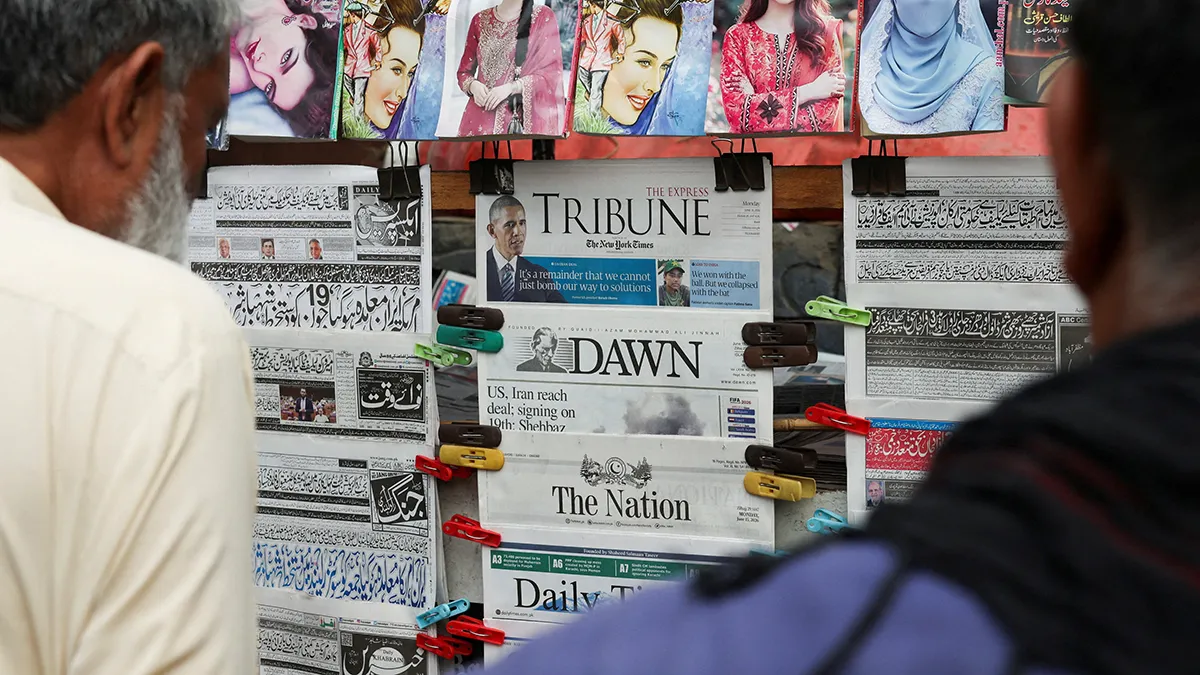
Men read newspapers reporting on the signing of the US-Iran peace agreement at a newsstand in Islamabad, Pakistan, on 15 June 2026 – REUTERS/ AKHTAR SOOMRO
A multipolar system does not require bloc politics
A more fragmented international order does not compel every state to adopt rigid alignment. Saudi Arabia and the United Arab Emirates maintain deep security ties with Washington while expanding comprehensive economic and technological cooperation with Beijing. Turkey similarly navigates regional politics through diversified, omnidirectional partnerships.
Pakistan can apply this exact underlying rationale: deepening cooperation with one major power need not come at the expense of ties with others.
China remains an indispensable strategic and economic partner, notably through the China-Pakistan Economic Corridor (CPEC) under the Belt and Road Initiative. Concurrently, the United States remains vital in trade, technology, and diplomacy via the US Department of State. Europe is a primary export destination and economic partner, the Gulf States provide capital investment and energy security, and Central Asia offers untapped connectivity potential.
Strategic autonomy should not be conflated with equidistance or passive neutrality. It represents preserving sovereign decision-making by cultivating multidimensional partnerships tailored to specific national interests, mitigating the hazards of concentrated dependency.

Pakistan’s Finance Minister Muhammad Aurangzeb and US Treasury Secretary Scott Bessent shake hands during their meeting in Washington, D.C., on 21 July 2026 – Ministry of Finance via REUTERS
Why this matters for European policy
Pakistan’s pursuit of strategic flexibility is directly relevant to Germany and the European Union.
European policymakers increasingly emphasise de-risking and resilience to address critical vulnerabilities in energy supplies, essential technologies, and supply chains. While Pakistan navigates these dynamics from a different socioeconomic standpoint, the structural dilemma is identical: how to benefit from global interdependence without allowing concentrated dependencies to restrict sovereign policy choices.
This is where Islamabad’s priorities and Europe’s strategic debate intersect.
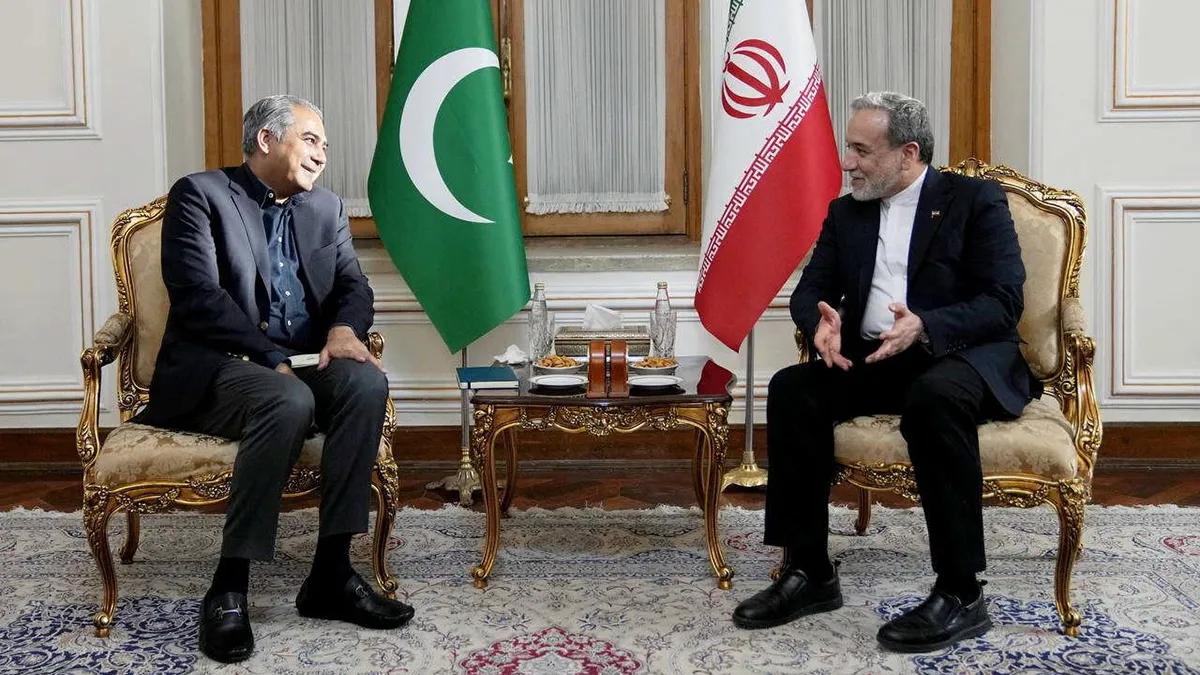
Iranian Foreign Minister Abbas Araqchi meets with Pakistani Interior Minister Mohsin Naqvi in Tehran, Iran, on 11 August 2026 – Ministry of Foreign Affairs of Iran/WANA via REUTERS
If European strategic autonomy entails diversifying partnerships, European external policy must acknowledge why partners across the Global South pursue their own strategic flexibility. Expanding credible European engagement with countries like Pakistan across trade, green investment, and technological cooperation reinforces the credibility of Europe’s own diversification agenda.
An economically resilient Pakistan presents tangible opportunities in renewable energy partnerships, digital transformation, and technical upskilling. For Germany in particular, bilateral cooperation in vocational training, manufacturing, and R&D can connect Pakistan’s demographic human capital potential with European demand for reliable, diversified international partnerships.
Europe’s quest for strategic autonomy cannot end at its borders. To build durable partnerships across the Global South, European policy must offer viable economic and technological alternatives rather than expecting partners merely to swap one dependency for another.

A billboard displays portraits of Saudi Crown Prince Mohammed bin Salman, Pakistani Prime Minister Muhammad Shehbaz Sharif, Pakistan Army Chief Field Marshal Asim Munir, and Turkish President Recep Tayyip Erdogan following the signing of the Makkah Joint Defence Agreement in Karachi, Pakistan, on 9 August 2026 – REUTERS/ AKHTAR SOOMRO
Translating geography into economic value
Diversification requires translating geographical positioning into substantive economic capacity through the Government of Pakistan and the private sector.
Located at the crossroads of South Asia, China, Central Asia, and the Middle East, Pakistan holds immense transit and trade connectivity potential. However, geography generates geopolitical influence only when it creates tangible economic value.
CPEC and infrastructure initiatives must aim beyond functioning solely as transit corridors. Seaports, motorways, and rail networks generate peak value when integrated with specialised industrial zones, logistics hubs, modern energy grids, and export-oriented manufacturing.
Deeper integration into regional supply chains will stimulate foreign direct investment and domestic employment. For European industry, a productive, well-connected Pakistan offers a reliable gateway to surrounding regional markets, converting physical connectivity into diversified economic options.

Pakistani Prime Minister Shehbaz Sharif shakes hands with Saudi Crown Prince Mohammed bin Salman upon arrival in Makkah, Saudi Arabia, on 7 August 2026 – Bandar Algaloud/Courtesy of Saudi Royal Court via REUTERS
Technology, skills, and strategic capability
Technological capacity will prove equally decisive. Artificial intelligence, cybersecurity, digital infrastructure, and advanced manufacturing increasingly underpin both economic competitiveness and national resilience.
Pakistan must focus on developing domestic expertise in targeted sectors while diversifying its international technological partnerships. The strategic objective is to ensure that access to critical digital infrastructure does not become a structural vulnerability restricting decisions by the Ministry of Foreign Affairs of Pakistan.
Investing in technical education and strengthening academia-industry linkages will translate Pakistan’s demographic dividend into digital service exports and high-value economic output. Deeper cooperation with Germany and the EU in workforce development and applied research will support this structural transition.
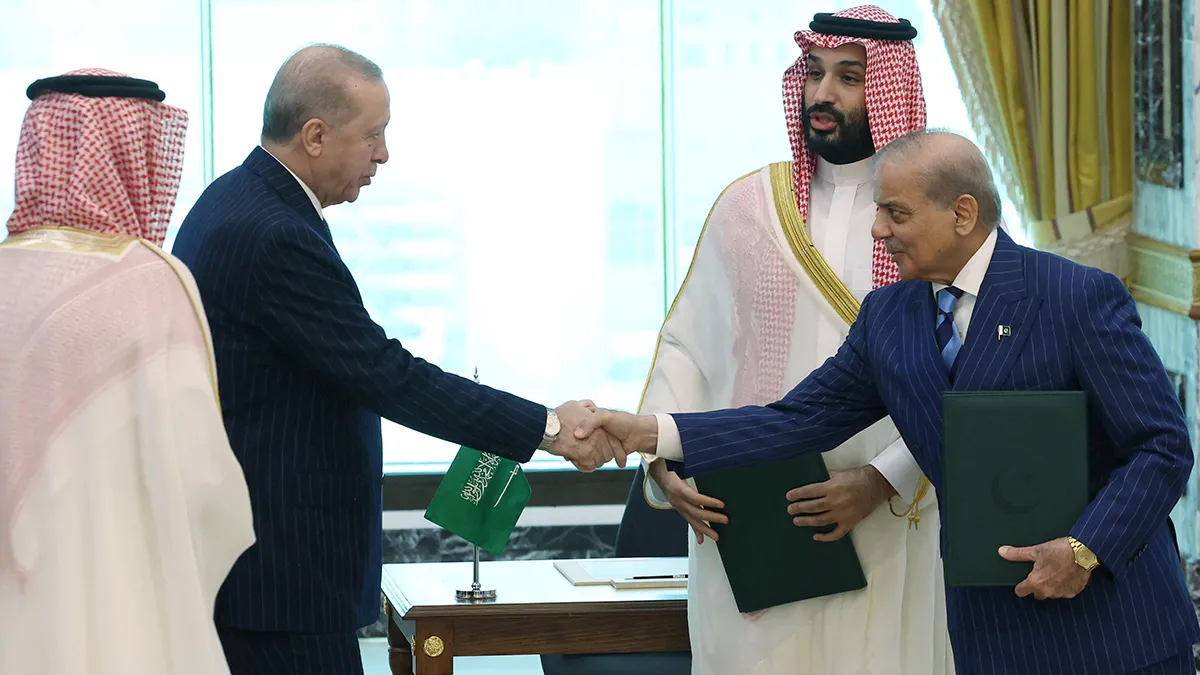
Turkish President Tayyip Erdogan shakes hands with Pakistani Prime Minister Shehbaz Sharif as Saudi Crown Prince Mohammed bin Salman looks on, following the signing of a joint defence agreement in Makkah, Saudi Arabia, on 7 August 2026 – Murat Cetinmuhurdar/Turkish Presidential Press Office/Handout via REUTERS
Strategic autonomy begins at home
Pakistan’s trajectory offers a fundamental lesson for middle powers: strategic autonomy cannot be attained merely by refusing to pick sides between rival geopolitical blocs; it must be anchored in domestic productive and institutional capacity.
Contemporary power operates across financial systems, supply chains, energy networks, and digital infrastructure. States vulnerable to severe disruption across these domains face narrowed foreign policy horizons. Islamabad therefore requires diversified international partnerships grounded in domestic economic resilience.

The Cnergyico Pk Limited refinery and crude oil storage tanks on the Hub coast in Balochistan province, Pakistan, on 18 March 2026 – REUTERS/ AKHTAR SOOMRO
This is where Pakistan’s strategic approach and Europe’s debate on strategic autonomy converge: both confront the shared challenge of leveraging globalisation while avoiding asymmetrical, concentrated dependencies.
Europe should embrace this strategic synergy. Supporting the diversification of global partners does not undermine European interests; it strengthens a balanced, rules-based international network.
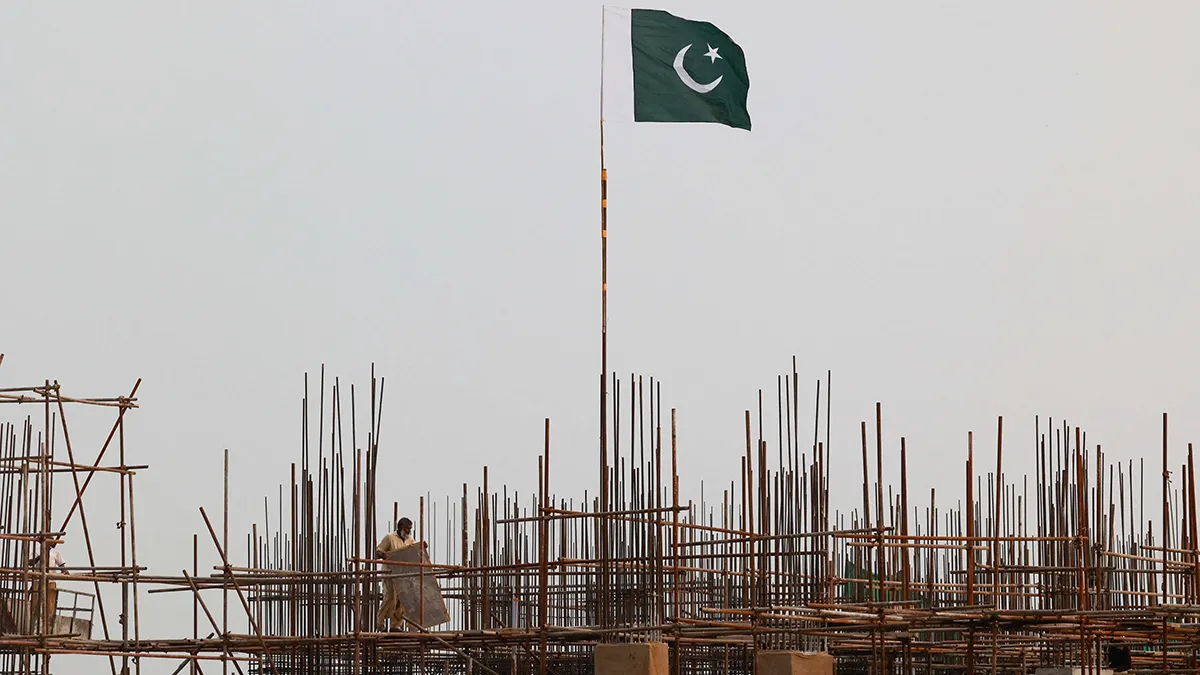
A Pakistani flag flutters above iron scaffolding as a worker operates on a construction site – REUTERS/ AKHTAR SOOMRO
In an emerging multipolar environment, strategic influence will belong to nations that combine domestic resilience with diversified foreign relations to safeguard sovereign decision-making. For Pakistan, this defines strategic autonomy; for Europe, fostering such resilience is a pragmatic investment in global stability.
Saima Afzal is a researcher specialising in South Asian security, counter-terrorism, and broader geopolitical dynamics across the Middle East, Afghanistan, and the Indo-Pacific. She is currently a researcher at Justus Liebig University Giessen (Germany).