

The Met Office has warned the El Niño event developing over the Pacific is shaping up to be the strongest in living memory – and it will impact the weather in London over the coming months.
Forecasters have said that the phenomenon will cause the UK to experience more storms and rain over the coming autumn and winter.
An El Niño event is declared when sea surface temperatures in the tropical eastern Pacific rise to 0.5C above the long-term average, impacting global rainfall patterns and average temperatures.
That would make this year’s weather event the largest since at least 1950, and possibly since the 19th century, according to the national forecaster.
Other climate groups have projected temperatures to even reach 4C above average.

People shelter from the rain under an umbrella, in Westminster, central London (Jonathan Brady/PA)
PA Wire
How will El Niño impact London’s weather?
The impact of such an event would mean that London, along with all of northwest Europe, would experience wetter and stormier conditions in the coming autumn and early winter.
El Niño can also increase the odds of cold weather late in the winter.
Professor Adam Scaife, head of long-range forecasting at the Met Office, said: “We should be clear that this is an unprecedented event. I have never seen an El Niño signal this intense in our forecasts.”
He added: “If the forecast is accurate – and other forecast systems show similar extreme values – then 2026 will far exceed our recent experience of El Niño and its worldwide climate influences.”
The Met Office said that El Niño events also drive an increase in global average temperature, with 2027 “very likely” to be the hottest year on record.
Met Office Science Fellow Dr Nick Dunstone said: “During large El Niño events significantly more heat is released from the ocean to the atmosphere leading to an increase in global average temperature, particularly in the calendar year following the winter peak of the El Niño.
“Hence, 2027 is very likely to replace 2024 as the warmest year on record and be another year to temporarily exceed plus 1.5C above the pre-industrial period”.
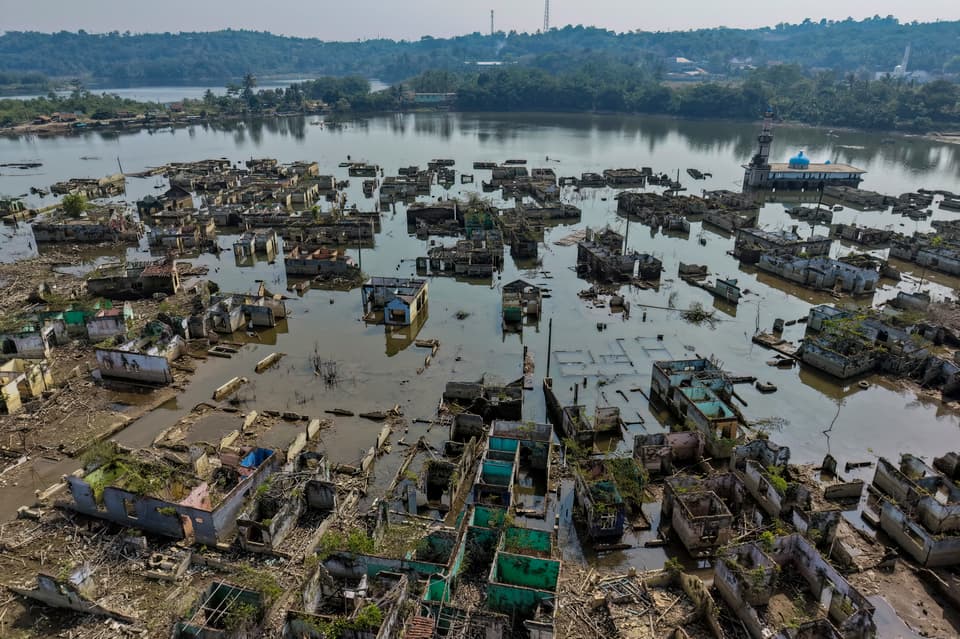
An aerial view shows Somang village in Indonesia’s western Banten province, which was deliberately flooded to make way for the construction of a dam, and has now re-emerged due to the El Niño-driven drought
AFP/Getty
Climate change ‘stress’ is increasing
Professor Stephen Belcher, the Met Office’s chief of science and technology, said: “This summer we have experienced heatwaves across Europe reminding us of the effects of climate change, this large El Niño is a reminder that natural variations in the climate system are also at play, adding to the stresses of climate change.”
The unprecedented string of heatwaves and lack of rainfall meant that England saw the driest July on record, with no meaningful rain in London, putting unprecedented pressure on the capital’s cherished parks and beauty spots.
Almost three-quarters of England and all of Wales have been pushed into drought, putting severe pressure on the water system, wildlife, farmers, emergency services and infrastructure.
During the UK’s fifth heatwave of the summer, the hottest day of the year was recorded in Kew Gardens last Thursday when temperatures reached 38.1C.
Wildfires have ravaged parts of the UK, with a blaze in Stourbridge destroying 19 homes and London Fire Brigade (LFB) taking huge numbers of calls to fires amid sweltering temperatures.
Following an emergency meeting to discuss the heatwave last week, Prime Minister Andy Burnham warned: “We might be in for a wet autumn and winter straight after this, because of El Nino and some of the issues there, which was reported to Cobra.”
The hard, baked ground could make London more susceptible to flash flooding, Sir Sadiq warned in a post on X.
Forecasters and officials have warned that it could take months of sustained rainfall before rivers, reservoirs and groundwaters are completely replenished.
The National Drought Group has warned that drought conditions could persist into the new year as, despite El Nino, current forecasts do not suggest this autumn will have the amount of rainfall required to drive recovery before December.